
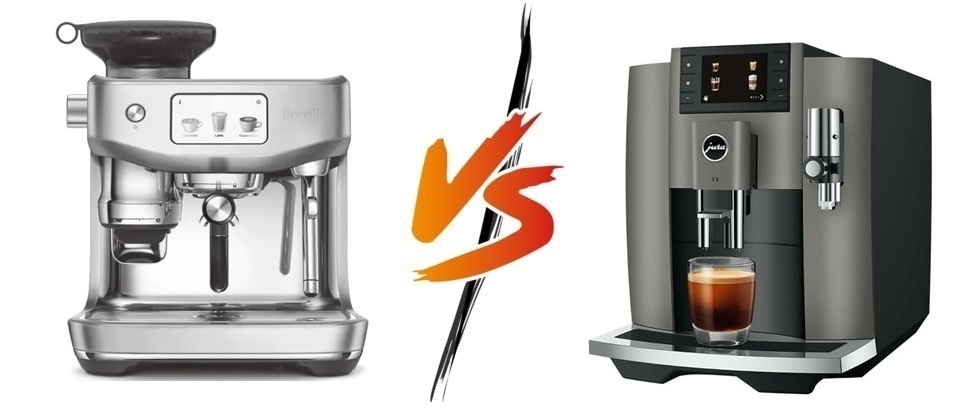
If you’ve been shopping for a high-end espresso machine lately, chances are you’ve run into two names over and over again: the Breville Oracle Jet and the Jura E8.
At first glance, they seem like they belong in the same category. Both are premium machines. Both promise café-quality coffee at home. Both sit well above entry-level pricing. And both target people who are serious about coffee but may not want the complexity of a fully manual espresso setup.
But after spending time with both machines, it becomes clear that they’re built for very different kinds of coffee drinkers.
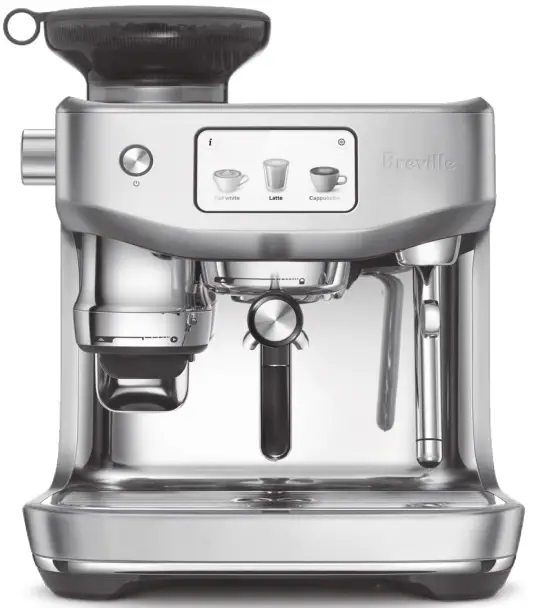
The Breville Oracle Jet is essentially a semi-automatic espresso machine that tries to automate the hardest parts of traditional espresso making without removing the hands-on experience entirely. It still feels like real espresso preparation. You grind, tamp, texture milk, and dial things in. It’s designed for people who want involvement and control without becoming full-time baristas.
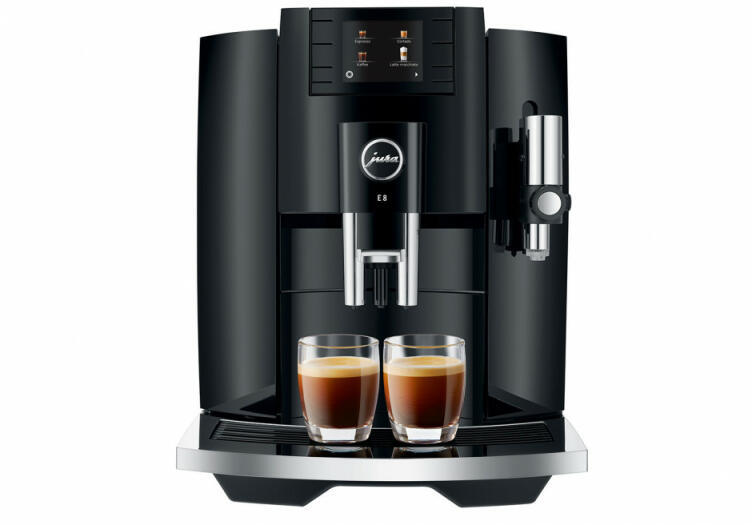
The Jura E8 takes the opposite approach. It’s a superautomatic machine through and through. You press a button, and it does nearly everything for you. Grinding, tamping, brewing, milk frothing, rinsing. It’s focused on convenience, consistency, and speed.
So which one is better?
That depends entirely on what kind of coffee experience you want every morning.
Breville Oracle Jet vs Jura E8 Comparison Chart
If you click the links below, under the product images, you will be redirected to Amazon.com. In case you then decide to buy anything, Amazon.com will pay me a commission. This doesn’t affect the honesty of this review in any way though.
| Specification | Breville Oracle Jet | Jura E8 |
|---|---|---|
 |  | |
| Check the best price on Amazon | Check the best price on Amazon | |
| Machine Type | Semi-automatic espresso machine with assisted automation | Fully automatic superautomatic espresso machine |
| Brewing System | Dual boiler | Thermoblock heating system |
| Grinder Type | Integrated conical burr grinder | Integrated precision grinder |
| Grinder Adjustability | Extensive espresso-focused grind settings | Limited user-adjustable settings |
| User Interface | Large touchscreen display | Color display with button navigation |
| Espresso Control | High level of manual customization | Mostly automated brewing |
| Milk Frothing System | Automatic and manual steam wand | Fully automatic milk frothing system |
| Milk Texture Quality | Café-style microfoam | Smooth automatic foam |
| Latte Art Capability | Yes, excellent for latte art | Limited |
| Simultaneous Brew & Steam | Yes | No true dual-boiler simultaneous workflow |
| Drink Customization | Advanced | Moderate to high |
| One-Touch Specialty Drinks | Partial automation | Full one-touch functionality |
| Espresso Quality | Rich, complex, specialty café style | Smooth, consistent, approachable |
| Best For | Espresso enthusiasts and hobbyists | Convenience-focused users |
| Bean Hopper Capacity | Large hopper with sealed lid | Medium-to-large integrated hopper |
| Water Reservoir Capacity | Large removable tank | Large removable tank |
| Portafilter | Commercial-style stainless steel | Internal automatic brewing unit |
| Steam Wand | Professional-style articulating wand | Automatic milk dispensing system |
| Cleaning Style | Manual and guided cleaning routines | Mostly automated cleaning cycles |
| Backflushing Required | Yes | No manual backflushing required |
| Descaling | Manual guided process | Guided automatic process |
| Noise Level | Moderate to loud | Relatively quiet |
| Warm-Up Speed | Fast for a dual boiler | Very fast |
| Build Materials | Stainless steel with premium components | High-quality plastics and metal accents |
| Machine Footprint | Large and heavy | More compact |
| Learning Curve | Moderate | Very easy |
| Workflow Style | Hands-on espresso preparation | Push-button automation |
| Maintenance Effort | Higher | Lower |
| Ideal Drink Types | Espresso, flat whites, cappuccinos | Lattes, cappuccinos, milk drinks |
| Consistency | User-dependent but highly capable | Extremely consistent |
| Energy Efficiency | Moderate | Very efficient |
| User Skill Requirement | Beginner to advanced enthusiast | Beginner-friendly |
| Overall Experience | Interactive and café-like | Effortless and appliance-like |
| My individual reviews | Breville Oracle Jet review | Jura E8 review |
Design & Build Quality
When you spend this much money on an espresso machine, design stops being just about appearance. At the premium end of the market, build quality affects everything from workflow and durability to how enjoyable the machine feels to use every single morning. A great espresso machine should feel solid, intuitive, and purposeful. It should make you want to use it.
That’s where the differences between the Breville Oracle Jet and the Jura E8 become immediately obvious.
These two machines approach design from completely different philosophies. One is inspired by traditional espresso culture and café equipment. The other is designed around modern automation, convenience, and sleek integration into everyday kitchens.
Neither approach is wrong, but they create very different ownership experiences.
Breville Oracle Jet Design Philosophy
The first thing you notice about the Oracle Jet is that it looks like a serious espresso machine.
Breville clearly wanted this machine to appeal to coffee enthusiasts who admire professional café equipment but still want something approachable enough for home use. The result is a machine that blends commercial-inspired aesthetics with consumer-friendly usability.
The stainless steel exterior plays a huge role in that impression. Unlike cheaper machines that rely heavily on glossy plastic shells, the Oracle Jet feels substantial the moment you touch it. The brushed metal surfaces give it a clean, premium look without becoming overly flashy. It has weight to it, both visually and physically.
That weight matters psychologically.
When you lock the portafilter into place or move the steam wand, the machine feels planted and stable. There’s no rattling or flexing. The components feel engineered rather than assembled.
The portafilter itself deserves special mention because it’s one of the most tactile parts of the espresso-making experience. Breville uses a heavy, café-style portafilter that genuinely feels premium in the hand. It’s balanced well, locks firmly into the group head, and contributes to the overall feeling that this machine takes espresso seriously.
That may sound like a small detail, but espresso enthusiasts care about these things. Lightweight portafilters often make machines feel toy-like, even if the internal brewing system is capable. The Oracle Jet avoids that problem entirely.
The steam wand is another area where Breville nailed the design. It has excellent mobility and enough clearance to comfortably work with different milk pitcher sizes. The articulation feels smooth and controlled rather than stiff or loose. Again, it resembles the workflow of higher-end commercial machines more than consumer appliances.
Breville also did a good job balancing modern technology with traditional espresso design. The touchscreen display integrates cleanly into the front panel instead of looking like a tablet glued onto the machine. Some espresso brands struggle with this. They add digital features that visually clash with the machine’s identity. The Oracle Jet manages to feel modern without losing the mechanical character people expect from premium espresso equipment.
The drip tray is large enough for practical daily use and slides in and out smoothly. Water tank access is straightforward. The bean hopper seals tightly and feels sturdy rather than fragile. These aren’t glamorous details, but they matter during long-term ownership.
There are some drawbacks, though.
The Oracle Jet is not a subtle machine.
It’s large, deep, and visually commanding. If you have limited counter space, this machine can quickly dominate your kitchen layout. In smaller kitchens, it almost becomes the focal point of the room whether you want it to or not.
The height can also create issues beneath low cabinets, especially when accessing the bean hopper. You need enough vertical clearance to comfortably refill beans and maintain the machine properly.
This is very much a machine designed for people willing to dedicate real kitchen space to coffee.
Another thing worth mentioning is that while the Oracle Jet feels premium, it still retains some characteristics of a high-end consumer appliance rather than a fully commercial-grade espresso machine. That’s not necessarily criticism because Breville intentionally positions itself between casual home machines and true prosumer café equipment.
But if you’ve used ultra-premium machines from brands like La Marzocco, Rocket Espresso, or ECM, you may notice that Breville’s buttons, hinges, and certain smaller components feel slightly more consumer-oriented.
Still, for its category, the Oracle Jet is extremely impressive from a design and construction standpoint.
Jura E8 Design Philosophy
The Jura E8 takes an entirely different approach.
Where the Oracle Jet wants to look like professional espresso equipment, the Jura E8 wants to look elegant, clean, and effortless.
And honestly, Jura has become one of the best companies in the world at designing superautomatic coffee machines that actually look luxurious instead of bulky or overcomplicated.
The E8 has a much softer visual presence than the Oracle Jet. The edges are rounded, the surfaces are smooth, and the overall silhouette feels more refined and minimalist. It integrates into modern kitchens far more naturally, especially kitchens designed around sleek appliances and uncluttered countertops.
This machine feels intentionally understated.
Instead of emphasizing mechanical espresso culture, Jura emphasizes convenience and sophistication. The E8 almost resembles a premium smart appliance more than a traditional coffee machine.
A lot of this comes down to the finish quality. Jura uses high-quality plastics exceptionally well. Normally, saying a machine contains plastic at this price point would sound negative, but Jura’s materials genuinely feel premium in person. Panels fit tightly together, surfaces resist cheap flexing, and moving parts operate with precision.
The machine also feels more compact and space-efficient than the Oracle Jet.
That makes a noticeable difference in real kitchens.
You can place the E8 in tighter spaces without it overwhelming the environment. It’s easier to fit under cabinets, easier to clean around, and generally less demanding in terms of spatial commitment.
The front-facing interface contributes heavily to the machine’s usability-focused design. The display is bright, readable, and logically organized. Drink selection feels straightforward even for first-time users. Jura clearly prioritizes reducing friction during daily use.
The coffee spouts adjust smoothly for different cup heights, and the milk system integrates neatly without creating visual clutter. Everything feels engineered around efficiency.
One thing Jura does exceptionally well is conceal complexity.
Internally, the E8 performs a huge number of automated functions, but externally it maintains a calm, uncluttered appearance. You don’t see exposed brewing hardware, large steam controls, or aggressive mechanical elements. For many buyers, that’s a huge advantage.
However, there are tradeoffs to this approach.
Compared side by side with the Oracle Jet, the Jura E8 does not feel as mechanically robust. The lighter construction and heavier use of premium plastics create a different tactile experience. The Oracle Jet feels industrial and substantial. The E8 feels polished and refined.
Some coffee enthusiasts may interpret that as less premium, especially if they associate metal construction with durability and quality.
There’s also less emotional engagement with the machine physically. Since so much of the brewing process is automated internally, the E8 can sometimes feel more like operating a luxury appliance than crafting coffee manually.
Again, whether that matters depends entirely on the type of coffee drinker you are.
Which Machine Feels More Premium?
This question is surprisingly complicated because both machines feel premium in completely different ways.
The Oracle Jet feels premium because of its weight, materials, café-inspired components, and hands-on workflow. It creates the sensation of using real espresso equipment.
The Jura E8 feels premium because of its refinement, elegance, precision engineering, and seamless automation.
Personally, the Oracle Jet leaves a stronger first impression physically. The stainless steel body, heavy portafilter, and professional-style layout simply feel more substantial.
But the Jura E8 arguably feels more sophisticated from a product design standpoint. Its integration, compactness, and overall polish are genuinely impressive.
Ultimately, the better design comes down to what kind of experience you want every day.
If you want your kitchen to feel like a specialty coffee bar, the Oracle Jet delivers that experience beautifully.
If you want premium coffee technology that blends effortlessly into modern life, the Jura E8 is hard to beat.
User Interface & Ease of Use
One of the biggest differences between the Breville Oracle Jet and the Jura E8 becomes obvious within the first five minutes of using them.
These machines are designed for completely different types of users.
The Oracle Jet is built for people who want to participate in the espresso-making process without dealing with the full complexity of traditional manual machines. It tries to simplify espresso while still preserving the feeling of making coffee yourself.
The Jura E8 takes the opposite approach. It aims to remove as much effort and decision-making as possible. The machine handles nearly everything automatically so the user can focus on simply choosing a drink and enjoying it.
That distinction shapes the entire user experience.
Neither machine is difficult to use, but the definition of “easy” changes depending on what kind of coffee drinker you are.
Breville Oracle Jet Interface Overview
The Oracle Jet represents a major evolution in how Breville approaches user interaction.
Older espresso machines often intimidated beginners because they relied heavily on analog controls, manual adjustments, and unexplained terminology. New users were expected to understand extraction timing, milk steaming, grind calibration, and temperature management almost immediately.
The Oracle Jet tries to bridge that gap by combining traditional espresso workflow with modern digital guidance.
At the center of the experience is the touchscreen display, which is one of the better implementations currently available on a premium home espresso machine.
The screen is bright, responsive, and logically organized. Menus feel clean instead of cluttered, and most options are presented in a way that doesn’t overwhelm less experienced users. Drink customization is straightforward, and the machine does a good job guiding users through various setup processes.
What I appreciate most is that the interface feels genuinely useful rather than decorative.
Some manufacturers add touchscreens purely for marketing purposes, but the Oracle Jet’s display actively improves usability. Adjusting settings, navigating drink options, and accessing maintenance routines all feel intuitive.
The machine also provides helpful visual prompts during operation. If you’re learning espresso basics, this guidance can significantly reduce frustration.
For example, the assisted tamping system removes one of the hardest variables for beginners. Tamping pressure is a common problem with traditional espresso machines because inconsistent tamping leads to inconsistent extraction. The Oracle Jet automates this process in a way that feels smooth and integrated into the workflow.
That’s important because it preserves the ritual of espresso making without requiring advanced barista skills.
You still grind coffee into the portafilter.
You still insert it manually.
You still engage with the brewing process physically.
But the machine quietly helps behind the scenes.
That combination of automation and interaction is really the defining characteristic of the Oracle Jet.
Learning Curve of the Oracle Jet
Even though the Oracle Jet simplifies many parts of espresso preparation, it still has a learning curve.
This is not a one-button machine.
You need to understand at least some espresso fundamentals to get the best performance from it. Grind adjustments matter. Bean freshness matters. Extraction timing matters. Milk texturing technique still matters even with automatic assistance.
The machine rewards users who are willing to experiment and improve over time.
For coffee enthusiasts, this is actually one of its biggest strengths.
Using the Oracle Jet feels engaging rather than passive. Over time, you start noticing how small changes affect flavor. You become more aware of coffee quality and brewing variables. The machine teaches you without forcing you into the deep end immediately.
However, casual users may find this involvement tiring after a while.
If you’re rushing to work at 6:30 in the morning, the process can feel more demanding than convenient. You need to pay attention during brewing. You need to handle the portafilter properly. You need to steam milk or position the pitcher correctly.
Even though Breville automates many tasks, there’s still an active workflow.
Cleanup also becomes part of the usability discussion. Because the Oracle Jet functions more like a traditional espresso machine, there are more components involved during preparation. You’re dealing with coffee grounds, steam wands, drip trays, and occasional splatter from milk texturing.
None of this is difficult, but it requires participation.
That’s really the best way to describe the Oracle Jet overall.
It’s approachable espresso with active involvement.
Jura E8 Interface Overview
The Jura E8 focuses on something completely different: effortless consistency.
From the moment you turn it on, the machine feels optimized around convenience. The interface is extremely approachable, even for someone who has never used a premium coffee machine before.
This is one of Jura’s biggest strengths as a company.
They understand that many buyers are not espresso hobbyists. They simply want excellent coffee at home without learning complicated brewing techniques.
The E8 accomplishes this exceptionally well.
The display system is clean, responsive, and easy to navigate. Drink icons are clearly labeled, customization menus are simple, and the overall layout minimizes confusion. Within minutes, most users can prepare drinks confidently without consulting the manual.
That level of accessibility matters more than many coffee enthusiasts realize.
For households where multiple people use the machine, simplicity becomes incredibly valuable. Guests can operate the Jura without assistance. Family members can customize drinks quickly. Morning routines become smoother because the machine removes unnecessary decisions.
The drink preparation process itself is where the E8 really separates itself from semi-automatic machines like the Oracle Jet.
You press a button.
The machine grinds the beans, tamps internally, brews the espresso, froths milk if necessary, and dispenses the finished drink.
That’s it.
There’s no portafilter handling.
No tamping.
No milk steaming technique.
No extraction monitoring.
No active participation required.
For many people, that level of automation feels luxurious.
Customization and Smart Features
One area where both machines perform well is customization, though they approach it differently.
The Oracle Jet gives users deeper control over brewing variables. You can adjust extraction settings more meaningfully, experiment with grind calibration, and tailor drinks with greater precision.
The Jura E8 allows customization too, but within a more guided framework.
You can adjust coffee strength, milk volume, temperature preferences, and drink sizes relatively easily. However, Jura intentionally limits deeper technical adjustments because the machine is designed to optimize results automatically.
That design philosophy helps maintain consistency.
The E8 excels at producing repeatable drinks with minimal variation. Once you save your preferences, the machine reproduces them reliably day after day.
The Oracle Jet, by comparison, offers greater potential but also greater variability. Results depend more heavily on user input and technique.
That difference is important.
Some users enjoy refining their drinks constantly.
Others want their coffee identical every morning.
Daily Workflow Comparison
The best way to compare these machines is to imagine using them every day for several months.
With the Oracle Jet, making coffee feels like a ritual.
You interact with the machine physically. You prepare the portafilter, monitor extraction, steam milk, and clean components afterward. There’s satisfaction in the process itself.
For coffee lovers, that engagement becomes part of the enjoyment.
But it also takes more time and attention.
The Jura E8 feels more like a premium appliance experience. You walk up to the machine, select your drink, and the system handles everything efficiently.
It’s fast.
It’s clean.
It’s predictable.
And that convenience can become addictive, especially on busy mornings.
The E8 also requires less mental energy overall. You don’t need to think about technique or workflow. The machine simplifies the entire coffee-making process into a few button presses.
That ease of use makes it especially appealing for offices, families, or users who prioritize speed and simplicity over hands-on involvement.
Which Machine Is Easier to Use?
Strictly speaking, the Jura E8 is easier to use.
There’s really no debate there.
It’s one of the most user-friendly premium coffee machines available today. Jura has spent years refining the superautomatic experience, and the E8 shows that maturity clearly.
Almost anyone can operate it successfully with minimal effort.
The Oracle Jet is easier than traditional espresso machines, but it still asks users to engage with coffee preparation actively. It simplifies espresso without fully automating it.
And honestly, that’s exactly why many people will prefer it.
The Oracle Jet makes users feel connected to the process. The E8 makes the process nearly invisible.
One prioritizes experience.
The other prioritizes convenience.
Personally, I think the better interface depends entirely on personality.
If you enjoy learning, experimenting, and feeling involved in your coffee routine, the Oracle Jet offers a far more rewarding user experience long term.
But if your goal is excellent coffee with minimal effort, the Jura E8 is difficult to beat. It removes nearly every barrier between you and a consistently good cup of coffee.
That simplicity is ultimately what makes the E8 so appealing to such a wide audience.
Coffee Quality & Brewing Performance
At the end of the day, this is the category that matters most.
You can have beautiful design, advanced touchscreens, and endless customization features, but if the coffee itself isn’t satisfying, none of it really matters. And when comparing the Breville Oracle Jet and the Jura E8, the differences in brewing philosophy become very clear once you start tasting drinks side by side.
Both machines make genuinely good coffee.
That’s important to say upfront because neither machine belongs in the category of mediocre home espresso systems. These are premium products capable of producing drinks far beyond what most people are used to from pod machines, standard drip coffee makers, or entry-level bean-to-cup systems.
But they achieve their results in very different ways.
The Oracle Jet prioritizes espresso authenticity and extraction quality.
The Jura E8 prioritizes consistency, convenience, and broad appeal.
Those priorities influence everything from flavor clarity to crema texture to milk drink balance.
Breville Oracle Jet Espresso Performance
The Oracle Jet produces espresso that feels much closer to what you’d expect from a specialty coffee shop.
That becomes obvious almost immediately after pulling your first properly dialed-in shot.
The espresso has more body, richer texture, deeper crema, and stronger flavor separation than what the Jura E8 typically delivers. Individual tasting notes become easier to identify, especially when using fresh, high-quality beans.
With the Oracle Jet, you can actually taste the difference between coffee origins more clearly.
A fruity Ethiopian roast retains its brightness and berry-like acidity.
A chocolate-heavy Brazilian bean develops richer sweetness and fuller mouthfeel.
A medium-roast Colombian espresso can show caramel, citrus, and nutty characteristics distinctly instead of blending into a generalized coffee flavor.
That level of flavor clarity matters to people who care deeply about coffee.
A huge reason for this is the machine’s brewing architecture. The Oracle Jet uses a dual-boiler system designed to maintain stable brewing temperatures while steaming milk simultaneously. Temperature consistency is critical for espresso because even small fluctuations can dramatically affect extraction quality.
The machine also allows for meaningful control over brewing variables.
You can adjust grind settings carefully.
You can fine-tune extraction timing.
You can experiment with dose and temperature preferences.
That flexibility gives skilled users the ability to optimize different coffees properly rather than relying entirely on automated presets.
And honestly, this is where the Oracle Jet starts to separate itself from superautomatic machines like the Jura E8.
The machine rewards effort.
If you spend time dialing in beans properly, the espresso quality improves noticeably. Shots become sweeter, more balanced, and more expressive. The machine gives you enough control to refine drinks rather than simply accepting factory-optimized output.
That creates a much more engaging coffee experience overall.
Espresso Texture and Mouthfeel
One area where the Oracle Jet performs particularly well is mouthfeel.
The espresso has density and structure.
Crema develops thickly and tends to hold longer in the cup. The body feels syrupy without becoming muddy, especially when brewing medium or darker roasts. Even milk drinks benefit because stronger espresso texture cuts through milk more effectively.
Flat whites and cappuccinos taste more integrated and balanced as a result.
This is something many casual coffee drinkers don’t consciously notice at first, but once you compare machines directly, the difference becomes difficult to ignore.
The Oracle Jet simply creates more café-like espresso.
That said, the machine does require proper setup to achieve these results consistently. Bean freshness matters. Grind calibration matters. User attention matters.
If poorly dialed in, the Oracle Jet can absolutely produce disappointing shots.
That’s the tradeoff for having more control.
Jura E8 Espresso Performance
The Jura E8 approaches espresso from a different angle entirely.
Instead of maximizing customization and specialty-level extraction, Jura focuses on delivering consistently enjoyable coffee with minimal user involvement.
And honestly, within that goal, the E8 performs extremely well.
Superautomatic machines historically struggled with espresso quality because they simplified too many variables. Older systems often produced weak, underwhelming shots with thin crema and little complexity.
The Jura E8 is far beyond that generation of machines.
Its espresso is smooth, balanced, and satisfying in a way that surprises many first-time users. The machine extracts coffee efficiently and consistently, creating drinks that are richer and fuller-bodied than most people expect from a fully automated system.
The E8 especially excels with traditional espresso blends and medium-to-dark roasts.
Chocolate-heavy coffees taste rounded and pleasant.
Nutty flavor profiles come through nicely.
Bitterness remains controlled even with stronger settings.
The machine is designed to create approachable espresso that appeals to a wide range of drinkers rather than emphasizing aggressive intensity or highly nuanced tasting notes.
That broad appeal is intentional.
Jura understands that many buyers are not specialty coffee obsessives analyzing extraction percentages and acidity levels. They simply want coffee that tastes reliably good every day.
The E8 accomplishes that remarkably well.
Where the Jura E8 Falls Slightly Short
Compared directly with the Oracle Jet, the Jura E8 produces espresso that feels slightly more compressed in flavor.
The coffee still tastes good, but there’s less separation between tasting notes. Bright coffees lose some complexity. Subtle acidity becomes muted. Crema tends to be thinner and lighter in texture.
Body is also somewhat softer overall.
This becomes especially noticeable when drinking straight espresso shots side by side. The Oracle Jet creates more intensity and depth, while the Jura E8 prioritizes smoothness and accessibility.
Now, whether that matters depends entirely on the user.
For many households, the Jura’s consistency is actually more valuable than chasing maximum espresso precision. The E8 rarely produces terrible coffee. It stays within a very pleasant performance range consistently.
The Oracle Jet has a higher ceiling.
The Jura E8 has a higher floor.
That’s probably the simplest way to describe the difference.
Brewing Speed and Consistency
The Jura E8 has a major advantage when it comes to repeatability.
Because the machine automates nearly every variable internally, drinks remain extremely consistent from cup to cup. Once you save your preferred settings, the machine reproduces them with impressive reliability.
This consistency is one of the biggest reasons people love premium superautomatic machines.
There’s very little guesswork involved.
You don’t wake up wondering whether your shot timing will be slightly off or whether your milk texture will behave differently that morning. The E8 removes most variability from the process entirely.
The Oracle Jet, while capable of superior espresso, depends more heavily on user technique and bean management.
One day your extraction may taste phenomenal.
The next day it may require adjustment because humidity changed slightly or the beans aged another few days.
For coffee enthusiasts, that variability is part of the fun.
For casual users, it can occasionally become frustrating.
Performance With Milk Drinks
Interestingly, the gap between these machines narrows significantly once milk enters the equation.
In straight espresso shots, the Oracle Jet clearly delivers superior depth and texture.
But in lattes, cappuccinos, and flat whites, the Jura E8 performs much closer to the Breville than many people would expect.
That’s because milk naturally softens and blends espresso characteristics.
The E8’s smoother extraction profile actually works very well in milk-heavy beverages. Drinks taste balanced, approachable, and easy to enjoy consistently.
The Oracle Jet still produces better milk drinks overall because its espresso carries more texture and complexity beneath the milk. But the difference becomes less dramatic compared to drinking espresso neat.
This is important because many buyers primarily drink milk-based beverages.
If you rarely drink straight espresso, the Jura E8’s brewing performance may satisfy you completely.
Temperature Stability and Workflow
The Oracle Jet’s dual-boiler system gives it a clear technical advantage during back-to-back drink preparation.
You can brew espresso and steam milk simultaneously without significant temperature fluctuations. This creates smoother workflow and stronger consistency during more demanding use.
The Jura E8 handles multitasking well too, but it prioritizes automation efficiency over barista-style workflow performance.
For households making several drinks quickly, both machines perform capably, though the Oracle Jet feels more powerful and café-like during intensive use.
Final Thoughts on Coffee Quality
If pure espresso quality is your top priority, the Oracle Jet is the stronger machine.
Its shots have more depth, more texture, more crema, and greater flavor clarity. It captures the character of specialty coffee better and gives users meaningful control over extraction quality.
For coffee enthusiasts, that difference matters enormously.
But the Jura E8 deserves credit because it achieves something different exceptionally well.
It delivers consistently enjoyable espresso with almost no effort. The machine removes complexity without sacrificing quality to the extent older superautomatic machines often did.
Personally, I think the Oracle Jet creates more exciting coffee.
The Jura E8 creates more dependable coffee.
One feels crafted.
The other feels optimized.
And depending on your lifestyle, either one could absolutely be the right choice.
Grinder Features & Performance
One of the most overlooked parts of any espresso machine is the grinder.
People tend to focus on pressure systems, milk frothing, touchscreens, or drink menus because those features are easier to market. But in reality, the grinder plays a massive role in determining how good your coffee actually tastes. Even the best espresso machine in the world will struggle to produce excellent shots if the grinder delivers inconsistent particle sizes or lacks proper adjustment control.
That’s especially true with espresso because espresso extraction is extremely sensitive to grind quality. Small changes in grind size can completely alter flavor, texture, crema, and shot timing.
This is one of the areas where the philosophies behind the Breville Oracle Jet and the Jura E8 become very clear.
The Oracle Jet treats the grinder as a serious espresso tool.
The Jura E8 treats the grinder as part of a seamless automation system.
Both approaches work well, but they serve very different users.
Breville Oracle Jet Grinder Overview
The grinder inside the Oracle Jet is surprisingly capable for an integrated setup.
Traditionally, built-in grinders on espresso machines have been viewed as compromises. Coffee enthusiasts often preferred separate standalone grinders because integrated systems usually lacked precision, consistency, or long-term adjustability.
Breville clearly understands this criticism, and the Oracle Jet’s grinder feels designed specifically to address it.
Right away, the grinder feels more serious than what you find on most consumer espresso machines. It’s fast, responsive, and engineered with espresso brewing in mind rather than general-purpose coffee grinding.
The consistency is impressive.
When grinding for espresso, the particle distribution remains relatively uniform, which contributes heavily to the machine’s strong extraction quality. Shots pull more evenly, crema develops properly, and flavor balance improves because the coffee bed extracts consistently under pressure.
This becomes especially noticeable when using fresh specialty beans.
Cheaper grinders often produce uneven particle sizes that lead to channeling, bitterness, or sour extraction. The Oracle Jet handles espresso grinding with enough precision that users can genuinely experiment with coffee profiles and extraction adjustments.
That alone separates it from many integrated systems on the market.
Grind Adjustment and Dialing In
One of the Oracle Jet’s biggest strengths is the level of control it gives users over grind calibration.
Espresso grinding requires precision because very small adjustments dramatically impact extraction time. A grind setting that’s slightly too fine may choke the machine, while a setting that’s slightly too coarse can lead to weak, under-extracted shots.
The Oracle Jet provides enough adjustment flexibility to meaningfully dial in different beans.
This is extremely important for coffee enthusiasts because no two coffees behave exactly the same. Roast level, bean density, freshness, humidity, and origin characteristics all affect how espresso extracts.
With the Oracle Jet, you can actually respond to those variables instead of being locked into broad preset ranges.
That creates a much more authentic espresso experience.
For example, lighter roasts typically require finer grinding and more precise extraction management compared to darker roasts. The Oracle Jet gives users enough control to optimize these differences properly.
And when everything aligns, the results can be genuinely impressive for an all-in-one machine.
The machine also benefits from Breville’s assisted tamping system, which works closely with the grinder to improve consistency. Traditional espresso preparation often falls apart because users tamp unevenly or inconsistently after grinding.
By partially automating this workflow, the Oracle Jet reduces user error while still maintaining a hands-on experience.
The process feels refined without becoming fully automated.
Grinder Speed and Workflow
The Oracle Jet’s grinder operates relatively quickly without feeling rushed or overly aggressive.
Grinding directly into the portafilter creates a smoother café-style workflow, and the dosing system generally performs reliably once calibrated properly.
The timing feels natural.
You grind, tamp, insert the portafilter, and pull your shot in a way that resembles traditional espresso preparation rather than automated coffee dispensing.
That matters more than people realize because workflow heavily influences how enjoyable a machine feels long term.
The grinder noise level is moderate.
It’s definitely noticeable, especially early in the morning, but it sounds more mechanical and purposeful than cheap or shrill. The noise level feels appropriate for a high-powered espresso grinder rather than excessively disruptive.
Retention is fairly low as well, though not perfect.
Some coffee grounds inevitably remain inside the system after grinding, which is common for integrated grinders. However, the Oracle Jet manages this reasonably well compared to many competing machines.
Limitations of the Oracle Jet Grinder
Despite its strengths, the Oracle Jet’s grinder still has limitations compared to dedicated standalone espresso grinders.
That’s important to acknowledge honestly.
High-end standalone grinders from companies like Niche, DF64, or Eureka still offer greater precision, lower retention, and more advanced burr configurations.
The Oracle Jet grinder is excellent for an integrated system, but it’s ultimately designed around convenience and compactness as well as performance.
Extremely advanced espresso users may eventually outgrow it if they become deeply obsessed with extraction experimentation.
But for the vast majority of home users, the grinder is more than capable enough to produce café-level espresso.
Honestly, it’s one of the best integrated grinders currently available in a premium home espresso machine.
Jura E8 Grinder Overview
The Jura E8 takes a completely different approach to grinding.
Where the Oracle Jet emphasizes control and espresso calibration, the Jura prioritizes speed, automation, consistency, and user simplicity.
And within that goal, the E8 performs very well.
The grinder is designed to integrate seamlessly into the machine’s fully automatic brewing system. Users aren’t expected to think heavily about grind variables because the machine handles optimization internally as much as possible.
That changes the relationship between the user and the grinder entirely.
With the Oracle Jet, the grinder is something you actively manage.
With the Jura E8, the grinder is something the machine manages for you.
This distinction shapes the entire ownership experience.
Grind Consistency on the Jura E8
The E8’s grinder produces consistent enough results to create very reliable coffee quality day after day.
Shots remain balanced, extraction stays predictable, and the machine performs especially well with medium and darker roast coffees.
The grinder is also relatively fast and noticeably quieter than the Oracle Jet’s system.
This contributes heavily to the E8’s luxury-appliance feel. Everything about the machine prioritizes smoothness and convenience.
You press a button, the grinder activates briefly, the machine brews your drink, and the process feels polished from start to finish.
For most users, that simplicity is incredibly appealing.
However, the E8 does not provide the same level of fine-tuned espresso control as the Oracle Jet.
The adjustment system is more limited and less granular. You can modify settings, but you’re generally selecting within optimized ranges rather than performing detailed espresso calibration.
That’s intentional.
Jura doesn’t want users constantly chasing grind perfection. The company designs its machines around consistent automatic performance rather than manual experimentation.
Flavor Impact and Brewing Relationship
The grinder’s role becomes especially noticeable when comparing flavor outcomes between the two machines.
The Oracle Jet’s grinder contributes to stronger flavor clarity, richer body, and more expressive espresso because users can optimize extraction more precisely.
The Jura E8’s grinder contributes to smoother, more approachable coffee by prioritizing consistency and balanced extraction profiles.
One isn’t objectively “better” for every person.
They simply target different priorities.
Coffee enthusiasts who enjoy dialing in beans and experimenting with extraction variables will almost certainly prefer the Oracle Jet’s grinder system.
People who want excellent coffee without technical involvement will probably appreciate the Jura’s approach more.
Noise Levels and Daily Use
Noise is another area where these grinders feel very different.
The Oracle Jet sounds more industrial and café-like. Grinding feels mechanical and powerful, which some users genuinely enjoy because it reinforces the sense of making “real” espresso.
The Jura E8 sounds softer and more controlled overall.
Morning coffee preparation feels quieter and less disruptive, especially in households where multiple people wake up at different times.
This may seem minor initially, but over months of daily use, noise level can significantly influence ownership satisfaction.
Long-Term Grinder Experience
Over time, the differences between these grinders become even more apparent psychologically.
The Oracle Jet encourages engagement.
You think about beans more carefully. You notice extraction changes. You become more aware of freshness, grind calibration, and espresso technique.
The machine gradually pulls users deeper into coffee culture.
The Jura E8 does the opposite.
It minimizes friction and simplifies the process so coffee becomes effortless rather than technical.
For many people, that’s exactly what they want.
Final Thoughts on Grinder Performance
If grinder performance is evaluated strictly from an espresso enthusiast perspective, the Oracle Jet wins clearly.
Its grind consistency, calibration flexibility, and workflow integration allow users to produce more refined espresso with greater flavor complexity and control.
The grinder feels like a legitimate espresso tool rather than a convenience feature.
But the Jura E8 deserves credit because its grinder succeeds brilliantly within the machine’s intended purpose.
It’s fast, quiet, consistent, and optimized for stress-free daily use. The machine removes technical barriers while still producing genuinely enjoyable coffee.
Personally, I think the Oracle Jet offers the more rewarding grinder experience long term, especially for people who enjoy coffee as a hobby.
But the Jura E8 offers the easier experience.
And depending on your priorities, ease may ultimately matter more than precision.
Milk Frothing & Specialty Drinks
For a lot of people, espresso quality alone isn’t the deciding factor when choosing a premium coffee machine.
Milk drinks are.
Cappuccinos, flat whites, lattes, macchiatos, cortados, and other milk-based beverages dominate modern coffee culture. Many buyers rarely drink straight espresso shots at all. They want creamy texture, balanced flavor, and café-style drinks that feel smooth and comforting every morning.
That’s why milk frothing performance matters so much.
And this is another category where the Breville Oracle Jet and the Jura E8 take dramatically different approaches.
The Oracle Jet focuses on milk quality and barista-style texture.
The Jura E8 focuses on convenience, automation, and consistency.
Both machines perform very well, but the experience of making milk drinks feels completely different depending on which machine you use.
Breville Oracle Jet Milk Frothing System
The Oracle Jet’s milk system is one of the strongest features of the entire machine.
Breville clearly understood that many people want café-quality milk texture without needing years of barista training. The challenge is that milk frothing is traditionally one of the hardest skills for beginners to learn properly.
Creating silky microfoam consistently takes practice.
Milk temperature matters.
Steam pressure matters.
Pitcher positioning matters.
Timing matters.
The Oracle Jet simplifies this process dramatically while still preserving the quality and feel of traditional steam wand frothing.
That balance is incredibly difficult to achieve, but Breville pulls it off surprisingly well.
The steam wand itself feels excellent to use. It has solid articulation, smooth movement, and enough flexibility to work comfortably with different pitcher sizes and milk quantities.
More importantly, the steam performance is genuinely strong.
The dual-boiler system allows the machine to produce stable steam pressure consistently, which is critical for high-quality milk texture. Weak steam systems often create large bubbles or thin foam instead of smooth microfoam.
The Oracle Jet avoids that problem.
Automatic Milk Texturing
One of the most impressive parts of the Oracle Jet is its automatic milk texturing system.
Unlike many automated steam systems that produce stiff or overly airy foam, the Oracle Jet creates milk texture that actually resembles café-quality microfoam when calibrated properly.
That’s a huge accomplishment.
The texture feels glossy, smooth, and integrated rather than dry or bubbly. Milk pours more naturally and blends with espresso more effectively.
Flat whites especially benefit from this.
A good flat white depends heavily on texture because the milk should feel velvety and tightly integrated with the espresso rather than sitting separately on top. The Oracle Jet handles this style of drink extremely well.
Lattes also develop a richer, creamier mouthfeel compared to many fully automatic systems.
And if you enjoy latte art, the Oracle Jet gives you a real chance to practice it successfully. The milk quality is genuinely capable of supporting basic latte art patterns once you develop some pouring skill.
That immediately separates it from many superautomatic machines.
Manual Flexibility and Enthusiast Appeal
Another major advantage of the Oracle Jet is flexibility.
The machine allows users to rely on automation or take greater manual control depending on skill level and preference.
Beginners can use the automatic steaming functions confidently while learning the basics.
More experienced users can adjust texture manually and refine drinks more aggressively.
This flexibility gives the machine long-term appeal because it grows with the user.
A lot of machines become limiting once your coffee knowledge improves. The Oracle Jet avoids that issue because it still allows meaningful involvement in the milk frothing process.
The steam wand also purges efficiently and recovers quickly between drinks, which matters when preparing multiple beverages back to back.
The workflow feels very café-inspired overall.
You steam milk separately.
You texture intentionally.
You combine espresso and milk manually.
That process creates a stronger emotional connection to the drink-making experience.
Weaknesses of the Oracle Jet Milk System
As strong as the Oracle Jet’s milk system is, it does come with added responsibility.
You still need to clean the steam wand regularly.
You still need to wipe it after use.
You still need to manage milk pitchers and positioning.
This machine does not fully remove user involvement.
And honestly, some people eventually discover they don’t actually want that involvement every morning.
On busy weekdays, even small additional steps can start feeling inconvenient over time.
The Oracle Jet also requires more attention during preparation. Even with automatic texturing support, the process still feels more active than fully automated milk systems.
That’s part of the machine’s identity, but it won’t appeal equally to everyone.
Jura E8 Milk Frothing System
The Jura E8 approaches milk drinks from the opposite direction.
Its primary goal is convenience.
And in that respect, it performs exceptionally well.
The E8’s milk system is designed around automation and speed. You connect the milk tube, select your drink, and the machine handles the rest with very little user involvement.
This simplicity changes the entire coffee experience.
Making a cappuccino on the E8 feels effortless.
The machine grinds the beans, brews the espresso, froths the milk, dispenses the drink, and often rinses itself afterward with minimal intervention required.
For busy households, this convenience becomes incredibly attractive very quickly.
You don’t need milk frothing skills.
You don’t need steaming technique.
You don’t even need to think much about workflow.
The machine handles everything internally.
Milk Texture and Drink Quality on the Jura E8
For a fully automatic system, the Jura E8 produces impressively good milk drinks.
The foam is smooth, consistent, and pleasant enough to satisfy most coffee drinkers completely. Cappuccinos come out balanced and creamy, while lattes feel rich and approachable.
Jura has spent years refining its milk systems, and it shows.
The machine produces drinks that feel polished and reliable rather than cheap or artificial.
However, compared directly with the Oracle Jet, the milk texture lacks some refinement.
The E8’s foam tends to feel slightly airier and less silky overall. It’s excellent by superautomatic standards, but it doesn’t fully replicate the dense, glossy microfoam created by a strong steam wand system.
This becomes especially noticeable in drinks like flat whites where milk texture plays a major role in the overall experience.
The Oracle Jet creates milk that blends more naturally with espresso.
The Jura E8 creates milk that feels slightly more separated structurally.
Again, many casual coffee drinkers may never notice this difference consciously.
But side-by-side comparisons reveal it clearly.
Specialty Drink Variety
One area where the Jura E8 performs extremely well is drink variety and convenience.
The machine offers a wide range of specialty beverages accessible through simple menu selections. Cappuccinos, lattes, macchiatos, espresso drinks, and milk coffees can all be prepared quickly with consistent results.
This makes the machine particularly appealing for families or households where multiple people have different coffee preferences.
One person can make a latte.
Another can make a cappuccino.
Someone else can prepare straight espresso.
The machine handles transitions smoothly without requiring major workflow adjustments.
The Oracle Jet can absolutely create all these drinks too, but the process requires more manual involvement and preparation.
The Jura E8 streamlines the entire experience.
Speed and Daily Workflow
This is probably the single biggest difference between these machines in real-world use.
The Jura E8 feels fast and effortless.
The Oracle Jet feels immersive and hands-on.
With the E8, milk drinks become almost instant.
You push a button and receive a finished beverage with very little attention required.
With the Oracle Jet, preparing milk drinks feels more intentional. You steam milk separately, monitor texture, pour manually, and clean components afterward.
Many coffee enthusiasts genuinely enjoy this process because it feels authentic and satisfying.
Others simply want coffee quickly before work.
Your personality matters enormously here.
Consistency vs Craftsmanship
The Jura E8 excels at consistency.
Its milk drinks taste nearly identical every day because the machine automates the process heavily. There’s comfort in that predictability, especially for households that value convenience and repeatability.
The Oracle Jet offers greater potential quality but also more variability.
A skilled user can create better milk drinks on the Oracle Jet than the Jura E8 can produce automatically.
But achieving that quality consistently depends more heavily on user attention and technique.
This reflects the larger philosophy behind both machines.
The Oracle Jet prioritizes craftsmanship.
The Jura E8 prioritizes simplicity.
Cleaning and Milk System Maintenance
Milk systems require maintenance regardless of machine type because dairy residue builds up quickly and can affect both hygiene and flavor.
The Jura E8 simplifies this process significantly.
The machine runs guided cleaning cycles and prompts users clearly when maintenance is needed. The automated rinsing systems help reduce daily workload substantially.
The Oracle Jet requires more active cleaning because you’re working directly with the steam wand and milk pitchers manually.
Again, this isn’t difficult, but it adds responsibility.
If you regularly make multiple milk drinks per day, the difference in maintenance workload becomes noticeable over time.
Final Thoughts on Milk Frothing & Specialty Drinks
If milk quality alone is the priority, the Oracle Jet wins.
Its steam performance, microfoam texture, and café-style workflow create better milk drinks overall, especially for users willing to engage with the process and refine their technique.
The drinks feel more handcrafted and more authentic.
But if convenience matters equally or more than absolute milk quality, the Jura E8 becomes incredibly compelling.
It delivers very good milk drinks with almost no effort, and the consistency is genuinely impressive for a fully automatic machine.
Personally, I think the Oracle Jet creates more satisfying coffee experiences.
The Jura E8 creates easier ones.
And depending on your lifestyle, that distinction may matter more than the final few percentage points of milk texture perfection.
Maintenance & Cleaning
Maintenance is one of the least exciting parts of owning a premium espresso machine, but it’s also one of the most important.
A coffee machine can make incredible drinks during the first few weeks, but long-term ownership depends heavily on how easy the machine is to clean, maintain, and live with day after day. If maintenance becomes frustrating, messy, or overly time-consuming, even great coffee can start to feel like a chore.
This is especially true for espresso machines because coffee oils, milk residue, mineral buildup, and moisture all accumulate quickly inside the system. Without proper cleaning, drink quality declines, internal components wear faster, and reliability problems become more likely.
When comparing the Breville Oracle Jet and the Jura E8, maintenance becomes one of the clearest examples of their different design philosophies.
The Oracle Jet behaves more like traditional espresso equipment.
The Jura E8 behaves more like a premium automated appliance.
That distinction shapes nearly every aspect of ownership.
Breville Oracle Jet Cleaning Experience
The Oracle Jet requires active involvement in cleaning and maintenance.
That’s not necessarily a flaw because it comes with the territory of semi-automatic espresso machines. In many ways, the cleaning process is simply part of the broader espresso ritual.
Still, prospective buyers should understand that this machine demands more hands-on care than a superautomatic system like the Jura E8.
After preparing drinks, several tasks become part of the normal workflow.
The steam wand needs wiping and purging.
The portafilter requires rinsing.
Coffee grounds must be emptied.
The drip tray fills relatively quickly and needs regular attention.
These tasks are not difficult individually, but together they create a more involved ownership experience overall.
For espresso enthusiasts, this often feels perfectly normal.
Many people actually enjoy maintaining their machines because it reinforces the feeling of using professional-style coffee equipment. Cleaning becomes part of the hobby rather than an annoyance.
But casual users may view the process differently, especially after several months of daily use.
Steam Wand Maintenance
Milk systems are usually the messiest part of espresso machine ownership, and the Oracle Jet is no exception.
Because the machine uses a traditional-style steam wand system, milk residue needs to be cleaned immediately after use. If milk dries inside or around the wand, performance can decline quickly and hygiene becomes a concern.
Fortunately, the Oracle Jet makes this process fairly straightforward.
The steam wand purges effectively, and wiping it down only takes a few seconds after steaming milk. But consistency matters. If users become lazy about cleaning routines, milk buildup can happen surprisingly fast.
This is one area where the Oracle Jet still expects users to behave somewhat like baristas.
The machine assists heavily with preparation, but it does not remove personal responsibility from maintenance.
That distinction is important because it affects the overall ownership personality of the machine.
Backflushing and Internal Cleaning
Like many serious espresso machines, the Oracle Jet requires periodic backflushing.
Backflushing helps clean coffee oils and residue from the internal brewing system using water and cleaning tablets. This process is critical for maintaining flavor quality and preserving long-term machine performance.
Breville simplifies the process with guided maintenance prompts, but users still need to perform the cleaning actively.
Some people enjoy this because it creates a stronger connection to the machine and reinforces good maintenance habits.
Others may see it as another task competing for time in busy daily routines.
The Oracle Jet also benefits from regular grinder cleaning and occasional descaling depending on water hardness.
Again, none of these tasks are particularly difficult.
But they require attention.
This machine rewards owners who are willing to care for it properly.
Accessibility and User Serviceability
One advantage of the Oracle Jet is accessibility.
Because the machine is more mechanically exposed than the Jura E8, cleaning and inspecting components feels more transparent. You can see the brewing system more directly. You interact with the grinder, portafilter, and steam wand physically.
That visibility makes it easier to understand what the machine is doing and where maintenance issues might develop.
For technically minded users, this is a huge advantage.
Many espresso enthusiasts prefer machines they can partially maintain or troubleshoot independently rather than relying entirely on proprietary service systems.
The Oracle Jet supports that mindset better than the Jura E8 does.
Even basic daily cleaning feels intuitive because the machine’s workflow resembles traditional espresso preparation closely.
Long-Term Ownership of the Oracle Jet
Over time, the Oracle Jet’s maintenance routine becomes part of the ownership identity.
You don’t simply press a button and walk away.
You participate in the process fully, including cleanup.
For coffee hobbyists, that involvement can actually become satisfying. Cleaning routines feel connected to the craft of espresso rather than disconnected household chores.
But it undeniably requires more effort.
If you frequently make multiple milk drinks daily, maintenance workload increases quickly. Steam wand cleaning, drip tray emptying, and coffee residue management become regular responsibilities.
The machine asks for commitment in exchange for higher-end espresso performance.
Jura E8 Cleaning Experience
The Jura E8 approaches maintenance from a completely different perspective.
Its goal is to reduce user workload as much as possible.
And honestly, Jura is exceptionally good at this.
The E8 automates large portions of the cleaning process in ways that dramatically simplify ownership for everyday users. The machine performs automatic rinsing cycles, provides clear maintenance alerts, and guides users step by step through necessary cleaning procedures.
This creates a much lower-friction experience overall.
Instead of expecting users to understand espresso machine maintenance deeply, Jura designs the machine to manage itself as intelligently as possible.
That philosophy makes the E8 feel far more approachable for casual coffee drinkers.
Automatic Rinsing and Cleaning Cycles
One of the best features of the Jura E8 is its automated cleaning behavior.
The machine rinses itself regularly during startup and shutdown cycles, helping maintain cleanliness internally without requiring constant user intervention.
This reduces coffee residue buildup significantly and helps preserve drink quality over time.
The milk system also benefits from guided cleaning programs that simplify what could otherwise become a frustrating process.
Milk systems are notoriously difficult to maintain on many coffee machines, but Jura streamlines the workflow effectively. The machine prompts users when cleaning is necessary and walks them through each step clearly.
This reduces the chances of neglect dramatically.
For busy households, this automation becomes incredibly valuable.
The machine actively helps users maintain it properly instead of relying entirely on discipline and routine.
Simplicity and Daily Convenience
Compared to the Oracle Jet, the Jura E8 feels dramatically easier to live with day to day.
There’s less visible mess.
Less active cleanup.
Less interaction with coffee grounds and brewing hardware.
The machine contains most of the brewing process internally, which creates a cleaner overall experience.
This is especially noticeable in the mornings.
With the Oracle Jet, making coffee feels like a process involving preparation and cleanup.
With the Jura E8, coffee preparation feels much closer to using a premium appliance.
You select a drink, enjoy it, and the machine handles much of the maintenance automatically afterward.
That convenience is one of the E8’s biggest strengths.
Limitations of Jura’s Maintenance Approach
However, the Jura E8’s automation comes with tradeoffs.
Because the brewing system is largely internal and proprietary, users have less direct access to key components. This can make deep cleaning or troubleshooting feel less transparent compared to the Oracle Jet.
Many Jura owners rely more heavily on authorized servicing for major maintenance or repairs.
This creates a different ownership relationship.
The machine handles routine cleaning exceptionally well, but when something goes wrong internally, the system feels less user-serviceable than a semi-automatic machine.
That’s not necessarily a problem for most buyers because the target audience prioritizes convenience over mechanical involvement.
Still, technically inclined users may find the closed-system design slightly limiting.
Descaling and Water Management
Both machines require descaling eventually, especially in areas with hard water.
The Jura E8 handles this process more automatically through guided prompts and integrated maintenance systems. Jura’s water filter integration also helps reduce mineral buildup proactively.
The Oracle Jet requires more active attention to water quality management.
Again, this reflects the broader philosophy difference between the machines.
Jura minimizes maintenance responsibility.
Breville preserves user involvement.
Reliability and Maintenance Psychology
One interesting difference between these machines is how maintenance affects the emotional ownership experience.
The Oracle Jet feels like maintaining espresso equipment.
The Jura E8 feels like maintaining a luxury appliance.
That distinction matters psychologically.
People who enjoy coffee as a hobby often tolerate or even appreciate maintenance involvement because it reinforces the authenticity of the experience.
People who simply want excellent coffee with minimal hassle usually prefer the Jura’s approach immediately.
Neither preference is wrong.
They simply reflect different lifestyles and expectations.
Final Thoughts on Maintenance & Cleaning
If ease of maintenance is your top priority, the Jura E8 wins clearly.
Its automated rinsing systems, guided cleaning programs, and simplified workflow make daily ownership significantly easier and less demanding. The machine reduces friction wherever possible, which is exactly what many buyers want from a premium superautomatic system.
The Oracle Jet requires more attention, more cleanup, and more active participation in maintenance routines.
But in return, it offers greater transparency, stronger user control, and a more authentic espresso machine experience overall.
Personally, I think the better maintenance experience depends heavily on personality.
If you enjoy engaging with your coffee equipment and don’t mind regular cleaning routines, the Oracle Jet’s maintenance demands feel reasonable and even satisfying at times.
But if convenience and simplicity matter most, the Jura E8 is unquestionably easier to live with over the long term.
Conclusion
After spending serious time comparing the Breville Oracle Jet and the Jura E8, one thing becomes very clear: these machines are not really trying to do the same thing.
Yes, both sit in the premium coffee machine category. Both promise café-quality drinks at home. And both are capable of producing genuinely excellent coffee. But the experience of owning them feels completely different from day one.
The Oracle Jet is for people who want to participate in coffee making. It delivers stronger espresso quality, better milk texture, more control over extraction, and a workflow that feels much closer to using professional espresso equipment. It asks more from the user, both in learning and maintenance, but it rewards that effort with deeper customization and a more engaging experience overall.
The Jura E8 focuses on convenience without sacrificing quality. It simplifies nearly every part of the process while still producing consistently enjoyable drinks. The automation is polished, the workflow is effortless, and the machine integrates into daily life incredibly well. For busy households or users who prioritize speed and simplicity, the E8 is one of the best superautomatic machines available right now.
Ultimately, choosing between these two machines comes down to personality more than specifications.
If you see coffee as a hobby and enjoy the process as much as the final drink, the Oracle Jet will likely feel more rewarding long term.
If you simply want excellent coffee every morning with minimal effort, the Jura E8 is probably the smarter choice.
Personally, I think the Oracle Jet offers the more exciting ownership experience because it creates coffee that feels crafted rather than automated. But I also completely understand why so many people fall in love with the Jura E8. Convenience has real value, especially when the coffee is still this good.