The home espresso market has become increasingly competitive over the past few years. What was once a choice between a basic pod machine and an expensive semi-professional espresso setup has evolved into a wide range of fully automatic, semi-automatic, and hybrid machines designed for different skill levels. Ninja has built a strong reputation by producing kitchen appliances that deliver impressive performance without demanding premium prices, and the Ninja AutoBarista espresso machine follows that same philosophy.
Rather than trying to imitate commercial café equipment, the AutoBarista aims to simplify espresso preparation while still giving users enough control to personalize their drinks. It combines an integrated grinder, automatic brewing functions, milk frothing capabilities, and several programmable drink options into a relatively compact machine. On paper, it promises café-style coffee without the learning curve that often comes with traditional espresso machines.
If you click the button above you will be redirected to Amazon.com. In case you then decide to buy anything, Amazon.com will pay me a commission. This doesn’t affect the honesty of this review in any way though.
After spending considerable time using the AutoBarista for daily espresso, cappuccinos, flat whites, americanos, and lattes, it becomes clear that Ninja has focused on making specialty coffee approachable rather than intimidating. It isn’t a machine designed exclusively for coffee enthusiasts who enjoy adjusting every brewing variable. Instead, it targets people who want consistently good coffee every morning with minimal effort while still enjoying freshly ground beans and real espresso extraction.
Like any appliance, it has strengths and weaknesses. Some features exceed expectations, while others reveal the compromises necessary to keep the machine accessible and reasonably priced. This review examines every aspect of the Ninja AutoBarista, from its construction and brewing performance to maintenance, energy consumption, and overall value.
Design & Build Quality
The design of an espresso machine plays a much bigger role than simply determining how attractive it looks on a kitchen countertop. A well-designed machine should balance aesthetics with practicality, ensuring that every button, removable component, and brewing element contributes to an enjoyable daily experience. After spending considerable time using the Ninja AutoBarista, I came away with the impression that Ninja invested significant effort into making the machine approachable for everyday users while still giving it a premium appearance. It may not be built to the same industrial standards as commercial espresso equipment, but it doesn’t feel like an inexpensive appliance either. Instead, it occupies a comfortable middle ground that should appeal to the majority of home coffee drinkers.
First Impressions
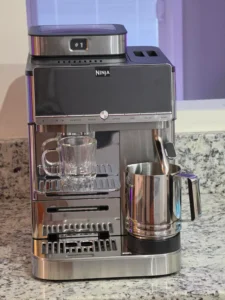
Straight out of the box, the AutoBarista makes a strong first impression. Rather than trying to mimic the polished stainless steel look of commercial café machines, Ninja has developed a more modern aesthetic that blends matte finishes with metallic accents. The result is a machine that feels contemporary without looking overly futuristic or overly complicated.
Its styling is understated, which I actually appreciate. Some espresso machines are covered in chrome, exposed pipes, and mechanical-looking controls that can appear intimidating, particularly for first-time espresso users. The AutoBarista takes a different approach by presenting a cleaner, more streamlined design that looks equally at home in a minimalist kitchen or alongside more traditional appliances.
Despite incorporating an integrated grinder, brewing system, water reservoir, and milk frothing components, the machine never appears bulky or overwhelming. It has enough visual presence to feel substantial, but it doesn’t dominate the countertop.
Footprint and Countertop Space
Counter space is always a consideration when buying a home espresso machine. Many fully automatic machines can be surprisingly large, especially once you factor in the clearance needed for removing water tanks or accessing bean hoppers.
The Ninja AutoBarista manages its footprint quite well. While it certainly requires more room than a capsule machine or a standard drip coffee maker, it remains compact considering everything it includes. Because the grinder is built into the machine, there’s no need to dedicate additional space to a separate burr grinder, which immediately helps keep the coffee station more organized.
The machine’s height is also well judged. It fits comfortably beneath most standard kitchen cabinets while still allowing access to the bean hopper from above. This may seem like a minor detail, but it’s something that becomes important if you plan to leave the machine in a permanent location rather than moving it around.
The overall layout also feels practical. The water tank, drip tray, bean hopper, and brewing area are positioned in a way that makes everyday interaction straightforward, without forcing awkward movements or requiring excessive countertop clearance.
Materials and Construction
At first glance, the AutoBarista appears more expensive than it actually is. Ninja has done a good job of combining different materials to create a premium look without dramatically increasing the cost.
Most of the exterior consists of high-quality plastic with metallic trim pieces that break up the design nicely. While some buyers automatically associate plastic with lower quality, that’s not necessarily a fair assessment here. The plastic used throughout the machine feels dense and well finished rather than thin or flimsy. There is very little creaking when handling the machine, and the various panels fit together neatly without noticeable gaps.
The finish itself deserves praise as well. Matte surfaces are generally more forgiving than glossy plastics, which tend to collect fingerprints, dust, and small scratches. During daily use, the AutoBarista maintained a clean appearance with only occasional wiping required to keep it looking fresh.
Naturally, this isn’t an all-metal machine. Anyone expecting the heavy stainless steel construction found on professional espresso equipment will immediately notice the difference. However, it’s important to remember the intended market. For a consumer-focused machine in this category, the overall build quality feels reassuringly solid.
Controls and Physical Components
One aspect that stood out during testing was the consistency of the physical controls. Buttons provide a satisfying amount of resistance without feeling stiff, and they respond reliably with each press. Nothing feels loose or poorly attached.
The adjustment dials and removable components also inspire confidence. The water reservoir slides into position smoothly without requiring excessive force, while the drip tray removes easily for cleaning without feeling unstable.
Cup positioning beneath the group head is convenient thanks to the adjustable drip tray configuration. Whether using a small espresso cup or a taller mug for milk drinks, the machine accommodates different sizes without requiring complicated adjustments.
The bean hopper lid closes securely and provides a reasonably good seal. Although no hopper can completely eliminate oxygen exposure over extended periods, this design helps preserve freshness for everyday use.
Water Reservoir and Bean Hopper
The water reservoir strikes a nice balance between capacity and convenience. It holds enough water for multiple drinks before requiring a refill, making it practical for households with several coffee drinkers.
Removing and replacing the tank is straightforward, and the integrated handle makes carrying it to the sink much easier than some competing designs. The transparent construction also allows you to monitor water levels at a glance, reducing the chances of unexpectedly running out midway through brewing.
The bean hopper is equally practical. Its capacity is sufficient for several days of regular use without constant refilling, although coffee enthusiasts who prefer switching between different bean varieties may find themselves emptying it more frequently.
One thing worth mentioning is that storing beans inside any hopper for extended periods isn’t ideal for maximum freshness. Personally, I still preferred filling it with only enough beans for several days rather than completely filling it. This isn’t a criticism of the machine itself but rather a good habit for preserving coffee quality.
Stability During Operation
Some espresso machines have a tendency to vibrate noticeably while grinding or brewing, occasionally causing cups to shift or rattle on the drip tray. Thankfully, that isn’t much of an issue here.
The Ninja AutoBarista feels stable throughout operation. Its weight is distributed well across the base, helping keep the machine planted firmly on the countertop even during grinding, which is typically the most demanding phase.
Rubberized feet provide additional grip and prevent unwanted movement. Even when preparing multiple drinks consecutively, the machine remained steady without producing excessive vibration.
This stability contributes to the overall impression that the machine has been engineered thoughtfully rather than simply assembled from standard components.
Everyday Practicality
What impressed me most wasn’t any single design feature but how well everything works together in daily use.
Every removable component is easy to access. The drip tray slides out smoothly, the water tank lifts away without difficulty, and the brewing area remains open enough to clean comfortably. These may sound like relatively small details, but they have a noticeable impact over months or years of ownership.
The layout also minimizes unnecessary steps during the brewing process. Filling beans, adding water, placing a cup, and selecting a drink all feel intuitive. Nothing requires awkward reaching or excessive force, which makes the machine particularly welcoming for users who simply want good coffee without treating espresso preparation as a hobby.
Durability Expectations
Although long-term reliability can only be judged after years of ownership, the initial construction leaves a positive impression.
The hinges, removable panels, brewing mechanism, and controls all feel capable of withstanding frequent daily use. Nothing about the machine feels disposable or fragile. Likewise, the fit and finish suggest that Ninja paid attention to manufacturing quality rather than focusing solely on appearance.
Like any espresso machine, longevity will depend partly on maintenance. Regular descaling, cleaning, and proper care will undoubtedly help extend its lifespan. Fortunately, the underlying construction appears robust enough to justify that investment of time.
Overall Assessment
From a design and build perspective, the Ninja AutoBarista succeeds because it focuses on practical usability rather than flashy styling. Every major component feels thoughtfully positioned, the machine occupies a manageable amount of countertop space, and the construction inspires confidence without pretending to be commercial-grade equipment.
There are certainly more luxurious espresso machines available, many featuring heavier stainless steel construction and more premium materials. However, those machines also cost considerably more. Within its price category, the AutoBarista strikes an impressive balance between appearance, durability, and everyday convenience.
Perhaps the greatest compliment I can give its design is that after the initial excitement wore off, I simply enjoyed using it. Everything felt familiar, comfortable, and dependable, which is exactly what you want from an appliance you’ll likely use every morning. Rather than drawing attention to itself through unnecessary complexity, the Ninja AutoBarista quietly delivers a well-rounded ownership experience, making its thoughtful design one of its strongest overall qualities.
User Interface & Ease of Use
One of the biggest selling points of the Ninja AutoBarista is that it removes much of the complexity traditionally associated with making espresso at home. While some coffee enthusiasts genuinely enjoy weighing coffee, timing extractions, adjusting grind settings for every shot, and manually steaming milk, that process isn’t for everyone. Most people simply want a machine that consistently makes excellent coffee without turning every morning into a lesson in espresso science. After using the AutoBarista extensively, it’s clear that ease of use was one of Ninja’s highest priorities, and in many ways, it’s one of the machine’s strongest features.
Rather than overwhelming the user with dozens of settings and advanced brewing parameters, the AutoBarista presents a clean, intuitive interface that guides you through each step. It strikes an effective balance between automation and customization, making it approachable for complete beginners while still offering enough flexibility to satisfy users who enjoy fine-tuning their drinks.
Initial Setup
The first interaction with any espresso machine often sets the tone for the overall ownership experience. Fortunately, the AutoBarista makes getting started remarkably straightforward.
After unpacking the machine, the setup process is logical and clearly explained. The water reservoir simply slides into place, the bean hopper is easy to fill, and the removable drip tray installs without any guesswork. Before brewing the first cup, the machine runs an initial rinse cycle to prepare the internal components, a process that requires very little user intervention.
Unlike some espresso machines that require navigating confusing menus before brewing your first coffee, the AutoBarista guides you through the essential setup in a way that feels intuitive. Even users who have never owned an espresso machine should have little trouble getting everything ready within a short amount of time.
The included documentation is also written in plain language rather than relying heavily on technical terminology. That’s a small detail, but it helps reinforce the idea that this machine is designed for everyday coffee drinkers rather than experienced baristas.
Control Panel Design
The control panel immediately stands out because of its simplicity. Everything is clearly labeled, with drink options and settings arranged in a logical manner. There isn’t an overwhelming collection of buttons competing for attention, and that makes the machine feel much less intimidating than many competitors.
Instead of hiding commonly used functions inside multiple menu layers, Ninja places the most important controls within easy reach. Selecting an espresso, americano, latte, or cappuccino takes only a couple of button presses, and adjusting drink size or strength feels equally straightforward.
The spacing between controls is also well thought out. Buttons are large enough to press comfortably without accidentally selecting the wrong option, something that can become surprisingly frustrating on machines with cramped layouts.
From a usability standpoint, it’s clear that the designers prioritized clarity over unnecessary complexity.
Display Quality
The display complements the physical controls nicely by providing useful information without becoming distracting.
Brightness is well balanced, remaining easy to read in both brightly lit kitchens and lower-light environments during early mornings. The text is clear, icons are easy to recognize, and important notifications are displayed prominently.
One feature I particularly appreciated was how the display communicates maintenance reminders. Rather than presenting confusing error codes, the machine provides understandable prompts that explain exactly what needs attention, whether that’s refilling the water tank, emptying the drip tray, or running a cleaning cycle.
This approach significantly reduces the learning curve. Instead of consulting the manual every time the machine displays a notification, most users can understand what the machine is asking simply by reading the screen.
The display never feels cluttered, which helps maintain the machine’s overall user-friendly character.
Daily Brewing Experience
The true test of any coffee machine is how enjoyable it becomes after weeks or months of daily use.
With the Ninja AutoBarista, the brewing process quickly becomes second nature. Once the water tank and bean hopper are filled, preparing coffee requires very little effort. Select your preferred drink, place a cup beneath the spout, and let the machine handle the grinding, dosing, brewing, and, depending on the beverage, milk preparation.
This level of automation doesn’t remove the feeling of making fresh coffee. You still hear the beans being ground and smell the fresh aroma before extraction begins, which contributes to the overall experience. The difference is that you aren’t responsible for manually measuring coffee, tamping the grounds, or adjusting extraction timing.
Morning routines become noticeably smoother because the machine eliminates several manual steps without sacrificing the freshness that comes from grinding whole beans.
Customization Options
Although simplicity is a major strength, the AutoBarista doesn’t completely eliminate user control.
Most coffee drinkers have personal preferences regarding strength, drink size, and milk ratio, and Ninja provides enough customization to accommodate those differences. Users can typically adjust the intensity of their coffee, choose between different beverage sizes, and fine-tune various drink settings according to their tastes.
I found this level of customization to be a sensible compromise. There are enough options to make drinks feel personalized, but not so many that the interface becomes overwhelming.
For households with multiple coffee drinkers, this flexibility is particularly useful. One person might enjoy a stronger espresso, while another prefers a milder latte. Once preferred settings have been established, recreating those drinks becomes fast and consistent.
That consistency is one of the machine’s greatest strengths. Instead of wondering whether today’s coffee will taste different from yesterday’s, the AutoBarista reliably produces familiar results.
Learning Curve
Many espresso machines require a period of experimentation before users become comfortable operating them. That learning process can be enjoyable for enthusiasts, but it often discourages newcomers.
The AutoBarista minimizes that barrier remarkably well.
Within only a few days of regular use, most people will likely feel completely comfortable operating the machine. The sequence of filling the reservoir, adding beans, selecting a beverage, and placing a cup quickly becomes routine.
Even maintenance tasks are presented in a way that feels approachable rather than intimidating.
What impressed me most was how forgiving the machine is. Forgetting a step rarely leads to frustration because the interface provides helpful reminders before problems occur. If the water tank is empty or the drip tray needs attention, the machine communicates this clearly instead of simply refusing to brew.
That proactive guidance makes ownership considerably less stressful, especially for first-time espresso users.
Accessibility for Different Experience Levels
One aspect that deserves recognition is how well the interface accommodates users with varying levels of coffee knowledge.
Complete beginners can rely almost entirely on the automatic programs and enjoy excellent coffee without understanding extraction ratios or grind size adjustments.
Meanwhile, users who have some experience with espresso can still experiment with bean selection, grind settings, and drink customization to improve results further.
This flexibility broadens the machine’s appeal considerably. It doesn’t force newcomers to become experts, nor does it completely remove opportunities for experimentation.
Instead, it provides a comfortable middle ground where users can gradually learn more about coffee if they choose to do so.
Everyday Convenience
Convenience often comes down to dozens of small design decisions rather than one standout feature.
The AutoBarista performs well in this regard. The water reservoir is easy to remove for refilling, the drip tray empties without making a mess, and the bean hopper remains accessible despite the machine’s relatively compact footprint.
The brewing height accommodates various cup sizes, reducing the need to constantly switch between different mugs or adjust the machine before each drink.
The machine also remembers commonly used settings, which saves time during busy mornings. Instead of adjusting every variable each day, users can simply select their preferred beverage and begin brewing almost immediately.
These small conveniences may seem insignificant individually, but together they create a noticeably smoother ownership experience.
Areas Where the Interface Could Improve
No interface is perfect, and the AutoBarista does have a few limitations.
Coffee enthusiasts who enjoy extensive control over extraction variables may find the available settings somewhat restrictive. The machine intentionally hides many of the advanced adjustments found on more enthusiast-focused equipment.
Some users may also wish for additional programmable user profiles, particularly in larger households where several people have distinct preferences.
Likewise, while the display is clear and easy to read, it remains relatively simple compared to the larger touchscreens found on some premium fully automatic espresso machines.
However, it’s worth remembering that each of these omissions appears to be a deliberate design choice rather than a flaw. Ninja clearly prioritized ease of use over adding features that many owners would rarely use.
Overall Assessment
The Ninja AutoBarista excels because it understands its audience. Rather than attempting to replicate the complexity of professional espresso equipment, it focuses on making high-quality coffee accessible to ordinary households.
The interface is clean, responsive, and logically organized. Daily operation quickly becomes effortless, while thoughtful guidance throughout setup, brewing, and maintenance reduces frustration and builds confidence. Even users with no previous espresso experience should feel comfortable preparing specialty coffee after only a short period of ownership.
Perhaps the best compliment I can give the AutoBarista’s user interface is that it gradually fades into the background. After the first few days, you stop thinking about how to operate the machine and simply enjoy making coffee. That seamless experience is a sign of thoughtful design, and it’s one of the reasons the AutoBarista stands out in an increasingly crowded market. It successfully combines automation, accessibility, and just enough customization to create an espresso machine that feels welcoming from the very first cup while remaining satisfying long after the novelty has worn off.
Coffee Quality & Brewing Performance
When evaluating any espresso machine, everything ultimately comes down to one question: how good is the coffee? A machine can have a beautiful design, intuitive controls, and dozens of convenient features, but if the espresso lacks flavor or consistency, those advantages quickly lose their appeal. After spending several weeks using the Ninja AutoBarista with a variety of coffee beans, drink styles, and brewing settings, I found that its brewing performance is one of its greatest strengths. While it doesn’t quite reach the level of high-end prosumer machines costing several times as much, it consistently produces espresso and specialty coffee that exceeds expectations for its price range.
What impressed me most wasn’t necessarily the occasional exceptional shot, but rather the machine’s ability to deliver reliable results day after day. Consistency is often overlooked when discussing coffee machines, yet it’s arguably more important than producing a perfect espresso once in a while. Most people want a machine they can rely on every morning, and in that regard, the AutoBarista performs remarkably well.
Espresso Extraction
Espresso serves as the foundation for nearly every specialty coffee drink, making extraction quality the single most important aspect of the brewing process.
The Ninja AutoBarista produces espresso with a pleasing appearance from the very first shot. Watching freshly ground coffee transform into a rich, golden stream is satisfying, and the extraction process looks surprisingly refined for a machine that automates much of the work.
One of the first things you’ll notice is the crema. Using fresh, quality beans, the machine consistently creates a layer of crema that is thick enough to enhance both the appearance and mouthfeel of the espresso. It has a warm caramel color with fine bubbles rather than the large, airy foam that often indicates poor extraction.
The crema naturally varies depending on the beans being used. Fresher coffee produces a richer, more persistent layer, while older beans generate less crema, but that’s true of virtually every espresso machine. The important point is that the AutoBarista allows good beans to shine rather than limiting their potential.
Flavor Profile
Perhaps the most pleasant surprise during testing was the overall flavor quality.
The AutoBarista extracts balanced espresso that highlights many of the characteristics of the chosen coffee beans. Medium roasts, in particular, perform exceptionally well. Chocolate, caramel, toasted nuts, and subtle fruit notes remain clearly distinguishable without becoming muddled or overly bitter.
Dark roast coffees produce the bold, full-bodied flavor many espresso drinkers enjoy, with deep cocoa notes and a satisfyingly rich finish. Importantly, the machine generally avoids over-extraction, which means darker beans rarely develop the harsh burnt flavors sometimes associated with automatic machines.
Lighter specialty roasts present a slightly greater challenge. Their higher acidity and more delicate flavor profiles often benefit from precise adjustments to temperature, pressure, and extraction time that enthusiast-level machines offer. While the AutoBarista still produces enjoyable results with lighter coffees, it doesn’t quite unlock the full complexity those beans are capable of delivering.
That said, the difference will likely matter only to dedicated specialty coffee enthusiasts. Most home users will find the flavor quality more than satisfying.
Brewing Consistency
Consistency is where the Ninja AutoBarista really begins to distinguish itself.
Many entry-level espresso machines can occasionally produce an excellent shot, but maintaining that quality across multiple drinks is often difficult. Small variations in water temperature, grind consistency, or extraction timing can dramatically affect the final cup.
Throughout extended testing, the AutoBarista demonstrated impressive reliability. Successive shots remained remarkably similar in both appearance and flavor. This level of consistency makes the machine particularly enjoyable for everyday use because you don’t find yourself constantly wondering whether today’s espresso will taste different from yesterday’s.
Preparing several drinks back-to-back also revealed stable performance. Whether making two cappuccinos for breakfast or several americanos for guests, the machine maintained consistent extraction without noticeable deterioration in quality.
For households where multiple people enjoy coffee throughout the day, this dependable performance becomes one of the machine’s most valuable qualities.
Temperature Stability
Temperature control plays a critical role in espresso brewing. Water that’s too cool often produces weak, sour coffee, while excessively hot water can lead to bitter, unpleasant flavors.
Fortunately, the AutoBarista handles temperature management quite effectively.
The machine heats up quickly after being switched on, allowing users to prepare coffee without a lengthy waiting period. More importantly, it maintains stable brewing temperatures throughout the extraction process.
Every espresso I prepared arrived at an enjoyable serving temperature without tasting overheated. This consistency contributes significantly to the balanced flavor profile the machine produces.
Milk-based drinks also benefit from effective temperature management. The espresso remains hot enough to blend well with steamed milk without requiring excessive heating that could negatively affect flavor.
While commercial dual-boiler machines still offer superior thermal stability under heavy workloads, the AutoBarista performs admirably within its intended home-use environment.
Brewing Speed
Modern lifestyles often demand convenience, especially during busy mornings.
The Ninja AutoBarista performs well in this area by minimizing waiting time without making the brewing process feel rushed.
From powering on the machine to enjoying the first espresso, the entire process is relatively quick. The initial warm-up period is brief, and once ready, the machine transitions efficiently through grinding, brewing, and beverage preparation.
Individual espresso shots are prepared at a comfortable pace that feels appropriate for proper extraction rather than excessively fast. Specialty milk drinks naturally require additional time because of the frothing process, but even these remain reasonably quick compared to manual preparation.
For households where several people prepare coffee before work, this efficient workflow makes a noticeable difference.
Drink Variety
Although espresso forms the foundation of the machine’s capabilities, the AutoBarista handles a wide variety of beverages equally well.
Americanos are particularly enjoyable because the machine integrates hot water into the brewing sequence smoothly. Rather than requiring manual dilution, the automated process produces a balanced drink with excellent consistency.
Espresso-based milk drinks such as lattes and cappuccinos maintain a good balance between coffee and milk. The espresso remains prominent enough to preserve its character without becoming overwhelmed by steamed milk.
Flat whites also turn out well thanks to the machine’s ability to prepare espresso with sufficient body to complement textured milk.
For users who enjoy changing their daily coffee routine, this versatility adds considerable value.
Performance with Different Coffee Beans
During testing, I intentionally used a variety of coffee beans to see how adaptable the AutoBarista would be.
Fresh medium-roast beans consistently produced the best overall results, offering an excellent balance of sweetness, acidity, and body. These coffees seemed particularly well suited to the machine’s brewing characteristics.
Dark roasts also performed reliably, producing rich, intense espresso with plenty of crema and satisfying depth.
Single-origin coffees retained much of their individual personality, although subtle tasting notes became slightly less pronounced than they might on more adjustable espresso machines.
As with any bean-to-cup system, freshness proved to be one of the most important factors affecting quality. Freshly roasted beans delivered significantly more aroma, flavor complexity, and crema than older coffee.
The AutoBarista provides a solid platform for experimenting with different coffee varieties, allowing users to discover their personal preferences without becoming overly technical.
Brewing Noise and Operation
Brewing itself is relatively quiet compared to the grinding stage.
Once the beans have been ground, the extraction process proceeds smoothly with only moderate pump noise. It never feels excessively loud or disruptive, particularly considering the amount of work the machine is performing.
The brewing sequence also feels refined. Water flow remains steady throughout extraction, and the machine transitions smoothly between different phases without abrupt interruptions.
These details contribute to an overall sense of quality that extends beyond the coffee itself.
Minor Limitations
Despite its impressive performance, there are naturally some limitations.
Coffee enthusiasts seeking complete control over every aspect of extraction may find the machine somewhat restrictive. Variables such as pressure profiling, manual pre-infusion control, and highly precise temperature adjustments remain outside the scope of what the AutoBarista offers.
Likewise, extracting the absolute maximum complexity from very light specialty coffees can be challenging compared to premium manual espresso setups.
However, these limitations are largely a consequence of the machine’s design philosophy. Ninja has clearly prioritized consistency, convenience, and accessibility over providing every possible adjustment.
For its intended audience, that decision makes a great deal of sense.
Overall Assessment
The Ninja AutoBarista delivers coffee that is consistently enjoyable, well-balanced, and surprisingly refined for an automated home espresso machine. It produces attractive espresso with rich crema, dependable extraction, stable temperatures, and enough versatility to prepare a wide range of specialty beverages without requiring advanced brewing knowledge.
What ultimately impressed me most wasn’t any single cup of coffee but the machine’s ability to repeat its performance day after day. Reliable extraction, dependable temperature control, and straightforward operation combine to create an experience that encourages regular use rather than occasional experimentation.
While dedicated espresso enthusiasts may eventually seek the greater control offered by premium semi-automatic machines, most coffee drinkers will find very little to complain about here. The AutoBarista consistently transforms fresh beans into flavorful espresso with minimal effort, and that reliability is perhaps its greatest achievement. It successfully bridges the gap between convenience and quality, delivering café-style coffee that feels satisfying whether you’re enjoying a quick morning espresso, an afternoon americano, or a creamy latte after dinner. For a machine designed to simplify home espresso, its brewing performance is genuinely impressive and remains one of the strongest reasons to consider it.
Grinder Features & Performance
A good espresso machine is only as capable as the grinder that feeds it. Even the most advanced brewing system cannot compensate for inconsistent or poorly ground coffee. That’s why the inclusion of an integrated grinder is one of the Ninja AutoBarista’s most important features. Freshly ground coffee is one of the biggest upgrades anyone can make to their daily coffee routine, and by incorporating a burr grinder directly into the machine, Ninja has created a true bean-to-cup experience that is both convenient and capable.
After using the AutoBarista with a wide variety of coffee beans over several weeks, I found the grinder to be one of the machine’s strongest components. It isn’t designed to replace a high-end standalone grinder aimed at coffee enthusiasts, but it performs exceptionally well for its intended audience. More importantly, it produces reliable, consistent grounds that contribute directly to the quality of the finished espresso.
Why an Integrated Grinder Matters
Many people underestimate just how important freshly ground coffee is. Even premium coffee beans begin losing their aroma and flavor shortly after they are ground. Within minutes, volatile aromatic compounds start to dissipate, and oxidation gradually reduces the complexity of the coffee.
By grinding immediately before brewing, the AutoBarista captures much more of the coffee’s natural aroma and flavor. Every time the grinder starts, you immediately notice the rich fragrance of freshly ground beans filling the kitchen. It’s a small but enjoyable part of the brewing process that reminds you why bean-to-cup machines are so appealing.
The convenience factor is equally important. Instead of purchasing a separate grinder, measuring coffee, transferring grounds, and cleaning multiple appliances, everything happens automatically inside the machine. This streamlines the morning routine while ensuring every cup begins with freshly ground coffee.
For many users, the integrated grinder alone represents a significant improvement over using pre-ground coffee or capsule-based systems.
Burr Grinder Design
Unlike inexpensive blade grinders that chop coffee beans unevenly, the AutoBarista uses a burr grinder. This distinction matters because burr grinders produce a much more consistent particle size, which is essential for balanced espresso extraction.
Uniform grounds allow water to flow evenly through the coffee puck, reducing the likelihood of under-extracted sour flavors or over-extracted bitterness. While the burr set inside the AutoBarista isn’t intended to compete with premium commercial grinders, it performs admirably for a home machine in this price category.
Throughout testing, the grinder consistently produced grounds that supported stable extractions. Espresso shots maintained a similar flow rate from one drink to the next, provided the same beans and grind setting were used. That consistency plays a major role in the machine’s dependable brewing performance.
The grinding mechanism also feels well integrated into the overall design. It operates smoothly without excessive vibration, and the transition from grinding to brewing feels seamless.
Grind Settings and Adjustability
No single grind size works perfectly for every coffee bean. Different roast levels, origins, and bean densities often require slight adjustments to achieve the best possible extraction.
The Ninja AutoBarista acknowledges this by providing multiple grind settings that allow users to fine-tune their coffee.
I found the available adjustment range to be well suited to everyday use. Small changes in grind size produced noticeable differences in extraction speed and flavor, allowing me to adapt the machine when switching between different coffee beans.
Medium-roast beans generally required only minor adjustments before producing balanced espresso with rich crema and pleasant sweetness. Darker roasts occasionally benefited from a slightly coarser grind, while lighter specialty coffees often performed better with a finer setting.
Although the adjustment range isn’t as extensive as that offered by dedicated espresso grinders costing several hundred dollars, it covers the needs of most home users remarkably well.
For someone who enjoys experimenting without becoming overwhelmed by endless variables, the available grind settings strike an excellent balance.
Grinding Consistency
Consistency is arguably the grinder’s most important characteristic, and this is an area where the AutoBarista performs surprisingly well.
During repeated brewing sessions, the grinder produced coffee grounds with a relatively uniform particle size. This translated directly into more consistent espresso extraction, stable shot timing, and reliable flavor from cup to cup.
Naturally, no integrated consumer grinder can match the precision of a professional flat-burr or large conical-burr grinder used in specialty cafés. There are still minor variations in particle size, and very fine coffee dust is occasionally present alongside larger particles.
However, these differences are relatively minor in practical use. Most users would be hard-pressed to notice any negative impact in the final cup, particularly when preparing milk-based drinks.
The grinder consistently delivers results that complement the machine’s automated brewing system rather than limiting its potential.
Bean Hopper Design
The bean hopper has been designed with everyday convenience in mind.
Its capacity is sufficient to hold several days’ worth of coffee for the average household, reducing the need for constant refilling. The wide opening also makes adding beans simple without creating unnecessary mess.
The lid fits securely and helps protect the beans from excessive exposure to air and moisture. While no hopper can preserve freshness indefinitely, the seal performs well enough for normal daily use.
Personally, I still preferred adding smaller quantities of beans every few days instead of filling the hopper completely. This practice keeps the coffee fresher and makes it easier to switch between different bean varieties.
One limitation worth mentioning is that changing beans frequently isn’t particularly convenient. Since the grinder is integrated into the machine, fully emptying the hopper requires a bit more effort than simply swapping containers on a standalone grinder.
For households that regularly rotate between multiple specialty coffees, this may be a minor inconvenience. For most users, however, it will rarely become an issue.
Bean Feeding and Reliability
Another pleasant surprise was how reliably the grinder handled different types of coffee beans.
Medium and lightly roasted beans fed smoothly into the grinding mechanism without requiring any intervention. Even after repeated use, I experienced very few instances where beans failed to feed properly.
Dark roasted beans, which tend to contain more surface oils, occasionally required a gentle shake of the hopper after sitting for several days. This isn’t unusual, as oily beans can stick together in almost any grinder.
Importantly, the machine never experienced serious clogging during my testing. The grinder resumed normal operation quickly even when switching between different roast levels.
That reliability contributes significantly to the machine’s stress-free daily operation.
Grinding Speed
The AutoBarista’s grinder is impressively efficient without feeling rushed.
Grinding begins shortly after selecting a beverage, and the machine quickly produces the required dose before transitioning directly into brewing.
The entire process feels well synchronized. There are no awkward delays between grinding and extraction, helping preserve the freshness of the coffee grounds.
For busy weekday mornings, this efficiency makes a noticeable difference. The machine never feels slow, yet it also avoids giving the impression that it’s sacrificing grinding quality simply to save time.
The balance between speed and consistency is well judged.
Noise During Grinding
Grinding coffee is inevitably the loudest part of preparing espresso, regardless of the machine being used.
The Ninja AutoBarista is no exception. The grinder produces a noticeable mechanical sound while operating, but it never reaches an unpleasant or alarming volume.
Compared to many standalone burr grinders I’ve used, the noise level feels entirely reasonable. The grinding cycle is also relatively brief, so the sound disappears almost as quickly as it begins.
Morning coffee preparation will certainly be audible to other members of the household, but the grinder isn’t excessively disruptive.
The sound itself also feels solid rather than strained. It gives the impression that the motor is comfortably handling the workload instead of struggling through each grinding cycle.
Maintenance and Cleaning
Like any coffee grinder, regular cleaning helps maintain consistent performance.
Fortunately, the AutoBarista requires relatively little day-to-day attention. Since the grinder is integrated into the machine, most users only need to brush away occasional coffee residue and follow the manufacturer’s recommended maintenance schedule.
Access to the bean hopper is straightforward, making routine cleaning simple enough to perform without specialized tools.
Coffee oils inevitably build up over time, particularly when using darker roasted beans. Periodic cleaning helps prevent these oils from affecting flavor or interfering with the grinder’s performance.
Thankfully, the grinder’s design doesn’t encourage excessive coffee buildup, reducing the amount of maintenance required between deep cleaning sessions.
Limitations
Despite its many strengths, the grinder does have a few limitations that are worth acknowledging.
Coffee enthusiasts seeking absolute precision may find the adjustment increments slightly broader than those available on dedicated espresso grinders. Extremely fine tuning for competition-level espresso simply isn’t the machine’s objective.
Likewise, the integrated nature of the grinder makes frequent bean changes somewhat less convenient than using a separate grinder with interchangeable hoppers.
Retention, while generally low, isn’t completely eliminated. A very small amount of ground coffee remains inside the grinder after each use, although this had little noticeable impact on brewing performance during testing.
These compromises are understandable considering the machine’s emphasis on convenience and automation.
Overall Assessment
The Ninja AutoBarista’s grinder successfully achieves what it was designed to do: deliver fresh, consistent coffee grounds with minimal effort from the user. It combines dependable burr grinding, practical adjustment options, reliable bean feeding, and straightforward maintenance into a system that complements the machine’s brewing capabilities exceptionally well.
While dedicated coffee enthusiasts may eventually seek the greater precision and flexibility offered by premium standalone grinders, the vast majority of home users are unlikely to feel limited by what the AutoBarista provides. The grinder consistently produces grounds that support balanced espresso extraction, rich crema, and flavorful specialty drinks, all while eliminating the extra work associated with separate equipment.
Perhaps the greatest compliment I can give the grinder is that it simply becomes part of the routine. Every morning, it quietly does its job without demanding attention, producing fresh coffee that tastes noticeably better than pre-ground alternatives. That combination of convenience, consistency, and reliable performance makes it one of the AutoBarista’s most valuable features and a major reason why the overall coffee experience feels so polished.
Milk Frothing & Specialty Drinks
For many people, buying an espresso machine isn’t just about making espresso. While a well-pulled shot is the foundation of any good coffee drink, it’s the milk-based beverages that often become part of the daily routine. Whether it’s a creamy latte before work, a frothy cappuccino after dinner, or a smooth flat white on a quiet weekend morning, the ability to prepare café-style milk drinks at home is one of the biggest reasons people invest in a bean-to-cup espresso machine.
This is an area where the Ninja AutoBarista performs surprisingly well. Rather than treating milk frothing as an afterthought, Ninja has integrated a system that complements the brewing process and makes preparing specialty drinks straightforward. It won’t replace the experience of manually steaming milk with a professional steam wand, but it delivers consistently enjoyable results while removing much of the learning curve that discourages beginners from making milk-based coffee at home.
After preparing dozens of different drinks throughout the testing period, I found the milk system to be reliable, easy to use, and capable of producing foam that significantly elevates the overall coffee experience.
First Impressions of the Milk System
The first thing that stands out is how approachable the milk frothing process feels.
Traditional espresso machines often require users to learn how to position a steam wand correctly, control milk temperature, introduce the right amount of air, and create silky microfoam. It’s a rewarding skill to master, but it also takes practice, patience, and plenty of trial and error.
The AutoBarista removes much of that complexity by automating the process. Once the milk system is prepared and the desired drink is selected, the machine handles the frothing with very little user intervention.
For someone new to home espresso, this automation immediately builds confidence. Instead of worrying about overheating the milk or creating large, bubbly foam, you can simply focus on enjoying the finished drink.
Milk Texture and Foam Quality
The quality of the foam is ultimately what determines whether milk-based drinks feel genuinely satisfying.
The Ninja AutoBarista produces foam that is creamy, smooth, and consistent across repeated drinks. Rather than creating stiff, dry foam filled with large bubbles, it produces a finer texture that blends well with espresso.
Lattes benefit from a silky consistency that gives the drink a rich mouthfeel without becoming overly heavy. The milk integrates smoothly with the espresso, creating a balanced beverage where neither component overwhelms the other.
Cappuccinos naturally feature a thicker layer of foam, and the machine handles this style well. The foam holds its shape long enough to maintain the drink’s presentation while remaining pleasant to drink rather than excessively airy.
The foam isn’t quite as refined as perfectly textured microfoam created by an experienced barista using a commercial steam wand. However, considering the level of automation involved, the results are genuinely impressive.
For everyday home use, I found the foam quality more than satisfying.
Milk Temperature
Temperature control is another area where the AutoBarista performs well.
Milk should be hot enough to create a comforting drink but not so hot that it loses its natural sweetness or develops a burnt taste. Overheated milk quickly becomes flat and unpleasant, masking many of the subtle flavors in the espresso.
Throughout testing, the machine consistently heated milk to a temperature that felt appropriate for immediate enjoyment. Drinks remained pleasantly warm without requiring additional heating, yet the milk retained its natural sweetness.
This balance contributes significantly to the overall quality of milk-based beverages. Instead of tasting scorched or overly hot, the milk complements the espresso with a smooth, creamy character.
The consistency of the temperature was equally impressive. Whether preparing the first latte of the morning or several cappuccinos in succession, the machine maintained remarkably similar results.
Preparing Different Specialty Drinks
One of the AutoBarista’s biggest strengths is its versatility.
Rather than excelling at only one type of beverage, it handles a variety of popular coffee drinks with confidence.
Lattes quickly became one of my favorite drinks to prepare on the machine. The balance between espresso and steamed milk felt well judged, producing a smooth, creamy drink with enough coffee flavor to remain satisfying.
Cappuccinos also turned out consistently well. The machine created a generous layer of foam without sacrificing the strength of the espresso underneath. The result was a drink that closely resembled what many people expect from their favorite coffee shop.
Flat whites proved equally enjoyable. Since these drinks rely more on finely textured milk than excessive foam, they serve as a good test of the frothing system’s capabilities. While the AutoBarista doesn’t quite replicate the velvety microfoam produced by skilled professional baristas, it comes surprisingly close.
Macchiatos and other espresso-forward beverages also benefit from the machine’s ability to add just enough milk without overwhelming the coffee itself.
Having multiple drink options available encourages experimentation and prevents the machine from feeling limited over time.
Espresso and Milk Balance
One aspect that impressed me throughout testing was how well the milk drinks preserved the flavor of the espresso.
On some automatic machines, milk-based beverages can become overly diluted, leaving very little coffee character behind. The AutoBarista generally avoids this problem by maintaining a balanced ratio between espresso and milk.
The espresso still contributes noticeable sweetness, body, and aroma even in larger milk drinks. Chocolate, caramel, and nutty notes remain present rather than disappearing beneath excessive foam.
This balanced approach creates drinks that feel carefully prepared rather than simply assembled.
For anyone who enjoys tasting both the coffee and the milk in equal measure, the AutoBarista performs admirably.
Performance with Different Types of Milk
Modern households often use a variety of milk options, so I was interested to see how the machine handled alternatives to traditional dairy milk.
Whole milk unsurprisingly produced the richest foam and the creamiest texture. Its natural fat content created smooth, stable foam that closely resembled café-quality results.
Semi-skimmed milk also performed well, producing slightly lighter foam while maintaining good consistency.
Among plant-based options, oat milk delivered the strongest overall performance. It created creamy foam with surprisingly good stability and blended naturally with espresso.
Soy milk generally produced respectable results as well, although the exact texture depended somewhat on the brand being used.
Almond milk was slightly less consistent. It still produced enjoyable drinks, but the foam tended to be lighter and less stable than dairy or oat milk.
The ability to work well with multiple milk types makes the AutoBarista a practical option for households with varying dietary preferences.
Ease of Preparing Milk Drinks
Perhaps the greatest advantage of the AutoBarista’s milk system is how simple it makes preparing specialty coffee.
Traditional steam wands require constant attention. You need to monitor temperature, control air introduction, and stop steaming at precisely the right moment.
The AutoBarista removes those responsibilities almost entirely.
Once the milk is ready and the beverage has been selected, the machine completes the process with minimal supervision. This automation significantly reduces the stress associated with making milk drinks, especially during busy mornings.
The simplified workflow also makes it easier for multiple family members to use the machine confidently, regardless of their coffee-making experience.
Instead of one person becoming the household barista, everyone can prepare quality milk drinks with similar results.
Cleaning the Milk System
Milk systems inevitably require regular cleaning, and this is an area where many espresso machines become frustrating.
Fortunately, Ninja has made maintenance relatively straightforward.
The machine incorporates cleaning functions that help flush milk residue from the internal system after use. These automatic rinse cycles reduce buildup and make daily cleaning far less demanding than manually dismantling every component.
Removable parts are also easy to access and rinse under running water.
While no milk system can be considered maintenance-free, the AutoBarista keeps the required effort to a reasonable minimum.
Regular cleaning remains important, particularly if milk is left sitting inside the system for extended periods, but the overall maintenance routine is manageable enough that it never became an inconvenience during testing.
Limitations
Although I was consistently pleased with the milk frothing performance, there are naturally a few limitations.
Coffee enthusiasts interested in creating intricate latte art may find the foam slightly less refined than manually textured microfoam produced with a professional steam wand.
Likewise, users who enjoy complete manual control over milk temperature and texture may prefer a traditional semi-automatic machine that allows unrestricted steaming techniques.
The automated system also prioritizes consistency over creativity. It excels at producing dependable results, but it doesn’t encourage the same level of experimentation that manual steaming offers.
These limitations are understandable given the AutoBarista’s focus on convenience and accessibility.
Overall Assessment
The Ninja AutoBarista delivers an impressively polished milk frothing experience that complements its excellent espresso brewing capabilities. It produces creamy, well-textured foam, maintains consistent milk temperatures, and prepares a wide variety of specialty coffee drinks with minimal effort from the user.
What stands out most is the confidence the machine gives its owner. Even someone with no previous experience steaming milk can prepare attractive lattes, cappuccinos, flat whites, and other café favorites after only a few attempts. That ease of use makes the machine especially appealing for households that regularly enjoy milk-based coffee but don’t necessarily want to learn professional barista techniques.
While experienced coffee enthusiasts may still prefer the precision and flexibility of a traditional steam wand, the AutoBarista succeeds in delivering a level of convenience that few manual machines can match. Combined with its dependable espresso extraction and integrated grinder, the milk frothing system helps transform the machine into a complete coffee solution that consistently produces enjoyable specialty drinks. For anyone who values rich, creamy coffee with minimal effort, this is undoubtedly one of the strongest aspects of the overall ownership experience.
Maintenance & Cleaning
No matter how impressive an espresso machine is on the day you buy it, the ownership experience ultimately depends on how easy it is to live with over time. One of the biggest reasons people stop using home espresso machines isn’t poor coffee quality but rather the amount of maintenance required to keep them running properly. A machine that demands constant cleaning or complicated maintenance routines can quickly become more of a burden than a pleasure.
Fortunately, the Ninja AutoBarista has clearly been designed with long-term usability in mind. While it certainly isn’t maintenance-free, no espresso machine truly is, Ninja has done an excellent job of simplifying the cleaning process and making routine upkeep feel like a natural part of using the machine rather than an inconvenient chore.
After several weeks of regular use, including preparing multiple espresso shots and milk-based drinks each day, I found the maintenance routine to be straightforward, well organized, and much less intimidating than many competing machines.
Why Regular Maintenance Matters
It’s easy to underestimate the importance of keeping an espresso machine clean, especially during the excitement of owning a new appliance. However, coffee contains oils that gradually accumulate inside brewing components, while minerals in tap water slowly build up throughout the heating system. Milk introduces another challenge, as even small amounts of residue can spoil quickly if not removed.
Ignoring these issues doesn’t just affect hygiene. It also impacts coffee flavor, brewing consistency, extraction pressure, and the overall lifespan of the machine.
The AutoBarista encourages regular maintenance by making it easy to perform. Instead of requiring users to remember complicated schedules or consult the instruction manual constantly, the machine helps guide the process with reminders and automated cleaning functions.
That approach significantly lowers the barrier to proper maintenance and increases the likelihood that owners will actually keep the machine in good condition.
Daily Cleaning Routine
Most of the day-to-day maintenance involves only a few simple tasks.
After brewing coffee, the drip tray gradually collects excess water from rinse cycles and occasional spills. Emptying and rinsing it takes less than a minute and quickly becomes part of the normal routine.
Used coffee grounds also need to be discarded regularly. Depending on how many drinks are prepared each day, this may only need to be done every few brewing sessions. Removing the grounds container is straightforward, and emptying it creates very little mess.
The brewing area itself benefits from a quick wipe every few days to remove stray coffee particles. Because the machine’s internal grinding and brewing process is well contained, very little coffee escapes into surrounding areas.
If you’re primarily preparing black coffee or espresso, daily cleaning requires surprisingly little effort.
The entire routine can easily be completed while waiting for the machine to cool after brewing.
Cleaning After Milk Drinks
Milk systems naturally require more attention than coffee brewing components, but the AutoBarista handles this remarkably well.
One of the biggest frustrations with some automatic espresso machines is having to completely dismantle the milk system after every use. Thankfully, Ninja has simplified this process considerably.
The machine incorporates automatic rinsing functions that flush milk residue from the internal pathways after preparing milk-based drinks. These rinse cycles help prevent buildup while reducing the amount of manual cleaning required.
Even with these automatic functions, I still found it worthwhile to rinse removable milk components thoroughly after each use. Milk proteins and fats can dry surprisingly quickly, and regular rinsing helps maintain both hygiene and frothing performance.
Fortunately, the parts are easy to remove and clean under warm running water.
Because the cleaning process is so straightforward, it never felt like a reason to avoid making cappuccinos or lattes. That’s an important achievement, as complicated milk systems often discourage people from using one of the machine’s most appealing features.
Automatic Cleaning Cycles
One of the standout aspects of the AutoBarista is its use of automated cleaning programs.
Rather than expecting users to remember every maintenance task manually, the machine periodically recommends appropriate cleaning cycles based on usage.
These automatic routines help rinse internal brewing components, remove coffee residue, and maintain consistent performance.
The cleaning process itself is largely automated. After following a few simple prompts on the display, the machine completes most of the work independently.
This level of automation makes maintenance far less intimidating for first-time espresso machine owners.
Instead of wondering whether they’ve cleaned the machine correctly, users can simply follow the guided instructions and let the machine handle the rest.
Water Reservoir Maintenance
The removable water reservoir contributes significantly to the machine’s overall ease of maintenance.
Its smooth interior makes cleaning simple, while the wide opening allows easy access when rinsing or wiping the inside.
Because the reservoir lifts away from the machine completely, carrying it to the sink feels much more convenient than trying to refill a fixed tank with a jug.
I generally rinsed the reservoir every few days and performed a more thorough wash approximately once a week. This helped prevent any mineral deposits or impurities from affecting water quality.
The transparent design also makes it easy to monitor cleanliness. Any buildup or residue becomes immediately visible, encouraging regular maintenance before problems develop.
Descaling
Perhaps the most important long-term maintenance task for any espresso machine is descaling.
Tap water naturally contains dissolved minerals that gradually accumulate inside heating elements and internal water pathways. Over time, these deposits reduce heating efficiency, restrict water flow, and can eventually affect brewing performance.
The AutoBarista helps simplify this process by providing automatic descaling reminders based on usage.
Rather than expecting users to guess when descaling is necessary, the machine notifies you when attention is required.
The actual descaling procedure is also relatively straightforward. Following the on-screen instructions, adding the recommended descaling solution, and allowing the machine to complete its cleaning cycle requires little technical knowledge.
Depending on local water hardness and brewing frequency, most users will only need to descale periodically.
This proactive approach helps preserve both performance and longevity without demanding constant attention.
Access to Internal Components
One characteristic that impressed me throughout ownership was how accessible the machine’s removable components are.
The drip tray slides out easily, the water reservoir removes smoothly, and the grounds container can be emptied without awkward positioning or excessive force.
These details may seem minor initially, but they make a significant difference over months or years of ownership.
There are very few areas where coffee residue tends to accumulate unnoticed, making routine cleaning more effective.
The brewing area also remains relatively open, allowing users to wipe away any stray grounds without needing specialized tools or brushes.
Thoughtful accessibility is often overlooked during reviews, but it has a substantial impact on how enjoyable an espresso machine remains over time.
Long-Term Care
While daily maintenance is relatively minimal, long-term ownership naturally requires occasional deeper cleaning.
Coffee oils gradually build up inside brewing components, particularly when darker roasted beans are used regularly. Periodic cleaning helps preserve both flavor quality and brewing consistency.
Fortunately, the AutoBarista appears well designed for extended ownership.
Its maintenance schedule feels realistic rather than excessive. None of the required tasks seem unnecessarily complicated, and the machine itself provides useful guidance throughout the process.
As with any espresso machine, using filtered water can further reduce mineral buildup while improving coffee flavor.
Likewise, regularly cleaning the grinder and bean hopper helps maintain consistent grinding performance.
None of these recommendations are unique to the AutoBarista, but the machine makes them easier to follow than many competing products.
Everyday Ownership Experience
Perhaps the greatest compliment I can give the AutoBarista is that maintenance never became something I dreaded.
Many espresso machines gradually become less enjoyable because owners begin postponing cleaning tasks until they become unavoidable.
With the AutoBarista, that never really happened.
The individual cleaning jobs are short, logically organized, and integrated naturally into everyday use. Emptying the drip tray, rinsing milk components, or following a cleaning prompt requires only a few minutes, making it much easier to stay on top of routine maintenance.
The result is a machine that continues producing excellent coffee without constantly reminding you of the work required to keep it operating properly.
That balance between performance and practicality is one of the AutoBarista’s most underrated strengths.
Areas for Improvement
Although maintenance is generally excellent, there are a few areas where the experience could be refined further.
Automatic rinse cycles inevitably consume a small amount of water, meaning the drip tray fills more quickly than some users might initially expect. While this contributes to better cleanliness, it also means the tray requires regular emptying.
Likewise, users who prepare numerous milk-based drinks each day will still need to clean the milk system consistently despite the automated rinse functions. No automatic system completely eliminates that responsibility.
Some owners may also prefer even easier access to certain internal areas for deep cleaning, although this is a relatively minor criticism considering the machine’s overall design.
None of these points significantly detract from the ownership experience, but they’re worth keeping in mind.
Overall Assessment
The Ninja AutoBarista succeeds because it recognizes that maintenance should support the coffee experience rather than interrupt it. Its thoughtful combination of automatic cleaning programs, guided maintenance reminders, accessible removable components, and straightforward daily routines makes caring for the machine far less demanding than many traditional espresso systems.
Regular upkeep remains essential, as it does with any espresso machine, but Ninja has removed much of the uncertainty that often discourages first-time owners. From emptying the drip tray and grounds container to descaling and cleaning the milk system, every task feels logical, clearly explained, and easy to complete.
Perhaps most importantly, the machine encourages consistency. Because maintenance requires so little time or effort, it’s much easier to keep the AutoBarista operating at its best over the long term. That translates into better-tasting coffee, more reliable performance, and greater confidence that the machine will continue delivering satisfying results for years to come. For anyone seeking a bean-to-cup espresso machine that combines convenience with manageable upkeep, the AutoBarista performs exceptionally well and proves that regular maintenance doesn’t have to be a complicated or time-consuming part of owning a quality coffee machine.
Here’s an expanded conclusion that brings the review together while remaining balanced and natural.
Conclusion
After spending considerable time with the Ninja AutoBarista, it’s clear that this machine succeeds by focusing on what matters most to the average coffee drinker: convenience, consistency, and enjoyable coffee. Rather than trying to compete directly with professional-grade espresso machines that demand significant time, skill, and financial investment, Ninja has created a bean-to-cup system that makes specialty coffee genuinely accessible. From grinding fresh beans to brewing espresso and preparing milk-based drinks, nearly every step of the process has been designed to simplify the experience without sacrificing quality.
Throughout testing, the machine consistently produced flavorful espresso with good crema, dependable extraction, and impressive shot-to-shot consistency. The integrated burr grinder proved to be one of its standout features, delivering fresh grounds that noticeably enhanced both aroma and flavor. The milk frothing system also performed well, producing creamy foam that made lattes, cappuccinos, and flat whites enjoyable enough to rival many drinks served in commercial coffee shops.
Just as importantly, the AutoBarista remains easy to live with. Its intuitive controls, straightforward maintenance routines, automatic cleaning programs, and thoughtful overall design help ensure that making coffee never feels like a chore. While experienced espresso enthusiasts may eventually wish for more manual control over brewing variables, those compromises are understandable given the machine’s emphasis on accessibility and ease of use.
The AutoBarista ultimately strikes an excellent balance between automation and personalization. It offers enough customization to satisfy users who enjoy experimenting with different beans and drink strengths, while remaining approachable for complete beginners who simply want reliable coffee every morning. Combined with its attractive design, solid build quality, and strong overall performance, it represents excellent value in the increasingly competitive bean-to-cup espresso market.
If you’re looking for an all-in-one espresso machine that delivers consistently satisfying coffee without requiring extensive barista skills, the Ninja AutoBarista is an easy recommendation. It may not replace a high-end café setup for dedicated espresso purists, but for the vast majority of home users, it provides an impressive combination of quality, convenience, and everyday practicality that makes it a pleasure to use day after day.