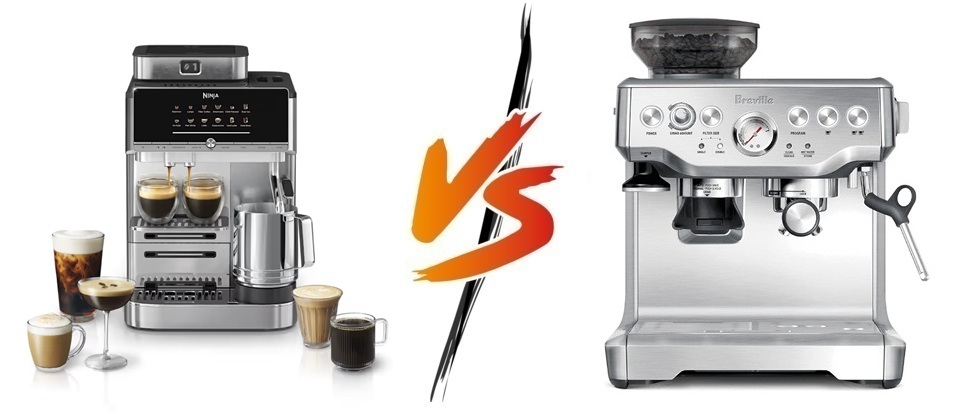
Home espresso machines have come a long way over the last decade. What used to require expensive commercial equipment and years of practice is now possible on a kitchen countertop. Two machines that often appear on buyers’ shortlists are the Ninja Auto Barista and the Breville Barista Express.
Although both are designed to produce café-style coffee at home, they take very different approaches. The Ninja Auto Barista focuses on convenience, automation, and consistency. It aims to simplify espresso making for people who want excellent coffee without spending months learning barista techniques. The Breville Barista Express, on the other hand, is built for people who enjoy being involved in every step of the brewing process. It offers much greater manual control, allowing users to fine-tune their espresso exactly the way they like it.
After spending time comparing their features, daily usability, coffee quality, and maintenance requirements, it becomes clear that these machines target different audiences. Neither is objectively better in every category. Instead, each excels in areas that matter to different types of coffee drinkers.
Let’s take a closer look.
Ninja AutoBarista vs Breville Barista Express
If you click the links below, under the product images, you will be redirected to Amazon.com. In case you then decide to buy anything, Amazon.com will pay me a commission. This doesn’t affect the honesty of this review in any way though.
| Specification | Ninja AutoBarista | Breville Barista Express |
|---|---|---|
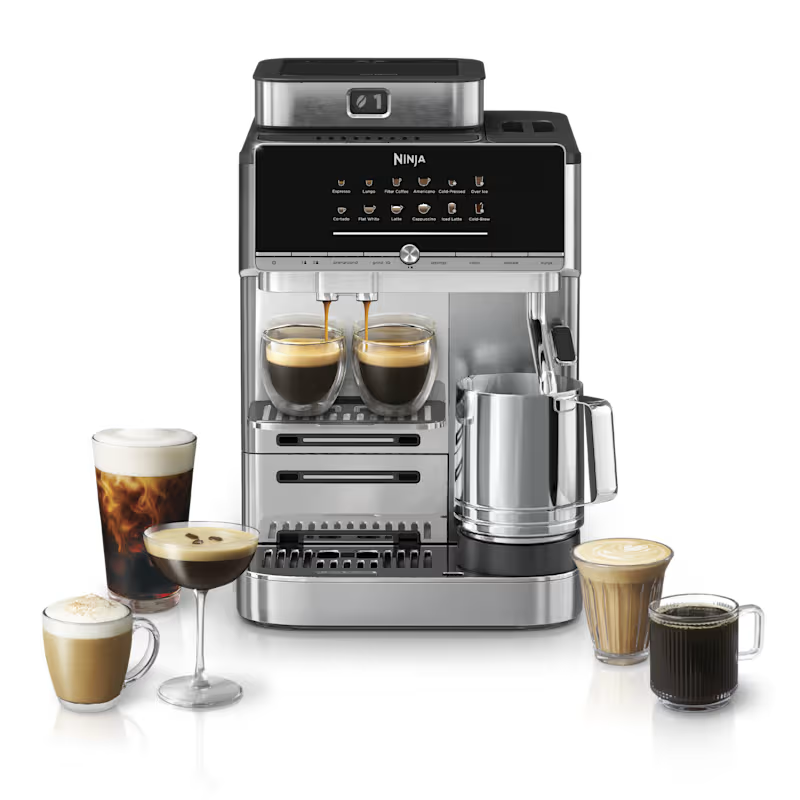 | 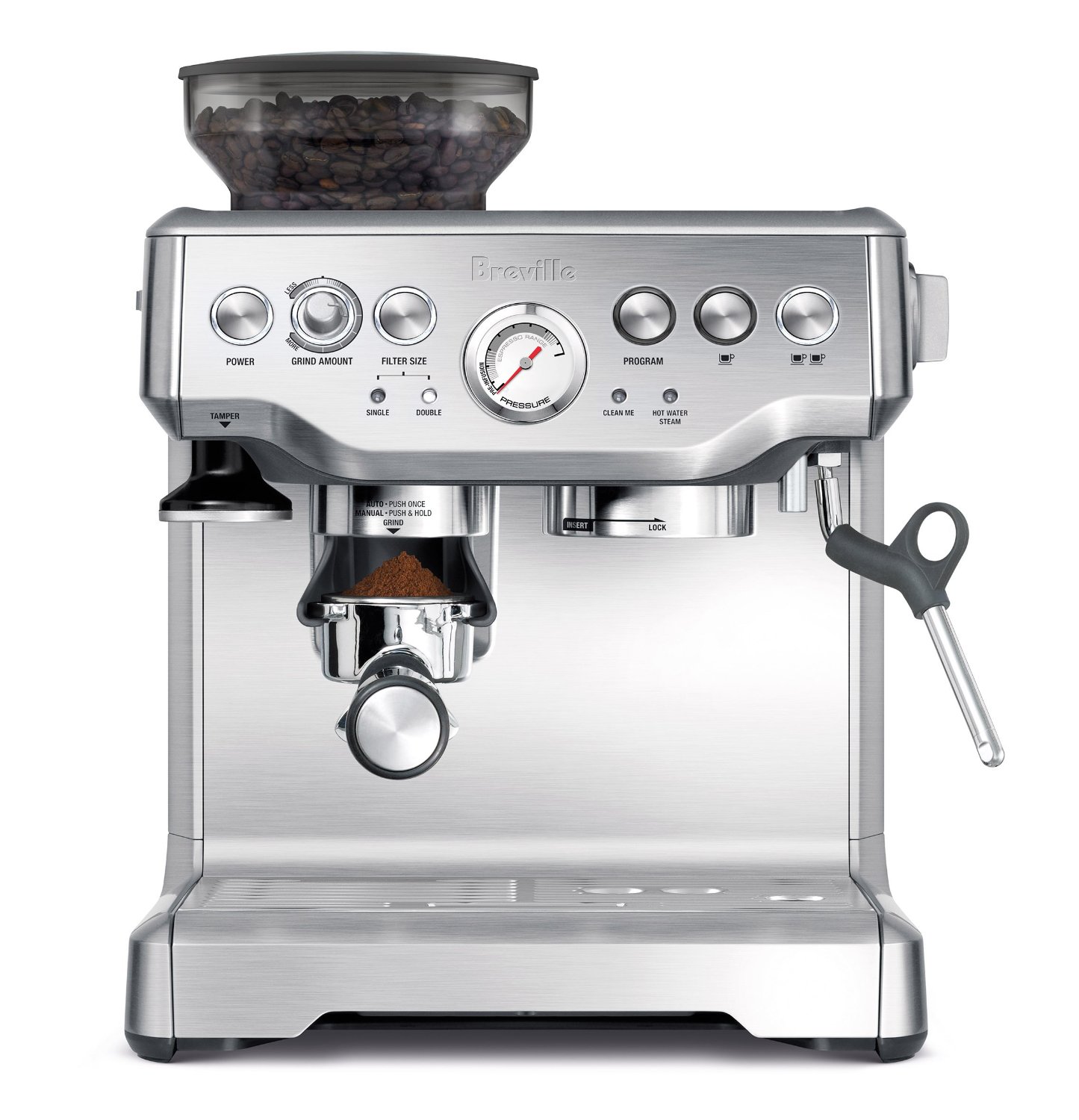 | |
| Check the best price on Amazon | Check the best price on Amazon | |
| Machine Type | Automatic espresso machine | Semi-automatic espresso machine |
| Best For | Beginners, busy households, convenience-focused users | Coffee enthusiasts, home baristas, hobbyists |
| Pump Pressure | 15-Bar Pump | 15-Bar Italian Pump |
| Built-in Grinder | Yes | Yes |
| Grinder Type | Integrated conical burr grinder | Integrated stainless steel conical burr grinder |
| Grind Settings | Multiple preset settings | Multiple adjustable grind settings with precise control |
| Coffee Bean Hopper Capacity | Approx. 12 oz (340 g) | ½ lb (8 oz / 250 g) |
| Water Tank Capacity | Approx. 2 quarts (64 oz / 1.9 L) | 67 oz (2 L) |
| Heating System | Thermoblock heating system | Thermocoil heating system with PID temperature control |
| Heat-Up Time | Fast (around 1 minute) | Approximately 30–60 seconds |
| Temperature Control | Automatic temperature management | Digital PID temperature control |
| Brewing Control | Automated brewing programs | Manual shot control with programmable volumes |
| Pressure Gauge | No | Yes |
| Portafilter Size | 54 mm | 54 mm Stainless Steel |
| Milk Frothing | Automatic milk frothing system | Manual steam wand |
| Latte Art Capability | Limited | Excellent |
| Drink Options | Espresso, Lungo, Americano, Cappuccino, Latte, and other specialty drinks | Espresso, Americano, Latte, Cappuccino, Flat White, Mocha, Macchiato, and more (manual preparation) |
| Customization | Moderate | Extensive |
| Automatic Drink Presets | Yes | No |
| Programmable Settings | Yes | Yes |
| Hot Water Function | Yes | Yes |
| Cup Clearance | Adjustable drip tray for different cup sizes | Adjustable with removable drip tray |
| Cleaning Alerts | Yes | Yes |
| Automatic Cleaning Programs | Partial automated cleaning | Manual cleaning with backflush capability |
| Descaling Reminder | Yes | Yes |
| Removable Water Tank | Yes | Yes |
| Removable Drip Tray | Yes | Yes |
| Dimensions (Approx.) | 13.4″ D × 12.0″ W × 14.6″ H | 13.8″ D × 12.5″ W × 15.9″ H |
| Weight | Approx. 24 lb (10.9 kg) | Approx. 23 lb (10.4 kg) |
| Body Material | Stainless steel with high-quality plastic components | Brushed stainless steel |
| Noise Level | Moderate and relatively quiet | Moderate; grinder is noticeably louder |
| Ease of Use | Excellent | Moderate (requires learning) |
| Maintenance Difficulty | Low | Moderate |
| Ideal User | Users wanting convenience and consistency | Users wanting maximum control and café-style espresso |
| My individual reviews | Ninja AutoBarista review | Breville Barista Express review |
Design & Build Quality
The design of an espresso machine is about far more than appearances. While an attractive machine can certainly enhance the look of a kitchen, the real measure of good design lies in how well the machine functions during everyday use. Build quality, ergonomics, durability, and the thoughtful placement of controls all contribute to the overall ownership experience. Since an espresso machine is often used every single day, even small design decisions can have a noticeable impact over time.
The Ninja Auto Barista and the Breville Barista Express approach design from completely different perspectives. One focuses on simplicity and convenience, while the other embraces a more traditional, café-inspired layout that gives users greater control over the brewing process. Neither philosophy is inherently better, but they cater to different types of coffee drinkers.
Overall Appearance
The Breville Barista Express immediately gives the impression of a serious espresso machine. Its brushed stainless steel exterior has become one of its defining characteristics, giving it a premium appearance that looks equally at home in a modern kitchen or a dedicated coffee station. It resembles the kind of equipment you might expect to see behind the counter of a small independent café, and that visual appeal is part of what has made it so popular among home baristas.
The machine has a purposeful design. Every dial, button, and gauge appears to have a specific function rather than simply existing for decoration. The pressure gauge positioned prominently on the front panel reinforces the machine’s professional aesthetic, while the exposed portafilter and steam wand remind users that this is designed to be a hands-on espresso experience.
The Ninja Auto Barista takes a noticeably different approach. Rather than attempting to replicate commercial espresso equipment, it embraces a cleaner and more contemporary design language. The machine features smoother lines, a more streamlined control panel, and an overall appearance that feels less intimidating to new users.
Its design is approachable. Someone unfamiliar with espresso machines is less likely to feel overwhelmed when looking at the Ninja for the first time. Instead of presenting numerous knobs and manual controls, the machine emphasizes clarity and ease of operation. This makes it particularly appealing for people who simply want great coffee without feeling like they need to study a user manual beforehand.
In purely visual terms, choosing between them comes down to personal taste. Those who appreciate professional-looking coffee equipment will likely prefer the Breville, while buyers seeking a cleaner, more modern appliance may gravitate toward the Ninja.
Materials and Construction
Build quality is one of the areas where the Breville Barista Express has earned its strong reputation.
The stainless steel housing gives the machine a reassuring sense of solidity. It feels substantial without appearing bulky, and its weight helps keep it stable while operating the portafilter. When inserting or removing the handle, there is very little movement, giving the machine a durable and well-engineered feel.
Many of the components that users interact with daily also inspire confidence. The portafilter has a satisfying weight that resembles commercial equipment, while the drip tray, bean hopper, and water tank all fit securely into place. Even after extended use, the machine generally maintains its premium feel with minimal rattling or flexing.
The Ninja Auto Barista uses a greater combination of metal and high-quality plastics. While some buyers automatically associate plastic with lower quality, that assumption isn’t always fair. The plastics used throughout the machine feel durable and well finished, and the overall assembly is solid. Panels fit together neatly, removable components slide smoothly into place, and nothing feels loose during normal operation.
One advantage of the lighter construction is portability. The Ninja is easier to lift when cleaning underneath it or repositioning it on the countertop. For users who occasionally store their machine between uses, this reduced weight can actually be an advantage.
Although the Breville ultimately feels more premium in the hand, the Ninja still feels like a thoughtfully engineered appliance rather than an inexpensive kitchen gadget.
Size and Countertop Presence
Espresso machines are rarely small appliances, and both of these models require a reasonable amount of countertop space.
The Breville Barista Express has a commanding presence. Its combination of integrated grinder, large bean hopper, steam wand, and protruding portafilter means that it occupies more visual space than its footprint alone might suggest. You’ll also need room in front of the machine while preparing espresso, since the workflow involves grinding, tamping, locking in the portafilter, and steaming milk.
For coffee enthusiasts who have created a dedicated coffee corner, this isn’t a drawback. In fact, the machine becomes something of a centerpiece.
The Ninja Auto Barista feels more compact in day-to-day use, even if the overall dimensions aren’t dramatically smaller. Its streamlined workflow means fewer accessories are spread across the countertop, helping keep the coffee station looking tidy.
This difference becomes particularly noticeable in smaller kitchens where workspace is limited. The Ninja’s more integrated design creates less visual clutter, making it easier to fit into apartments or kitchens where counter space is at a premium.
Ergonomics and Everyday Use
Good ergonomics often go unnoticed until they’re missing.
The Breville has clearly been designed for people who enjoy participating in every step of the brewing process. The portafilter locks into place securely, the steam wand moves freely through a wide range of motion, and the grinder controls are positioned within easy reach. Every action feels deliberate, allowing experienced users to develop a smooth workflow over time.
However, this hands-on design also means there are more individual tasks involved in making coffee. Grinding, tamping, extracting, and steaming all require interaction with different parts of the machine.
The Ninja simplifies much of this process.
Its controls are logically arranged, removable components are easy to access, and beverage selection is straightforward. Users spend less time thinking about the mechanics of making espresso and more time simply enjoying the finished drink.
This difference in ergonomics reflects the overall philosophy of each machine. The Breville encourages involvement, while the Ninja prioritizes convenience.
Water Tank and Bean Hopper Design
Both machines feature removable water reservoirs that are easy to refill, but their implementation differs slightly.
The Breville’s rear-mounted water tank offers a generous capacity and includes a convenient handle for removal. It slides in and out smoothly, although users with limited clearance behind their cabinets may find rear access slightly less convenient.
The integrated bean hopper sits directly above the grinder and includes a secure lid that helps preserve bean freshness. Its transparent design allows users to monitor coffee levels without opening the hopper.
The Ninja also features a well-designed water reservoir that removes easily for filling and cleaning. Depending on kitchen layout, some users may find access slightly more convenient during daily use.
Its bean storage integrates neatly into the overall design, maintaining the machine’s clean appearance while still providing enough capacity for regular household use.
Neither machine has significant flaws here, but the Ninja’s overall layout feels slightly more intuitive for beginners.
Fit and Finish
Looking closely at the finer details reveals the care that has gone into manufacturing both machines.
On the Breville, buttons have positive tactile feedback, adjustment dials rotate smoothly, and removable parts align precisely. The stainless steel surfaces resist flexing, while seams between panels remain consistent throughout the machine.
The Ninja demonstrates similarly good manufacturing standards. While its materials differ, the overall fit and finish are impressive. Doors close securely, trays slide confidently into place, and the controls feel responsive rather than flimsy.
Neither machine gives the impression of being cheaply assembled.
Over months and years of ownership, these small details become surprisingly important because they contribute to the overall perception of quality every time the machine is used.
Which Machine Feels Better Built?
If build quality is judged purely by materials and long-term durability, the Breville Barista Express holds the advantage. Its stainless steel construction, commercial-inspired components, and substantial weight give it a premium feel that few machines in its price range can match.
However, if overall design is evaluated by usability rather than materials alone, the Ninja Auto Barista deserves considerable praise. Its modern layout, intuitive organization, lighter construction, and approachable interface make it exceptionally easy to live with on a daily basis.
Ultimately, these machines represent two equally successful but very different interpretations of what a home espresso machine should be. The Breville is built to recreate the experience of operating professional café equipment, rewarding users who enjoy mastering every aspect of espresso preparation. The Ninja, meanwhile, is designed to make high-quality coffee as accessible and effortless as possible. Both are thoughtfully engineered, but the better choice depends on whether you value craftsmanship and manual control or streamlined convenience and everyday practicality.
User Interface & Ease of Use
For many buyers, the user interface and overall ease of use will ultimately determine whether an espresso machine becomes part of their daily routine or ends up collecting dust on the countertop. Even the best-built machine can become frustrating if it requires too much effort to operate, while a well-designed interface can make preparing café-quality coffee feel almost effortless.
This is one of the biggest areas where the Ninja Auto Barista and the Breville Barista Express differ. Both machines are capable of producing excellent coffee, but they approach the brewing process from completely different philosophies. The Ninja Auto Barista emphasizes automation, guided brewing, and convenience, while the Breville Barista Express is built around manual control and the traditional workflow of making espresso.
Neither approach is objectively superior. Instead, the better choice depends on how involved you want to be in preparing your coffee each day.
Getting Started
The first experience with any espresso machine often sets the tone for ownership.
The Ninja Auto Barista is clearly designed with first-time espresso users in mind. After unpacking the machine, assembling the removable components is straightforward, and the controls are immediately understandable. Most functions are clearly labeled, and the interface encourages users to follow a simple, step-by-step brewing process.
There is very little intimidation factor. Even someone who has never owned an espresso machine before can usually prepare their first drink within a short period of setting the machine up. The learning curve is intentionally kept shallow, allowing users to focus on enjoying their coffee rather than figuring out how the machine works.
The Breville Barista Express creates a very different first impression.
While assembly itself is relatively simple, the number of accessories and controls can initially feel overwhelming. Users are introduced to the bean hopper, grind adjustment dial, portafilter, tamper, steam wand, filter baskets, dosing tools, and pressure gauge before they’ve even brewed their first shot.
Unlike the Ninja, the Breville assumes that the user is willing to learn the basics of espresso preparation. The instruction manual becomes much more important during those first few days of ownership, and many new users spend additional time watching tutorials or reading brewing guides to better understand concepts such as grind size, extraction time, and tamping pressure.
This isn’t necessarily a disadvantage. For many coffee enthusiasts, learning these techniques is part of the fun. However, buyers looking for immediate simplicity may find the initial setup more demanding.
Control Layout
The design of the controls says a great deal about the intended audience for each machine.
The Ninja Auto Barista keeps everything organized and approachable. Beverage options are clearly presented, buttons are logically positioned, and navigating between different drink selections feels intuitive. The machine guides users through the brewing process without requiring them to constantly monitor every variable.
The interface feels similar to many modern kitchen appliances. There are few unnecessary distractions, and the controls focus on helping users achieve consistent results with minimal effort.
The Breville takes a more traditional approach.
Instead of hiding the brewing process behind automation, it places important controls directly into the user’s hands. The grind amount dial, shot selection buttons, steam control knob, and pressure gauge all require active participation during brewing.
Initially, this can appear more complicated than it actually is. Once users become familiar with the machine’s layout, every control begins to make sense. Each adjustment serves a specific purpose, allowing the user to refine their espresso rather than relying on preset programming.
The interface is less about simplicity and more about flexibility.
Daily Workflow
Perhaps the biggest difference between these two machines becomes apparent during everyday use.
Making espresso with the Ninja Auto Barista is designed to be a smooth, streamlined experience. The workflow is intentionally simplified to eliminate as much guesswork as possible. Users add beans and water, select their preferred beverage, position their cup, and allow the machine to handle much of the brewing process automatically.
This efficiency becomes particularly valuable during busy mornings.
When you’re preparing coffee before work, the ability to make a quality drink with minimal effort is a significant advantage. The machine reduces the number of manual steps required, allowing users to enjoy espresso without turning the process into a lengthy ritual.
The Breville Barista Express offers a completely different experience.
Preparing a drink involves several individual steps. Coffee beans are ground into the portafilter, the grounds are distributed evenly, tamped with consistent pressure, and locked into the group head before extraction begins. Afterward, milk is steamed manually if preparing a latte or cappuccino.
For experienced users, this workflow becomes enjoyable. Many coffee enthusiasts appreciate the sense of involvement and craftsmanship that comes with preparing espresso manually.
For beginners or people with limited time, however, the process can initially feel lengthy compared to the Ninja’s largely automated approach.
Learning Curve
The learning curve is one of the most important considerations when choosing between these machines.
The Ninja Auto Barista requires very little prior knowledge.
Because many brewing variables are automatically managed, users don’t need to understand the finer details of espresso extraction to achieve satisfying results. This makes the machine particularly attractive to households where several people will use it, regardless of their coffee experience.
Guests and family members can usually operate the machine without needing detailed instructions.
The Breville Barista Express requires a greater investment of time.
New users often discover that producing excellent espresso involves experimentation. Small changes to grind size, coffee dose, tamp pressure, and extraction time can dramatically affect flavor.
The first few shots may not be perfect.
Some may taste sour because the extraction is too fast, while others may become bitter if the grind is too fine. Understanding these variables takes practice, patience, and a willingness to learn.
Fortunately, the machine rewards that effort.
As users become more experienced, they gain the ability to consistently produce espresso tailored to their personal preferences. This sense of progression is one of the reasons the Breville has remained popular for so many years.
Customization Options
The amount of customization available further separates these machines.
The Ninja Auto Barista focuses on making excellent coffee through intelligent automation. While users can choose between different beverages and basic settings, much of the brewing process remains optimized by the machine itself.
This creates a consistent experience from cup to cup.
The Breville encourages experimentation.
Users can adjust grind size, dosing, extraction time, and milk texturing techniques. Different coffee beans can be dialed in individually, allowing enthusiasts to explore how roast level and origin affect flavor.
This level of control makes the machine far more engaging for hobbyists who enjoy refining every aspect of their espresso.
The trade-off is that greater flexibility also introduces more opportunities for user error.
Milk Preparation
Preparing milk-based drinks highlights another significant usability difference.
The Ninja’s milk system is designed for convenience. It simplifies frothing and reduces the amount of technique required to prepare drinks such as cappuccinos and lattes.
For most households, this means consistently enjoyable milk drinks without extensive practice.
The Breville’s manual steam wand requires considerably more skill.
Proper milk steaming involves positioning the steam wand correctly, stretching the milk during the early stages of steaming, and creating smooth microfoam without introducing excessive bubbles.
This process can take weeks to master.
Once learned, however, it produces far superior results for latte art and café-style beverages.
Again, the difference comes down to convenience versus control.
Everyday Ownership Experience
Over weeks and months of ownership, the differences between these machines become even more apparent.
The Ninja Auto Barista integrates effortlessly into daily life. Its straightforward interface minimizes decision-making, allowing users to prepare quality coffee quickly and consistently. The machine asks very little of its owner beyond routine cleaning and occasional maintenance.
This simplicity makes it particularly appealing for busy professionals, families, and anyone who values speed during hectic mornings.
The Breville Barista Express offers a more rewarding long-term experience for people who enjoy coffee as a hobby.
Many owners find themselves gradually improving their technique, experimenting with new coffee beans, and learning how subtle adjustments influence extraction. Rather than becoming repetitive, the brewing process often becomes increasingly satisfying over time.
For these users, the machine provides a sense of accomplishment that fully automatic systems simply cannot replicate.
Which Machine Is Easier to Use?
There is little doubt that the Ninja Auto Barista is the easier machine to operate. Its intuitive interface, simplified workflow, and guided brewing process make it approachable for complete beginners while delivering reliable results with minimal effort. It removes much of the uncertainty that often discourages new espresso drinkers from purchasing a home machine.
The Breville Barista Express, by comparison, asks much more from its owner. It requires patience, practice, and a willingness to learn traditional espresso techniques. However, that additional effort is rewarded with greater flexibility, deeper customization, and the satisfaction of mastering the art of espresso preparation.
Ultimately, choosing between them depends on what you want from the experience. If your priority is making excellent coffee quickly and consistently with as little effort as possible, the Ninja Auto Barista offers one of the most user-friendly experiences available. If you enjoy learning new skills and want complete control over every stage of brewing, the Breville Barista Express provides a far more engaging and rewarding journey.
Coffee Quality & Brewing Performance
At the end of the day, an espresso machine is judged by one thing above all else: the quality of the coffee it produces. Premium materials, attractive styling, and advanced features all add value, but none of them matter if the espresso in the cup falls short. Fortunately, both the Ninja Auto Barista and the Breville Barista Express are capable of producing enjoyable coffee, though they achieve those results in very different ways.
The Breville is built around giving the user complete control over the brewing process. Every variable, from grind size to extraction time, can influence the final flavor, making it possible to produce exceptional espresso with enough practice. The Ninja Auto Barista, meanwhile, focuses on delivering consistently good coffee through automation. Instead of requiring users to fine-tune every setting, it handles much of the brewing process itself, making quality espresso more accessible to everyday coffee drinkers.
Neither approach is inherently better. The right choice depends on whether you prioritize consistency and convenience or customization and experimentation.
Espresso Extraction
Espresso is a surprisingly delicate beverage. Even small changes in brewing variables can dramatically affect the taste, aroma, and texture of the final shot.
The Breville Barista Express embraces this complexity. Users are expected to dial in their coffee by adjusting the grinder, choosing the appropriate dose, tamping evenly, and monitoring extraction. While this process requires more effort, it also provides far greater control over the finished espresso.
When everything comes together, the results can be outstanding.
A properly dialed-in shot from the Breville is rich, balanced, and full-bodied. The flavors are layered rather than one-dimensional, allowing the natural characteristics of the coffee beans to shine through. Fruit-forward light roasts can display bright acidity and floral notes, while darker roasts develop chocolate, caramel, and roasted nut flavors with remarkable clarity.
The Ninja Auto Barista takes a different path.
Rather than expecting users to adjust every brewing parameter manually, the machine automates much of the extraction process. It is designed to consistently produce well-balanced espresso with minimal user intervention. This makes it significantly easier for beginners to achieve enjoyable results without worrying about grind adjustments or shot timing.
While experienced espresso enthusiasts may notice that the Ninja offers less opportunity for fine-tuning, many casual coffee drinkers will appreciate the machine’s dependable consistency.
Flavor Profile
Coffee flavor is influenced by countless variables, including bean quality, roast level, grind consistency, water temperature, pressure, and extraction time.
The Breville allows users to explore all of these variables in depth.
Switching from a medium roast to a light-roasted Ethiopian coffee, for example, often requires changes to the grind size and extraction time. The machine provides enough flexibility to make these adjustments, allowing users to optimize each coffee individually.
This ability to tailor the brewing process often results in more expressive flavors.
Experienced users can highlight sweetness, enhance body, or emphasize acidity depending on their preferences. The espresso feels more personalized because every variable has been adjusted intentionally.
The Ninja Auto Barista prioritizes balance rather than experimentation.
Its automated brewing system aims to produce a pleasant, approachable flavor profile regardless of the beans being used. The resulting espresso is smooth, consistent, and enjoyable, making it well suited to daily drinking.
Although it may not reveal every subtle flavor note hidden within specialty coffee beans, it performs remarkably well for a machine designed around convenience.
Crema Quality
A thick layer of golden crema is often considered a sign of properly brewed espresso.
The Breville consistently produces impressive crema when paired with freshly roasted beans and an appropriate grind setting. Because users have greater control over extraction, they can adjust their technique to maximize crema production while maintaining balanced flavor.
Fresh coffee makes a noticeable difference.
Beans roasted within the previous few weeks typically produce a richer, more stable crema than older supermarket coffee. The Breville allows experienced users to take full advantage of freshly roasted specialty beans.
The Ninja also produces attractive crema under normal conditions.
Its automated extraction process generates a satisfying layer of crema that enhances both appearance and mouthfeel. While it may not always achieve the same thickness or complexity as a perfectly dialed-in Breville shot, it remains more than adequate for most home users.
For milk-based beverages, the difference becomes even less noticeable.
Consistency Between Shots
One of the greatest strengths of the Ninja Auto Barista is its consistency.
Because the brewing process relies heavily on automation, users are far less likely to encounter dramatic variations from one shot to the next. This predictability is particularly valuable in busy households where multiple people use the machine.
Whether making espresso on Monday morning or Saturday afternoon, the results remain reassuringly similar.
The Breville tells a different story.
Consistency depends almost entirely on the operator.
If the grind size changes slightly, the tamp pressure varies, or the coffee dose differs by even a small amount, the extraction can change significantly. Beginners often experience inconsistent results while learning the machine.
Fortunately, consistency improves dramatically with experience.
Once users develop a repeatable workflow, the Breville becomes highly reliable. In skilled hands, it can consistently produce café-quality espresso that rivals far more expensive equipment.
Temperature Stability
Maintaining stable brewing temperatures is essential for proper espresso extraction.
If water is too cool, the coffee may taste sour or underdeveloped. If it becomes too hot, bitterness can overwhelm the cup.
Both machines perform well in this regard.
The Breville maintains reliable brewing temperatures throughout extraction, allowing users to achieve balanced shots across different roast profiles. This stability becomes particularly important when experimenting with lighter specialty coffees, which often require more precise temperature control.
The Ninja likewise delivers dependable thermal performance.
Its automated brewing system ensures that water reaches an appropriate temperature before extraction begins, minimizing the risk of inconsistent results caused by fluctuating heat.
In everyday use, most users are unlikely to notice significant differences in temperature stability between the two machines.
Brewing Speed
Convenience plays an important role in brewing performance, especially during busy mornings.
The Ninja Auto Barista is clearly optimized for efficiency.
The simplified workflow allows users to move from powering on the machine to enjoying a freshly brewed drink with relatively little effort. Automated brewing reduces preparation time, making the entire experience feel quick and seamless.
This makes the Ninja particularly attractive for households where several drinks need to be prepared in a short period.
The Breville requires considerably more preparation.
Grinding coffee, distributing grounds evenly, tamping correctly, locking in the portafilter, extracting the espresso, and steaming milk all add time to the process.
None of these individual steps take very long, but together they create a brewing ritual that naturally requires more patience.
For some owners, this slower pace is part of the enjoyment.
For others, especially those rushing to work, it may occasionally feel less practical.
Performance with Different Coffee Beans
One area where the Breville truly excels is its ability to adapt to different coffee beans.
Coffee from different regions behaves differently during extraction. A light-roasted Kenyan coffee often requires different settings than a dark Italian-style espresso blend.
The Breville gives users the freedom to make these adjustments.
As a result, adventurous coffee drinkers can explore a wide variety of specialty beans while tailoring the brewing process to each one.
The Ninja is more focused on providing consistently enjoyable results regardless of the beans being used.
While it performs well with many coffees, it doesn’t encourage the same level of experimentation. Users who regularly purchase specialty beans may occasionally feel limited by the reduced level of manual control.
For most households using a favorite everyday blend, however, this limitation is unlikely to become a concern.
Espresso-Based Drinks
Both machines perform admirably when preparing drinks beyond straight espresso.
The Breville produces rich espresso that forms an excellent foundation for cappuccinos, lattes, flat whites, and Americanos. Because users control both extraction and milk steaming, they can customize each drink to their exact preferences.
The Ninja also excels at preparing popular milk-based beverages.
Its automated brewing system delivers consistently balanced espresso that pairs well with steamed milk, making it easy to prepare enjoyable specialty drinks with very little effort.
While experienced baristas may appreciate the Breville’s greater flexibility, many households will find the Ninja’s consistency more valuable in daily use.
Which Machine Brews Better Coffee?
Answering this question depends largely on the person standing behind the machine.
The Breville Barista Express has the higher performance ceiling. Given fresh beans, proper technique, and a willingness to experiment, it is capable of producing espresso that rivals what many independent coffee shops serve. Its manual controls allow experienced users to unlock flavors and nuances that automated systems simply cannot match.
The Ninja Auto Barista, however, offers something equally valuable: dependable consistency. It removes much of the uncertainty associated with espresso preparation, allowing users to produce smooth, balanced coffee with very little effort. Instead of rewarding technical skill, it rewards simplicity and reliability.
Ultimately, coffee quality isn’t determined solely by the machine itself. It also depends on the user’s priorities. Those who enjoy refining recipes, experimenting with specialty beans, and chasing the perfect espresso shot will likely appreciate everything the Breville has to offer. Those who simply want excellent coffee every morning without a steep learning curve will find the Ninja Auto Barista delivers an impressive combination of flavor, consistency, and convenience.
Grinder Features & Performance
An espresso machine is only as good as the coffee grounds it uses, which is why the grinder is one of the most important components of any bean-to-cup system. Even the most advanced brewing technology cannot compensate for poorly ground coffee. Particle size, consistency, and the ability to make precise adjustments all play a major role in determining how an espresso shot extracts and ultimately tastes.
The Ninja Auto Barista and the Breville Barista Express both feature integrated grinders, eliminating the need to purchase a separate appliance. This is a significant advantage for home users, as it saves counter space while ensuring coffee is ground immediately before brewing. Freshly ground beans retain far more aroma and flavor than pre-ground coffee, making an integrated grinder one of the most valuable features an espresso machine can offer.
Although both machines include built-in grinders, they are designed with very different priorities. The Breville focuses on giving users as much control as possible over the grinding process, while the Ninja aims to simplify the experience through automation and consistency.
Why the Grinder Matters
Before comparing the two machines directly, it’s worth understanding why the grinder is so important.
Espresso requires an exceptionally fine and consistent grind. Unlike drip coffee or French press brewing, espresso forces hot water through compacted coffee under high pressure. If the grounds are too coarse, water passes through too quickly, producing weak and sour espresso. If they’re too fine, extraction becomes slow, often resulting in bitterness and over-extracted flavors.
Consistency is equally important.
A grinder that produces a mixture of large and tiny particles creates uneven extraction. Smaller particles release flavor too quickly, while larger pieces remain under-extracted. The result is a cup that tastes muddled rather than balanced.
This is why coffee enthusiasts often say the grinder is even more important than the espresso machine itself.
Grinder Design
The Breville Barista Express features an integrated conical burr grinder, which has become one of the machine’s defining strengths.
Unlike inexpensive blade grinders that chop coffee beans into uneven fragments, burr grinders crush beans between two precisely engineered burrs. This produces a much more uniform particle size, leading to better extraction and more consistent espresso.
Conical burr grinders also generate less heat during grinding than many alternative designs. Excessive heat can prematurely release aromatic oils and subtly alter coffee flavor, so keeping temperatures lower helps preserve freshness.
The Ninja Auto Barista also uses a burr grinder rather than a simple blade system, ensuring a level of grind consistency appropriate for espresso brewing. Like many of the machine’s features, however, the grinder has been optimized for ease of use rather than extensive customization.
Its design emphasizes reliability and simplicity, allowing users to enjoy freshly ground coffee without needing to constantly adjust settings or troubleshoot grind-related issues.
Grind Consistency
One of the Breville’s greatest strengths is the consistency of its grinder.
Across repeated use, it produces relatively uniform coffee particles that support balanced espresso extraction. This consistency becomes particularly noticeable when using freshly roasted specialty beans, where subtle differences in grind quality can significantly affect flavor.
Because the grinder performs so well, users are able to make small adjustments that produce meaningful changes in extraction.
For example, moving just one grind setting finer may slow the espresso shot enough to increase sweetness while reducing acidity. These kinds of refinements are difficult to achieve with lower-quality grinders.
The Ninja Auto Barista also performs well in terms of grind consistency.
Its grinder delivers dependable results that work effectively with the machine’s automated brewing system. Since much of the brewing process has been optimized around specific grinding characteristics, users generally experience consistent extraction without needing to make constant adjustments.
While advanced coffee enthusiasts may find the Breville capable of greater precision, the Ninja’s grinder is more than capable of producing enjoyable espresso for everyday use.
Grind Size Adjustments
Customization is where the differences between these two machines become most apparent.
The Breville Barista Express gives users extensive control over grind size.
This flexibility is essential because different coffees require different grind settings. A freshly roasted light roast often needs a finer grind than an older dark roast, while humidity and bean age can also influence extraction.
Being able to adjust grind size allows users to compensate for these variables.
As coffee enthusiasts gain experience, they often find themselves making small adjustments every time they switch to a new bag of beans. The Breville encourages this level of experimentation, allowing owners to optimize extraction for virtually any coffee they choose.
The Ninja Auto Barista takes a far simpler approach.
Rather than expecting users to constantly modify grind settings, the machine is designed to work effectively with minimal intervention. The grinder has been tuned to complement the machine’s automated brewing system, helping deliver reliable results with far less trial and error.
For beginners, this simplicity is often a welcome advantage.
Rather than worrying about whether the grind should be slightly finer or coarser, users can focus on simply enjoying their coffee.
Dosing Performance
Grinding coffee is only one part of the process.
Equally important is delivering the correct amount of coffee for each shot.
The Breville allows users to adjust the amount of coffee dispensed into the portafilter. This gives experienced baristas another variable to fine-tune when dialing in espresso. Increasing or decreasing the dose can subtly affect extraction time, body, and overall flavor balance.
This flexibility becomes particularly valuable when experimenting with different basket sizes or coffee varieties.
The Ninja handles dosing much more automatically.
Instead of requiring users to manually evaluate every dose, the machine is designed to deliver an appropriate quantity of coffee for its brewing system. This greatly simplifies operation and helps maintain consistency from drink to drink.
Again, the trade-off is control versus convenience.
Bean Hopper Design
Both machines feature integrated bean hoppers that keep coffee beans readily available for brewing.
The Breville’s hopper has a generous capacity and includes a secure lid that helps protect beans from exposure to air. The transparent construction allows users to quickly check bean levels without opening the hopper.
Some coffee enthusiasts prefer storing only enough beans for a few days at a time, as prolonged exposure to light and oxygen gradually reduces freshness. Fortunately, the hopper is easy to empty when switching between different coffee varieties.
The Ninja also includes a thoughtfully designed bean hopper that integrates neatly into the machine’s overall appearance.
Its storage capacity is well suited for everyday household use, reducing the frequency of refilling while maintaining easy access for cleaning.
Both hoppers perform their intended function well, though the Breville offers slightly greater flexibility for users who frequently change beans.
Noise Levels During Grinding
No built-in grinder is completely silent, and both machines generate noticeable noise while grinding coffee.
The Breville produces the familiar mechanical sound associated with burr grinders. While it is certainly audible, the grinding process is relatively brief, and the sound is consistent rather than harsh.
The Ninja’s grinder is similarly noticeable but often feels slightly more refined during operation. Because the machine has been engineered with automation in mind, the overall grinding process feels smooth and integrated into the brewing cycle.
In practical terms, neither machine is likely to wake an entire household, but both produce enough sound that early morning coffee preparation won’t be completely silent.
Long-Term Reliability
Reliability is another important consideration for integrated grinders.
Coffee oils and fine particles naturally accumulate over time, making periodic cleaning essential regardless of which machine you choose.
The Breville’s grinder has built a strong reputation for long-term durability when properly maintained. Routine cleaning helps preserve grinding consistency and prevents old coffee residue from affecting flavor.
The Ninja’s grinder is likewise designed for regular home use, with accessible components that simplify routine maintenance. Because the machine emphasizes convenience throughout its design, cleaning the grinder generally feels straightforward and manageable.
As with any espresso machine, regular care is far more important than the specific grinder design when it comes to long-term performance.
Which Grinder Performs Better?
Both machines include capable integrated grinders that offer a significant advantage over purchasing pre-ground coffee. Fresh grinding alone dramatically improves aroma, flavor, and overall espresso quality, making either machine a worthwhile upgrade for coffee lovers.
That said, the Breville Barista Express clearly offers the stronger grinder for users who want maximum control. Its conical burr grinder provides excellent consistency, a wide range of grind adjustments, and the flexibility needed to optimize extraction for different coffee beans. It rewards experimentation and allows owners to continually refine their espresso as their skills improve.
The Ninja Auto Barista takes a more approachable approach. Its grinder is designed to work seamlessly with the machine’s automated brewing system, producing reliable and consistent results with minimal effort. While it doesn’t offer the same level of precision or customization, it succeeds in delivering freshly ground coffee without burdening users with constant adjustments.
Ultimately, the better grinder depends on the type of coffee experience you’re looking for. If you enjoy experimenting with specialty beans, dialing in new recipes, and making fine adjustments to achieve the perfect shot, the Breville’s grinder is the clear winner. If your goal is to enjoy fresh, flavorful espresso every day without a steep learning curve, the Ninja Auto Barista’s grinder offers an excellent balance of convenience, consistency, and ease of use.
Milk Frothing & Specialty Drinks
While a great espresso forms the foundation of many coffee beverages, milk preparation is what transforms a simple shot into drinks like lattes, cappuccinos, flat whites, macchiatos, and mochas. For many people, these milk-based beverages are the reason they invest in an espresso machine in the first place. A machine that can consistently produce silky, well-textured milk opens the door to recreating the café experience at home.
The Ninja Auto Barista and the Breville Barista Express both allow users to prepare a wide range of specialty coffee drinks, but they take fundamentally different approaches to milk frothing. Much like the rest of these machines, the Ninja prioritizes convenience and automation, while the Breville embraces manual control and traditional barista techniques.
Neither system is inherently better. Instead, they appeal to different types of coffee drinkers. Some users simply want delicious milk-based beverages with as little effort as possible, while others enjoy developing the skills needed to create café-quality microfoam and even practice latte art.
Understanding Milk Frothing
Before comparing the two machines, it’s worth understanding why milk frothing is so important.
Properly steamed milk isn’t simply hot milk with bubbles on top. During steaming, air is incorporated into the milk while simultaneously heating it. When done correctly, the result is smooth, velvety microfoam made up of tiny, uniform bubbles that create a creamy texture and naturally complement espresso.
Poorly steamed milk often contains large bubbles that separate quickly, producing a dry foam that sits awkwardly on top of the drink. Well-textured microfoam, on the other hand, blends seamlessly with the espresso, creating a richer mouthfeel and allowing for decorative latte art.
Achieving this balance requires both the right equipment and, in many cases, practice.
The Breville’s Manual Steam Wand
The Breville Barista Express uses a traditional manual steam wand similar to those found on commercial espresso machines.
This immediately appeals to coffee enthusiasts because it provides complete control over the steaming process. Users determine how much air to introduce into the milk, how quickly it heats, and when the steaming process should end.
This freedom allows experienced users to create exceptionally smooth microfoam.
With proper technique, milk develops a glossy, paint-like texture that pours beautifully into espresso. This is the texture required for high-quality lattes, flat whites, and latte art.
The manual steam wand also accommodates different drink styles.
A cappuccino generally requires more foam than a latte, while a flat white uses less aeration and emphasizes silky milk texture. Because users control the steaming process directly, they can adjust the texture to suit each beverage.
This flexibility is one of the Breville’s greatest strengths.
However, it also introduces a learning curve.
Learning to Steam Milk
Using a manual steam wand is often the most challenging part of learning espresso preparation.
The first few attempts rarely produce café-quality milk.
New users frequently introduce too much air, resulting in large bubbles and stiff foam. Others fail to create enough aeration, producing milk that is simply warm rather than properly textured.
Positioning the steam wand correctly also takes practice.
Small adjustments in depth and angle dramatically affect how the milk stretches and spins inside the pitcher. Developing the muscle memory to consistently produce smooth microfoam often takes several weeks of regular use.
This learning process can initially feel frustrating.
Fortunately, it also becomes one of the most rewarding aspects of owning the Breville.
As users improve, they begin producing milk that rivals what skilled baristas serve in specialty coffee shops. That sense of progress adds to the overall enjoyment of the machine.
The Ninja’s Automated Milk System
The Ninja Auto Barista approaches milk preparation from a completely different perspective.
Instead of expecting users to master steaming techniques, the machine automates much of the frothing process.
This dramatically reduces the amount of skill required to prepare milk-based beverages.
Rather than worrying about steam wand positioning, milk temperature, or foam texture, users simply follow the machine’s straightforward workflow. The result is consistently frothed milk suitable for a wide variety of coffee drinks.
For households where multiple people use the machine, this simplicity becomes a major advantage.
Everyone can prepare enjoyable cappuccinos or lattes without needing specialized training or extensive practice.
While coffee enthusiasts may miss the creative freedom of manual steaming, many everyday users will appreciate the reliability and ease of the Ninja’s system.
Milk Texture Comparison
The texture of the finished milk is where the differences between these machines become most noticeable.
The Breville’s manual steam wand has the higher performance ceiling.
In skilled hands, it produces silky, glossy microfoam with incredibly fine bubbles. This texture blends beautifully with espresso, creating drinks that closely resemble those served by experienced café baristas.
The milk feels rich and creamy without becoming excessively foamy.
Because the foam integrates so well with the liquid milk, each sip maintains a consistent texture from beginning to end.
The Ninja produces milk that is consistently enjoyable but somewhat less refined.
Its frothing system creates smooth foam suitable for everyday beverages, but it generally lacks the same degree of polish achieved through expert manual steaming.
Most casual coffee drinkers will be perfectly satisfied with the results.
Only those who regularly visit specialty coffee shops or enjoy making latte art are likely to notice the difference.
Specialty Coffee Drinks
Both machines support a broad selection of espresso-based beverages.
The Breville allows users to prepare virtually any café-style drink imaginable.
Espresso shots can be paired with manually textured milk to create cappuccinos, lattes, flat whites, cortados, macchiatos, mochas, and Americanos. Because every stage of the brewing process remains under user control, each drink can be customized extensively.
Want a stronger latte with an extra espresso shot?
No problem.
Prefer a dry cappuccino with abundant foam?
That’s easily achieved as well.
This flexibility makes the Breville especially attractive for coffee enthusiasts who enjoy experimenting with recipes.
The Ninja also performs admirably across a wide variety of specialty drinks.
Its automated brewing and milk systems simplify the preparation of popular beverages, allowing users to produce café-inspired drinks with minimal effort.
For busy mornings, this convenience is difficult to overlook.
Instead of spending several minutes adjusting grind settings and steaming milk manually, users can quickly prepare drinks that satisfy most everyday coffee cravings.
Latte Art Potential
Latte art has become something of a benchmark for milk quality.
Creating hearts, tulips, or rosettas requires milk with exceptionally fine microfoam and precise pouring technique.
The Breville is fully capable of producing milk suitable for latte art.
Once users become comfortable with steaming, the machine provides everything necessary to practice increasingly complex designs. Many owners find themselves gradually improving their pouring technique alongside their espresso-making skills.
For coffee enthusiasts, this becomes an enjoyable hobby in its own right.
The Ninja, however, isn’t really intended for latte art.
Although its milk texture works well for drinking, it generally doesn’t produce the same silky consistency required for intricate designs.
This won’t matter to most households, but aspiring home baristas may find themselves wishing for greater manual control.
Speed and Convenience
Convenience is another area where the Ninja distinguishes itself.
Preparing milk-based drinks requires relatively little effort.
Automation reduces both preparation time and the possibility of user error, making it easy to produce enjoyable beverages before work or while entertaining guests.
The Breville naturally requires more involvement.
Steaming milk manually adds another step to the brewing process, and cleaning the steam wand immediately afterward is essential for proper hygiene.
For experienced users, this routine becomes second nature.
For newcomers, it can initially feel like additional work compared to the Ninja’s more streamlined approach.
Again, neither system is objectively better.
It simply depends on whether you enjoy participating in the process or prefer the machine to handle much of the work for you.
Cleaning After Milk Preparation
Milk systems require regular cleaning regardless of the machine.
The Breville’s manual steam wand must be wiped immediately after steaming and briefly purged to remove residual milk from inside the wand. This routine takes only a few seconds but becomes an important habit for maintaining both hygiene and steaming performance.
Most experienced users perform this automatically after every drink.
The Ninja’s milk system is similarly designed with routine cleaning in mind.
Many removable components can be detached and rinsed with minimal effort, helping keep maintenance straightforward. Because the system emphasizes convenience, cleaning generally feels less intimidating for users unfamiliar with traditional steam wands.
Regular maintenance is important for both machines, but neither presents unusual challenges when cared for properly.
Which Machine Makes Better Milk Drinks?
Both the Ninja Auto Barista and the Breville Barista Express are capable of producing excellent milk-based coffee beverages, but they cater to very different audiences.
The Breville offers the highest ceiling for milk quality. Its manual steam wand allows experienced users to create beautifully textured microfoam, customize drinks precisely, and even develop latte art skills. While the learning curve is steeper, the rewards are significant for anyone who enjoys mastering the craft of espresso preparation.
The Ninja Auto Barista, by contrast, focuses on accessibility. Its automated milk system removes much of the complexity associated with steaming, making it easy for virtually anyone to prepare consistently enjoyable cappuccinos, lattes, and other specialty drinks. Although it doesn’t offer the same level of control or refinement, it delivers dependable results with far less effort.
Ultimately, the better choice depends on what kind of coffee experience you’re looking for. If you see milk steaming as part of the enjoyment and want to recreate the techniques used in professional cafés, the Breville is the clear winner. If your priority is preparing delicious specialty drinks quickly, consistently, and without a lengthy learning curve, the Ninja Auto Barista provides an experience that is both practical and highly satisfying for everyday use.
Maintenance & Cleaning
No matter how advanced an espresso machine is, regular maintenance is essential for keeping it performing at its best. Coffee oils, milk residue, mineral deposits, and used coffee grounds gradually build up over time, affecting both flavor and machine performance if left unattended. Fortunately, maintaining a home espresso machine doesn’t have to be difficult. The key is developing a simple routine that keeps the machine clean without turning maintenance into a chore.
The Ninja Auto Barista and the Breville Barista Express both require regular care, but they differ significantly in how much attention they demand from their owners. Much like every other aspect of these machines, the Ninja emphasizes simplicity and convenience, while the Breville expects users to take a more active role in maintaining both the machine and its individual components.
Neither approach is inherently better. Some coffee enthusiasts actually enjoy the maintenance routine because it encourages them to care for their equipment properly. Others simply want a machine that requires as little upkeep as possible. Understanding these differences can help determine which machine better fits your daily routine.
Why Regular Maintenance Matters
Espresso machines work under high pressure while handling natural coffee oils and finely ground coffee. Every shot leaves behind residue inside the brewing system, and milk steaming introduces another layer of cleaning requirements.
If these residues aren’t removed regularly, several problems can develop.
Coffee oils gradually become rancid, negatively affecting the flavor of freshly brewed espresso. Fine coffee particles can clog filters and brewing components, reducing extraction quality. Mineral deposits from hard water can accumulate inside the machine, eventually affecting water flow and heating performance.
Milk residue deserves particular attention.
Unlike coffee oils, leftover milk can spoil quickly if allowed to dry inside or around a steam wand. This not only affects hygiene but can also reduce steaming performance over time.
Fortunately, both machines are designed with maintenance in mind. The difference lies in how much of the cleaning process is automated versus how much responsibility falls on the user.
Daily Cleaning Routine
The easiest way to keep an espresso machine in excellent condition is through simple daily maintenance.
With the Ninja Auto Barista, this routine is intentionally straightforward.
After brewing, users typically empty the used coffee grounds, rinse removable components if necessary, and wipe down any surfaces that have come into contact with coffee or milk. Depending on the model and drink prepared, some components can simply be removed and rinsed under warm running water.
Because much of the brewing process is automated, there tends to be less scattered coffee grounds and less overall mess compared to more manual espresso machines.
The Breville Barista Express requires a slightly more involved routine.
After every espresso shot, the used coffee puck should be knocked out of the portafilter basket, which is then rinsed before the next use. The group head often benefits from a quick flush to remove any remaining coffee particles.
If milk has been steamed, the steam wand should be wiped immediately with a damp cloth and briefly purged to clear any milk trapped inside the nozzle.
Although these tasks take only a few minutes, they are essential for preserving performance and maintaining proper hygiene.
Cleaning the Brewing System
The brewing system is the heart of any espresso machine.
On the Breville, regular cleaning involves more than simply rinsing the portafilter. Coffee residue gradually accumulates around the group head and inside internal brewing components.
To address this, the machine supports periodic backflushing.
Backflushing uses water, and occasionally a specialized cleaning tablet, to flush coffee oils and residue from internal passages. This process helps maintain consistent water flow while preventing old coffee oils from affecting the flavor of future espresso shots.
Many experienced owners build backflushing into their weekly or monthly maintenance schedule depending on how frequently they use the machine.
The Ninja simplifies much of this process.
Its brewing system has been designed to minimize user involvement, and many cleaning procedures are either partially automated or significantly easier to perform. Depending on the specific model, cleaning reminders may prompt users when routine maintenance is due, reducing the likelihood that important tasks are forgotten.
For busy households, these reminders are a welcome convenience.
Milk System Maintenance
Milk preparation naturally creates additional cleaning responsibilities.
The Breville’s manual steam wand requires immediate attention after every use.
This sounds more demanding than it actually is.
Once milk steaming is finished, users simply wipe the wand clean with a damp cloth before briefly releasing steam to clear any milk remaining inside. This entire process takes less than half a minute but prevents dried milk from accumulating inside the steam wand.
Periodic deep cleaning of the steam tip may also be necessary, particularly if milk residue begins restricting steam flow.
Fortunately, the steam tip can usually be cleaned without much difficulty using the provided cleaning tools.
The Ninja’s milk system has been designed with convenience in mind.
Removable milk-related components are generally easy to access and rinse, reducing the amount of manual scrubbing required. This makes the machine particularly appealing for users who regularly prepare milk-based beverages but don’t want complicated cleaning routines afterward.
Regardless of which machine you choose, cleaning milk components immediately after use remains one of the simplest ways to avoid future maintenance issues.
Drip Tray and Waste Management
Both machines feature removable drip trays that collect excess water and coffee spills during normal operation.
The Breville’s drip tray is sturdy and generously sized, making it easy to remove, empty, and rinse. It also serves as a storage location for some cleaning accessories, helping keep everything organized.
Users should empty the tray regularly, especially if preparing multiple drinks each day.
Allowing water to sit for extended periods can eventually lead to unpleasant odors.
The Ninja’s drip tray is equally straightforward to remove and clean.
Because the machine emphasizes a cleaner overall workflow, many users find that the tray accumulates slightly less mess during everyday operation.
In either case, regularly rinsing the drip tray prevents residue from building up and keeps the coffee station looking tidy.
Descaling
Water quality plays an important role in the long-term health of any espresso machine.
Over time, minerals naturally present in tap water begin accumulating inside heating elements and water pathways. This process, known as scaling, gradually reduces efficiency and may eventually affect brewing performance if ignored.
Both the Ninja Auto Barista and the Breville Barista Express require periodic descaling.
How frequently this needs to be done depends largely on local water hardness and overall usage.
In areas with particularly hard water, descaling may be necessary every few months.
Using filtered water can significantly reduce mineral buildup while also improving coffee flavor.
The descaling process itself is relatively straightforward on both machines and typically involves running a descaling solution through the internal water system before thoroughly flushing with clean water.
Although it requires a little time, regular descaling helps preserve performance and can extend the machine’s lifespan considerably.
Cleaning the Grinder
Since both machines include integrated grinders, grinder maintenance should not be overlooked.
Coffee beans naturally release oils during grinding, and fine coffee particles gradually accumulate around the burrs.
The Breville allows relatively easy access to its grinder for routine cleaning.
Many owners periodically remove remaining beans, brush away accumulated coffee particles, and clean accessible burr surfaces to maintain grinding consistency.
This simple routine helps prevent stale coffee residue from affecting flavor.
The Ninja’s grinder also benefits from occasional cleaning.
Its accessible design makes routine maintenance relatively straightforward, allowing users to remove leftover coffee particles without extensive disassembly.
Neither grinder requires excessive maintenance, but periodic cleaning helps preserve both flavor and grinding performance.
Long-Term Ownership
One of the biggest differences between these two machines becomes apparent over months and years of ownership.
The Ninja Auto Barista has clearly been engineered to reduce the amount of attention required from its owner.
Automated reminders, removable components, and simplified cleaning procedures make maintenance feel like a natural extension of daily use rather than an additional responsibility.
For busy households, this convenience can make a meaningful difference.
The Breville Barista Express demands a bit more commitment.
Owners who establish consistent habits quickly find that routine maintenance becomes second nature, but there is no denying that the machine asks for more involvement. Cleaning the portafilter, maintaining the steam wand, periodically backflushing the brewing system, and adjusting the grinder all become part of owning a traditional manual espresso machine.
For many enthusiasts, however, these routines are viewed as part of the overall coffee experience rather than an inconvenience.
Which Machine Is Easier to Maintain?
When comparing maintenance requirements, the Ninja Auto Barista clearly offers the more user-friendly experience. Its emphasis on automation, accessible removable components, and simplified cleaning procedures makes routine upkeep quick and approachable, even for first-time espresso machine owners. The machine is designed to minimize effort while still encouraging proper maintenance through helpful reminders and intuitive design.
The Breville Barista Express requires more regular attention, but it rewards that effort with excellent long-term performance. Owners who consistently clean the portafilter, steam wand, grinder, and brewing system are likely to enjoy years of reliable operation and consistently high-quality espresso. While the maintenance routine is undeniably more involved, it is also typical of traditional espresso machines and becomes increasingly familiar with experience.
Ultimately, both machines can provide dependable service for many years when properly maintained. The difference lies in how much responsibility the owner wants to take. If convenience and low-effort upkeep are your priorities, the Ninja Auto Barista is the clear winner. If you enjoy taking an active role in caring for your equipment and don’t mind spending a few extra minutes maintaining it, the Breville Barista Express remains a rewarding machine to own over the long term.
Conclusion
The Ninja Auto Barista and the Breville Barista Express are both excellent home espresso machines, but they succeed by catering to very different types of coffee drinkers. While they share the same goal of helping users enjoy café-style beverages at home, the experience they provide from start to finish is quite different.
The Breville Barista Express is built for those who enjoy the craft of making espresso. Its premium stainless steel construction, highly capable burr grinder, manual steam wand, and extensive customization options allow users to fine-tune every aspect of the brewing process. It has a steeper learning curve and requires more time and attention, but the payoff is a level of control and espresso quality that can rival many independent coffee shops. For coffee enthusiasts who enjoy experimenting with different beans, perfecting extraction, and mastering milk texturing, the Breville remains one of the strongest choices in its class.
The Ninja Auto Barista takes a more approachable route. It focuses on convenience, consistency, and ease of use, making it an excellent option for beginners, busy professionals, and households where multiple people use the machine. Its intuitive interface, automated brewing process, and simplified milk frothing system remove much of the complexity associated with home espresso, allowing users to prepare enjoyable drinks with minimal effort. While it doesn’t offer the same degree of customization as the Breville, it consistently delivers satisfying results without requiring extensive practice.
Ultimately, neither machine is objectively better than the other because they are designed for different priorities. If you view making espresso as a hobby and enjoy learning the finer details of extraction and milk steaming, the Breville Barista Express is likely the more rewarding investment. If your goal is to prepare reliable, high-quality coffee quickly and conveniently every morning, the Ninja Auto Barista is the better fit. Whichever machine you choose, both are capable of transforming your daily coffee routine and bringing the café experience into your own kitchen.