
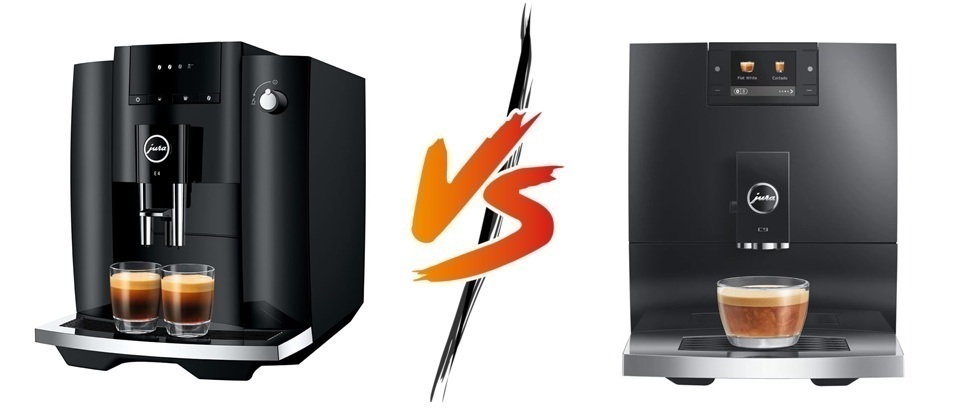
If you’re looking at the Jura E4 and Jura C9, you’re already shopping in a part of the automatic coffee-machine market where expectations are pretty high. Both machines are designed around the same basic idea: put good beans in the hopper, press a button and get consistently good coffee without turning the kitchen into a miniature café.
They approach this idea in distinct ways.
Jura E4 focuses on the basics. It’s a coffee-first machine built around espresso and black coffee, with a minimalist interface and no integrated milk system. Jura says it’s for those who want the essentials, and that’s true. It features a Professional Aroma Grinder, Pulse Extraction Process, eighth-generation brewing unit, and straightforward controls.
Jura C9 is more ambitious, though. It uses the same bean-to-cup idea, but adds a milk system, 2.8-inch color display, and more features like 17 specialty drinks and seven grind settings. It’s also substantially more versatile, offering everything from espresso and coffee to flat whites, cortados, cappuccinos and latte macchiatos.
That makes this less of a conventional “which machine is better?” comparison and more of a question about what kind of coffee drinker you’re.
For black coffee drinkers, the E4 is a good choice. If you want a machine that can handle the whole household’s coffee preferences, the C9 is in another league.
I’ve broken the comparison down into the areas that actually matter when living with a machine every day: design, controls, coffee quality, grinder performance, milk drinks, cleaning, noise and energy use, and finally value.
Jura E4 vs Jura C9 Comparison Chart
If you click the links below, under the product images, you will be redirected to Amazon.com. In case you then decide to buy anything, Amazon.com will pay me a commission. This doesn’t affect the honesty of this review in any way though.
| Specification | Jura E4 | Jura C9 |
|---|---|---|
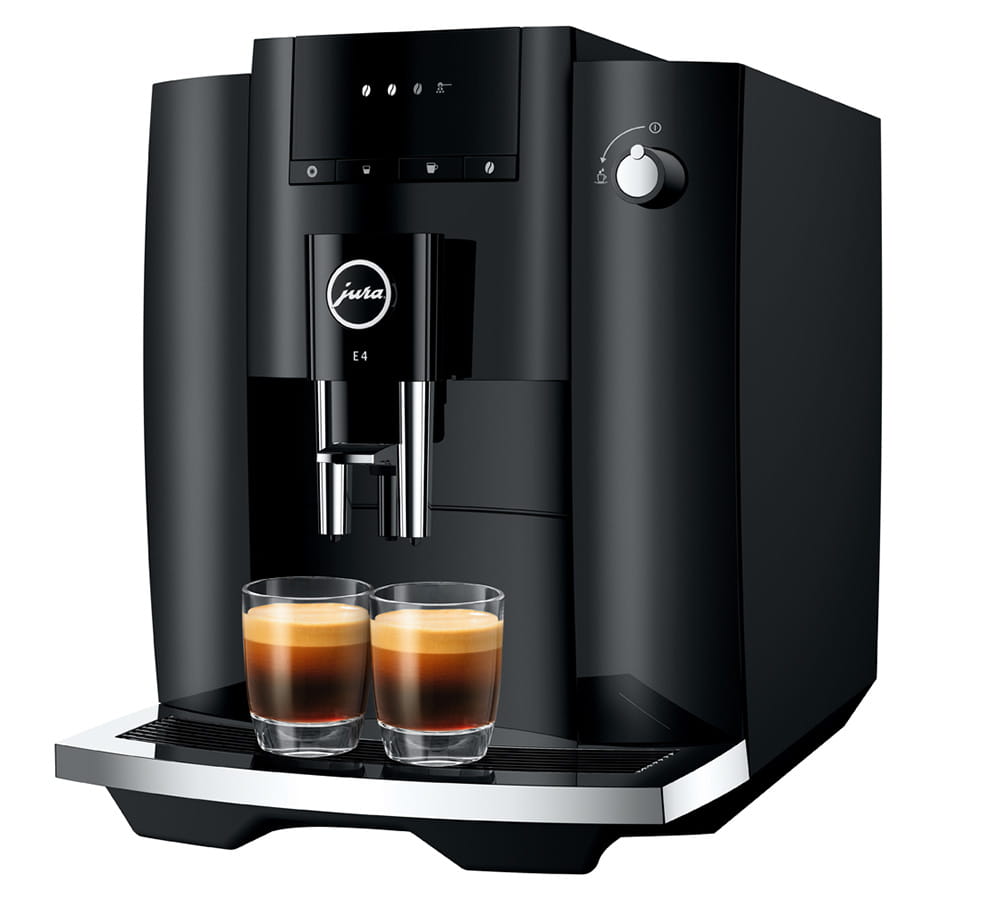 | 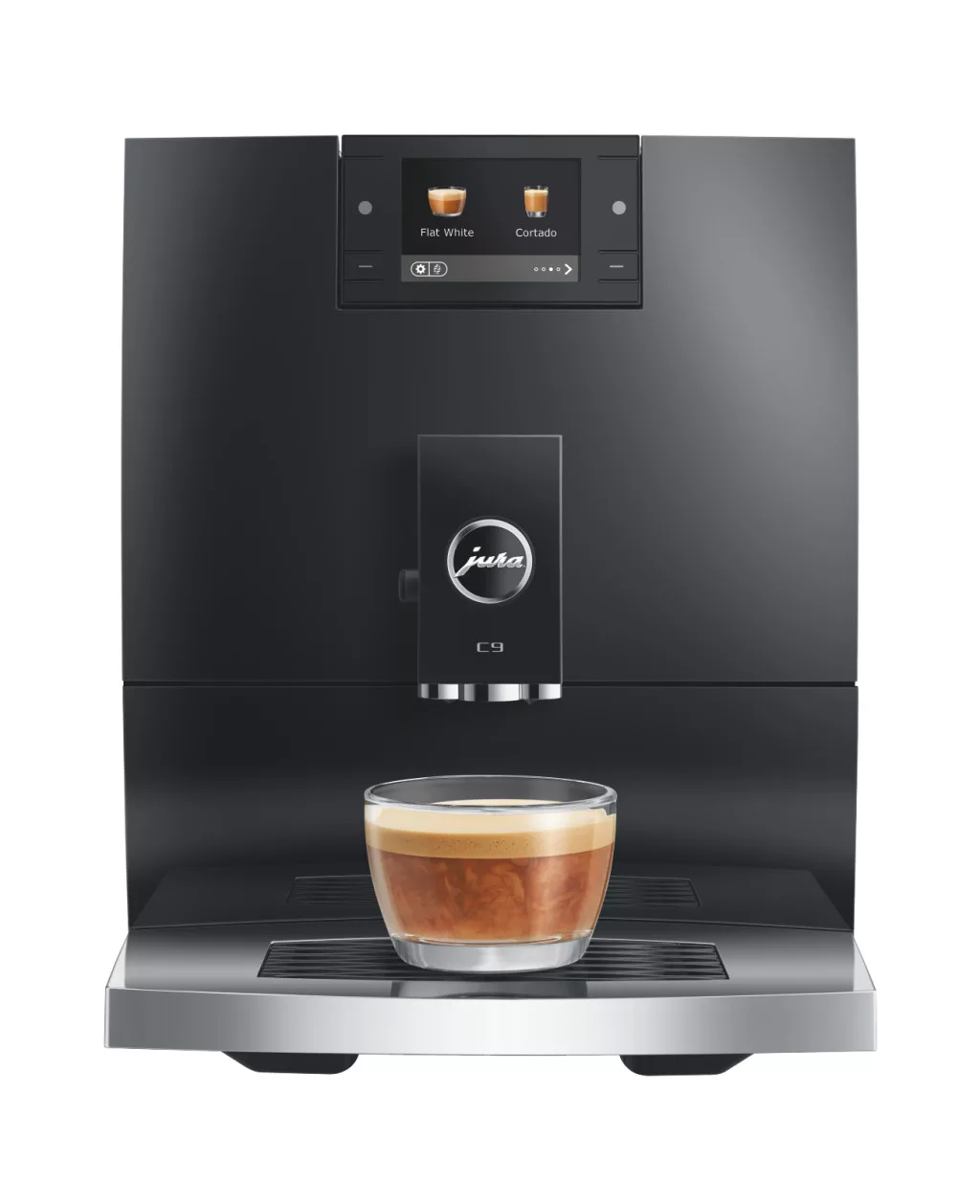 | |
| Click here to check the best price on Amazon | Click here to check the best price on Amazon | |
| Machine type | Automatic bean-to-cup espresso machine | Automatic bean-to-cup espresso machine |
| Primary focus | Espresso and black coffee | Espresso, coffee and specialty milk drinks |
| Professional Aroma Grinder | Yes | Yes |
| Grind settings | Adjustable | 7 |
| Brewing unit | Variable brewing unit | Variable brewing unit |
| Brewing-unit capacity | 5–16 g | 5–16 g |
| Pulse Extraction Process (P.E.P.) | Yes | Yes |
| 3D brewing process | Yes | Yes |
| Light Extraction Process | No | Yes |
| Coffee-strength settings | 3 | 10 |
| Brewing-temperature settings | — | 3 |
| Specialty drinks | Focused selection | 17 |
| Integrated milk system | No | Yes, HP1 |
| Milk spout | — | CX1 interchangeable milk spout |
| Water tank capacity | 1.9 L | 1.6 L |
| Bean hopper capacity | 280 g | 200 g |
| Pre-ground coffee option | Yes | Yes |
| Display | Symbol display | 2.8-inch color display |
| Controls | Physical buttons | Physical buttons with color display |
| J.O.E. / connectivity | Limited | Wi-Fi/J.O.E. support |
| Water filtration | CLEARYL compatible | CLEARYL compatible |
| Automatic cleaning programs | Yes | Yes |
| Automatic milk-system cleaning | Not applicable | Yes |
| Height | Approx. 34.6 cm | Approx. 32.5 cm |
| Width | Approx. 28 cm | Approx. 26 cm |
| Depth | Approx. 44.4 cm | Approx. 43.7 cm |
| Weight | Approx. 9.8 kg | Varies by market/configuration |
| Best suited to | Black-coffee drinkers | Households wanting coffee and milk specialties |
| Main advantage | Simplicity and larger capacities | Versatility and customization |
| Main disadvantage | No integrated milk drinks | More expensive and more maintenance |
| My individual reviews | Jura E4 review |
Quick comparison
| Category | Winner |
|---|---|
| Design & Build Quality | Jura C9 |
| User Interface & Ease of Use | Jura C9 |
| Coffee Quality & Brewing | Jura C9, narrowly |
| Grinder Features & Performance | Jura C9 |
| Milk Frothing & Specialty Drinks | Jura C9 |
| Maintenance & Cleaning | Jura E4 |
| Water/Bean Capacity | Jura E4 |
| Simplicity | Jura E4 |
| Customization | Jura C9 |
| Best for black coffee | Jura E4 |
| Best for milk drinks | Jura C9 |
| Best all-rounder | Jura C9 |
| Best for simplicity | Jura E4 |
Bottom line: The E4 is the more focused machine. It’s the better fit if you mainly drink espresso and black coffee and want a straightforward, relatively low-maintenance experience. The C9 is the more versatile option, with a wider range of drinks, integrated milk preparation and substantially more control over brewing parameters.
Design & Build Quality
Side by side, the Jura E4 and Jura C9 show a family resemblance but they’re not for the same buyer, they’ve a similar look, but they target different buyers. Both look premium and understated, as you’d expect from Jura, and they’re both solid machines that fit well in a home coffee setup. The difference is in the details. The E4 is deliberately minimalist and functional, while the C9 looks more contemporary and polished, with a feature set to match.
Neither machine is designed to disappear into the background. They’re both fairly substantial countertop appliances, and you’ll want to think about where you’re going to put one before buying. At the same time, neither looks excessively bulky once it’s in position. Jura controlled the proportions well, given they contain a grinder, brewing unit, heating system, water reservoir, electronics, and the C9 has a milk system.
Jura E4: minimalist and purposeful
The E4 is the more restrained of the two machines. Its design is built around a fairly simple idea: remove anything that isn’t necessary for making good coffee.
There’s no large touchscreen taking up the front. There isn’t a huge selection of colorful drink icons. Instead, the control panel uses buttons and symbols to keep the interface straightforward. That simplicity gives the E4 a slightly more traditional appearance, it’s not dated though. If anything, it makes the machine look more like a professional coffee appliance than a piece of consumer electronics.
I actually think this is one of the E4’s strongest design decisions.
A lot of modern appliances seem determined to add screens and smart features whether they’re useful or not. The E4 takes the opposite approach. The machine looks as though it was designed around the brewing system first and the user interface second.
The front panel is clean, and the coffee outlet is positioned centrally, making cup placement easy. The overall arrangement is logical. You don’t have to search around the machine to figure out where the important components are.
The E4 is about 28 cm wide, 34.6 cm high and 44.4 cm deep in the U.S. configuration, and it weighs around 9.8 kg. That’s not a small machine, but it’s reasonable for a premium automatic espresso machine with a 1.9-liter water tank and 280-gram bean hopper.
The depth is probably the dimension I’d pay the most attention to. Forty-four centimeters is enough that you need to make sure your countertop has sufficient room, especially if it’s under cabinets. You’ll also need to leave enough space around it to remove and refill the water tank and bean container comfortably.
The E4’s larger water and bean capacities are actually part of its practical design. Jura didn’t make it compact at the expense of convenience. The 280-gram bean container is particularly useful if you’re making several coffees a day. You can fill it up and largely forget about it.
That matters more than it sounds.
One of the annoyances of smaller automatic coffee machines is constantly topping up beans or water. The E4 is designed more like a machine you set up and then use repeatedly throughout the week.
That materials and construction also give the E4 a reassuringly solid feel. This isn’t a lightweight appliance that feels as though it needs to be handled carefully. At roughly 9.8 kg, there’s enough weight that it stays firmly planted when you operate the controls or remove the drip tray.
The machine’s physical presence also contributes to the impression of quality. It feels engineered rather than decorative.
The Jura C9 is a more modern take
The C9 takes a different approach.
It’s still a Jura but it looks more sophisticated and contemporary than the E4. The machine has a convex-concave front design, wave-shaped water tank, and chrome-plated cup platform, giving it more visual character.
From the front, it’s especially noticeable.
The C9 has more visual elements, accommodating its larger color display and more functions, yet it doesn’t look cluttered.
This pretty matters.
The C9 offers 17 specialty drinks; it also has ten coffee-strength settings, seven grind settings, and three brewing-temperature levels. You might expect a machine with that many functions to have a control panel covered in buttons, but it doesn’t. The 2.8-inch color display handles most of the organization.
The C9 is surprisingly compact, given the hardware inside. At about 26 cm wide, 32.5 cm high, and 43.7 cm deep, it’s slightly smaller than the E4 in all dimensions.
That difference isn’t dramatic, but it could be significant if counter space is limited.
It’s interesting that the more feature-rich machine is actually the smaller one. Adding an integrated milk system and color display might seem like it would make the appliance much larger, but Jura kept the C9 relatively compact.
But there’s a trade-off: capacity. The C9’s 1.6-liter water tank and 200-gram bean hopper are smaller than the E4’s.
So design priorities differ slightly.
The E4 offers more capacity in a straightforward design.
The C9 offers more functionality, with a slightly smaller footprint.
Materials and perceived quality
Neither machine feels flimsy.
This matters, given Jura machines’ premium prices. At this level, buyers expect the physical construction to justify at least some of the price, and both machines largely deliver that impression.
The E4’s simplicity gives it a reassuring solidity. There aren’t as many visual elements competing for attention, and the machine feels like one cohesive appliance.
The C9 feels more refined, though. Polished surfaces and styling details make the C9 look more expensive, especially from the front.
That downside of that polished appearance is that it can require a little more attention to keep looking pristine. Glossy surfaces show fingerprints, coffee splashes, and water marks more easily than matte finishes.
This isn’t unique to the C9, but it’s worth considering if you notice fingerprints on appliances.
Water tank and bean hopper design
Placement and accessibility of water and bean containers are important aspects of build quality, often overlooked.
After all, you can have the most beautifully designed espresso machine in the world, but if refilling it’s awkward, you’ll eventually get annoyed.
The E4’s larger capacities make it particularly practical. With a 1.9-liter water tank, you’ll refill less often, and the 280-gram bean container is generous for a home machine.
The C9’s 1.6-liter tank and 200-gram hopper are respectable. They won’t be a major inconvenience in a normal household. However, the E4 has an advantage if you make a lot of coffee daily.
This better design depends on your priorities.
The E4 is designed for capacity and straightforward use.
The C9 is designed for compactness and functionality.
The cup platform and overall ergonomics
Both machines have a conventional layout with the coffee outlet above the cup area and drip tray underneath.
The C9’s chrome-plated cup grille adds visual polish, giving it a premium look. It collects coffee drops, so you’ll need to wipe it regularly to maintain its appearance.
The E4 is more utilitarian.
This isn’t a criticism. The E4’s simpler appearance may appeal to those who prefer functional appliances.
Both machines are ergonomic. Important controls are where you expect them, and you don’t need to reach around the back for normal coffee preparation.
The biggest consideration is ensuring you’ve enough clearance around the machine. Automatic coffee machines need room not only for their footprint but also for removing tanks, emptying grounds and accessing maintenance components.
Which one feels premium?
I’d give the C9 a slight advantage, subjectively.
The E4 feels solid and expensive due to its restraint. The C9 has a more immediate premium effect. The curved front, polished details, and color display make it look sophisticated initially.
However, this doesn’t mean the C9 is dramatically better built.
Both machines are part of the premium Jura ecosystem, with the physical heft and construction you’d expect at this price level.
The E4 may be preferable if you’re concerned about keeping things simple long-term. With fewer external systems and no integrated milk circuit, it has fewer components involved in everyday operation.
A bigger design philosophy
The E4 and C9 represent two different interpretations of what a premium automatic coffee machine should be. And that’s what sets them apart.
The E4 is almost minimalist by design. Jura has taken the approach of focusing the machine on espresso and black coffee and avoiding features that aren’t necessary for that purpose.
That gives it a very coherent identity.
The C9 is more ambitious; it accommodates specialty drinks, milk preparation, more customization, and a more sophisticated interface. So, it feels like a complete coffee station, not just a dedicated black-coffee machine.
One approach isn’t objectively better than the other.
If you mostly drink espresso and coffee, I think the E4’s simplicity is genuinely attractive. There’s something reassuring about buying a machine that concentrates on the drinks you actually consume instead of paying for a long list of features you may never use.
If you have a household with different coffee preferences, though, the C9’s design makes more sense. The C9’s additional functionality is integrated, not tacked on, and the machine stays compact despite its broader capabilities.
Design and build quality verdict
For pure build quality, I’d call the two machines very close. Both machines are substantial and well-designed, with solid construction, as you’d expect from Jura.
The E4 wins for simplicity, practicality and capacity. The E4’s larger water tank and bean hopper make it well suited for people who drink several black coffees a day; its minimalist exterior looks clean and purposeful.
The C9 wins for overall design sophistication. It’s slightly smaller, has a more modern appearance, incorporates a color display without becoming visually overwhelming and manages to pack more functionality into a smaller footprint.
If I were choosing based purely on appearance, I’d take the C9. It looks more modern and has more of that premium “centerpiece appliance” quality.
If I were choosing based purely on practical design, I’d have a harder time dismissing the E4. The E4’s simplicity and larger capacities are useful, particularly for someone with no interest in milk drinks.
So, for this category, my overall winner is the Jura C9, but only by a narrow margin. The E4 isn’t the lesser-built machine. It’s simply the more focused one.
User Interface & Ease of Use
This biggest difference between the Jura E4 and Jura C9 isn’t the coffee-making technology. It’s how you interact with the machine. Both are automatic bean-to-cup espresso machines designed to take much of the work out of preparing coffee but they’ve very different ideas about how much control the user should have.
The Jura E4 has a minimalist approach. It uses a simple button-and-symbol interface. And limits the number of choices. The C9 has a 2.8-inch color display, physical buttons. And more drinks and customization options.
That honestly means the E4 is arguably easier to understand, while the C9 is easier to personalize.
But understanding and personalizing aren’t the same thing. And after living with an automatic espresso machine, I’ve found that the difference can have a surprisingly big effect on how enjoyable the machine is to use every morning.
The Jura E4 is all about simplicity.
The E4’s philosophy is clear from its control panel.
No giant touchscreen here.
No dozens of colorful drink pictures either.
The menus aren’t complicated.
Jura uses a symbol-based display and physical controls for its focused selection of drinks and functions.
For somebody who primarily drinks espresso, coffee or other black coffees, this is a very sensible arrangement.
You don’t need the machine to ask you what kind of milk foam you want if you aren’t making a milk drink. You don’t need an icon for every specialty coffee. You don’t need to scroll through options to find the button for a regular cup of coffee.
You select what you want and the machine does the rest.
This is one of the E4’s strengths.
There’s little friction between wanting coffee and getting it.
Physical controls have an advantage.
The E4’s physical controls also have a practical advantage that can be easy to overlook.
Buttons give tactile feedback.
You can operate the machine without staring at a touchscreen. This is useful in the morning when you’re waking up and don’t want to interact with another screen.
It makes the E4 feel like an appliance, not consumer electronics.
I like that.
Coffee machines don’t need to be designed like smartphones. A good interface should make common tasks easy, and the E4’s physical controls accomplish that without trying to do too much.
The display communicates information and guides you through functions, rather than entertains.
The E4’s limited choices are useful.
The E4 has three coffee-strength levels, according to Jura.
At first, that might sound restrictive compared to the C9’s ten levels. But there’s another way to look at it.
Most people don’t need ten levels.
If you ask someone if they want their coffee weak, medium, or strong, they can answer immediately. If you ask them about level 4, 5, or 6, you’ve introduced a decision that may not add much value.
That’s how the E4 works.
It gives you enough control to personalize your coffee without making it a hobby.
For people who want a dependable morning coffee, that’s a feature, not a limitation.
Setting up the E4.
Initial setup is relatively straightforward, although, like any premium bean-to-cup machine, you should take the time to follow the instructions rather than immediately filling everything and pressing buttons at random.
You’ll need to set up the water system, configure the filter, fill the bean container, and adjust your coffee preferences.
After that, daily operation is simpler.
This is important for automatic espresso machines.
The first day is for learning.
This following days should not.
The E4 makes this transition well because it doesn’t introduce new settings or menus.
Once you’ve found a setting you like, you can leave the machine alone.
Jura C9: a much more sophisticated interface
The C9 takes a very different approach.
It has a 2.8-inch color display combined with physical buttons, giving you a visual interface without relying entirely on touchscreen controls.
This is probably the right decision for a machine with this many functions.
The C9 offers 17 specialty drinks, ten coffee-strength levels, seven grind settings, three brewing-temperature levels and adjustable drink parameters. Without a display, that amount of functionality would become unnecessarily difficult to navigate.
The color screen gives each function a clear visual identity and makes the machine feel more modern.
It also helps you understand what’s happening.
Instead of having to remember what a particular symbol means, you’re presented with recognizable drink options and instructions.
That becomes particularly useful when you start exploring drinks beyond basic espresso and coffee.
More choices, but not necessarily more confusion
There’s a common assumption that adding features automatically makes an appliance harder to use.
That’s not always true.
A well-designed interface can actually make a complicated machine easier to use than a simpler machine with poorly organized controls.
The C9 is a good example.
Yes, there are considerably more choices than on the E4. But the color display gives those choices a logical structure.
You can select a drink, adjust the relevant settings and start the preparation without having to understand how the entire machine works.
That’s an important aspect of good interface design.
You don’t need to know exactly how Jura’s brewing unit works to make a cappuccino.
You don’t need to understand the Light Extraction Process to select a Light Brew.
The machine handles the complicated parts behind the scenes.
Ten coffee-strength levels
This is where the C9 begins to justify its more sophisticated interface.
Ten coffee-strength levels provide significantly more control than the E4’s three.
Whether you’ll actually use all ten is another question.
I suspect most people will settle on one or two preferred settings.
But having the additional range can be useful when you’re experimenting with different beans.
For example, a medium roast might taste best at one setting, while a darker roast could work better at another. Rather than changing beans and accepting whatever strength the machine happens to produce, you have more opportunity to tune the result.
It also works well in a household where people have different preferences.
One person can have a stronger espresso.
Another can have a milder coffee.
The machine doesn’t force everyone into the same setting.
Seven grind settings
The C9 also provides seven grind settings.
This is a more advanced control and one that I think experienced coffee drinkers will appreciate more than complete beginners.
You don’t need to understand grind size to use the C9. The machine will happily make coffee without you touching this setting.
But if you start experimenting with different beans, grind adjustment gives you another way to refine the result.
That’s the difference between the E4 and C9 in a nutshell.
The E4 says, “We’ve already made the important decisions for you.”
The C9 says, “If you want to get involved, here’s some room to experiment.”
Neither philosophy is wrong.
Brewing temperature control
The C9 also offers three brewing-temperature levels.
Again, this isn’t something everyone will need to adjust.
But temperature can have a noticeable effect on how coffee tastes, particularly with different roasting styles.
Giving users three options is a reasonable compromise. You’re not handed an infinitely adjustable temperature scale, but you’re also not locked into one setting.
For someone who enjoys experimenting, it’s another useful tool.
For someone who wants a cup of coffee at seven in the morning and doesn’t care about extraction theory, you can simply leave it at the factory setting.
That’s one of the things I like about the C9’s interface: advanced features are available without requiring you to use them.
Specialty drinks and interface design
The biggest reason the C9 benefits from its display is the sheer number of drinks it can prepare.
Jura lists 17 specialties, including espresso, coffee, double versions, cortado, espresso macchiato, cappuccino, flat white and latte macchiato, as well as Light Brew versions of several drinks and a portion of milk foam.
Trying to manage all of that through a minimalist symbol panel would be unnecessarily complicated.
The C9’s display gives you a much clearer overview.
It’s also helpful when you’re making a drink that you don’t prepare every day.
If you only make a latte macchiato once every few weeks, you don’t want to memorize a complicated button sequence.
You want to look at the machine, find the drink and press the appropriate control.
That’s exactly where the C9 has an advantage.
Personalization versus convenience
A trade-off exists between the two machines.
The E4 is convenient for those whose preferred drink is already supported by its interface.
The C9 is more convenient if your preferences change frequently.
Imagine drinking a strong espresso every morning.
With the E4, you can configure your preferred strength and simply press the button.
With the C9, you can do the same thing, but you have considerably more options available.
This difference matters more if you alternate between drinks.
You might want an espresso on Monday, a cappuccino on Tuesday, and so on.
The C9 handles such routines better.
Connectivity and smart features
The C9 supports connectivity through Jura’s J.O.E. ecosystem and Wi-Fi, depending on the setup.
This adds convenience for those who enjoy controlling their coffee experience through a smartphone.
I wouldn’t buy either machine for app connectivity.
The physical machine is already capable of doing what most people need.
The C9 is a more modern option for someone who enjoys smart-home integration.
The E4 is more like an appliance.
The C9 is closer to a connected coffee system.
Cleaning prompts and maintenance guidance
Another important part is how the machine communicates maintenance.
It’s easy to ignore when comparing specifications, but it becomes important after months of ownership.
Both machines use Jura’s maintenance programs and provide guidance for cleaning and maintenance.
The C9’s display makes instructions easy to follow.
That’s a practical benefit of having a color screen.
Maintenance is less of a guessing game.
The machine can tell you what needs to happen and guide you through the process.
The E4 does this too, but its display provides less information.
Which machine is easier for a beginner?
The E4 has a slight advantage for a beginner.
It’s easier to understand.
You can learn the essential controls quickly, and there aren’t many opportunities to accidentally change something you didn’t intend to change.
The C9 isn’t difficult.
Once you understand the layout, it’s approachable.
The C9 has a higher ceiling.
A beginner can use it.
An enthusiast can explore its settings.
That’s a strong design.
Which machine is better for a household?
I’d choose the C9 without hesitation.
The E4’s simplicity is great in households where everyone drinks the same coffee.
But that’s not how most households work.
One person likes strong coffee, another wants milk, somebody wants a cappuccino, somebody else wants a flat white, and guests want something different.
The C9’s interface is better suited for this situation.
With a wider drink selection, you don’t have to compromise as much.
The downside of the C9 is its interface
The C9 has its flaws.
This main issue is that there’s more to learn.
Ten strength levels can be excessive.
Seven grind settings may be more control than some users need.
Three temperature levels add another variable.
And when you start changing settings, you may wonder if the coffee is really better or if you’re just enjoying the experimentation process.
That’s not a criticism of Jura specifically. It’s a natural result of giving users more control.
There’s also something satisfying about the E4’s restraint that the C9 can’t quite replicate.
With the E4, you can develop a routine and forget about the machine.
The C9 always tempts you to experiment.
For some, that’s what makes it enjoyable.
For others, it’s just unnecessary complexity.
Ease of use
The Jura E4 wins if you think ease of use means “I want to press a button and get my coffee without thinking about it.”
It’s remarkably straightforward. That minimalist controls, limited number of choices and focused drink selection all work together to create an appliance that feels almost effortless once it’s set up.
The C9 wins if your definition of ease of use is “I want the machine to make many drinks without complicating things.”
The color display, physical buttons, and organized menus make the extra features manageable. You get more control without having to become an expert in espresso preparation.
The Jura C9 gets the win because it combines many features with a user-friendly interface.
But the E4 deserves credit for understanding something that many modern appliances forget: sometimes the easiest interface is the one that simply gives you fewer things to think about.
If your daily routine is espresso, coffee, press button, drink, the E4 may actually feel like the more luxurious machine. If you want variety and customization, the C9 is the better choice.
Coffee Quality & Brewing Performance
Coffee quality is what matters most when spending this much on an automatic espresso machine. A machine can have a beautiful exterior, a clever interface and a long list of features but if the espresso tastes flat or the coffee lacks aroma and body, none of those extras matter for very long.
The good news is that both the Jura E4 and Jura C9 are built around a strong brewing platform. Jura hasn’t sacrificed the basics for flashy features in these machines. Both use Jura’s Professional Aroma Grinder, a variable brewing unit, Pulse Extraction Process (P.E.P.). And a 3D brewing process. The C9 also has a newer Light Extraction Process, giving it an extra approach to coffee preparation.
The difference between the two isn’t just about one making good coffee and the other making better coffee. They offer different experiences instead. The E4 focuses on conventional espresso and black coffee, while the C9 offers more choice in coffee extraction and serving.
The Jura E4 is built around black coffee
The E4’s strongest point is that Jura engineered it for the drinks you’ll make most often.
No integrated milk system takes up space or complicates brewing. It’s dedicated to grinding beans, making espresso, and producing black coffee.
This focus makes sense.
A good automatic espresso machine needs to get several things right at the same time. It must grind beans consistently, dose coffee correctly, heat water to the right temperature, force water through coffee at the right pressure, and control extraction to produce a consistent result.
The E4 combines Jura’s Professional Aroma Grinder and Pulse Extraction Process with an eighth-gen brewing unit and 3D brewing tech.
Jura says its Professional Aroma Grinder can produce up to 12.2% more aroma compared with the company’s previous grinder generation. Don’t take that percentage as a guarantee of better-tasting coffee, since beans, freshness, roast level, and settings all impact the taste. It shows the grinder is key to Jura’s approach to extracting flavor from beans.
And that’s something you notice when you use a good automatic machine.
The coffee doesn’t taste like the generic, burnt beverage older bean-to-cup machines produce. With fresh beans and sensible settings, the E4 can produce a cup with plenty of aroma, decent body and a clean finish.
It won’t turn supermarket beans into specialty coffee, but it provides a solid platform for good beans.
Pulse Extraction Process and espresso
Jura’s Pulse Extraction Process, or P.E.P, is one of its signature technologies.
The idea is to improve water introduction during short coffee drink extraction. P.E.P uses pulses for more thorough extraction, rather than forcing one stream of water through the coffee.
This is particularly relevant for espresso in practical terms.
The E4’s espresso has a more concentrated character than typical large automatic coffee. There’s a reasonable balance between intensity and smoothness if the machine is dialed in right.
That’s important because one of the biggest weaknesses of inexpensive automatic machines is that they can produce something that looks like espresso but tastes more like concentrated filter coffee.
The E4 is much better at maintaining espresso character.
That crema is also generally convincing. It may not be as thick and persistent as crema from a high-end semi-automatic setup, but it’s visually appealing and contributes to the overall espresso impression.
More, the E4’s flavor earns its place.
The E4’s variable brewing unit
The E4 uses a variable brewing unit capable of handling between 5 and 16 grams of ground coffee.
This is a big range for a home automatic machine.
Jura can vary the coffee amount based on the selected drink and strength. The machine doesn’t just use the same amount of grounds and change the water amount each time.
This explains why the E4 can produce different results between a small espresso and a large coffee.
Jura’s 3D brewing process is designed for even water movement through coffee grounds.
You don’t need to understand the engineering to appreciate the result. What matters is consistency when drinking the coffee.
Automatic machines shine when it comes to consistency.
You can make coffee on Monday morning and Friday afternoon without remembering the details, like coffee amount, tamping, or extraction time.
The E4 handles those variables.
Black coffee is where the E4 really makes sense
The E4 is good at conventional black coffee.
If you drink espresso, long coffee, or similar black beverages, the E4 doesn’t waste its capabilities on things you don’t need.
This is important when comparing to the C9.
The C9 is more versatile, but its black coffee isn’t dramatically better.
For a person who drinks nothing but espresso and coffee, the E4 can actually feel like the more logical purchase.
It focuses on the core job.
Bean quality is important
Neither machine can overcome poor coffee beans, it’s worth noting.
This is probably the single most important point to remember when evaluating automatic espresso machines.
Using stale, over-roasted beans in a $200 machine will be disappointing.
Put fresh, properly roasted beans into a well-adjusted Jura E4 and the difference can be substantial.
The E4’s grinder and brewing system provide a good foundation, but the hopper’s contents still determine the cup’s quality.
Freshness matters because coffee loses aromatic compounds over time. This machine can extract what’s available in the beans, but it can’t create flavors that have already disappeared.
This is relevant for the E4, which has a large 280-gram hopper.
As a low-volume drinker, you might not want to fill the hopper and leave the beans for weeks.
The capacity is excellent for convenience, but freshness should still take priority.
Jura C9 takes a broader approach to extraction
Much of the E4’s brewing DNA is shared by the C9, and it takes this a step further.
That machine use the Professional Aroma Grinder. And P.E.P., which is a variable brewing unit that can handle 5, 16 grams. And it also features 3D brewing technology. It’s this combination, along with Jura’s Light Extraction Process, that sets it apart.
From a coffee perspective, the difference between the two machines is arguably the most interesting one.
Light Brew isn’t just a watered-down version of regular coffee.
Jura designed this process to yield a lighter and more aromatic cup, making it easier to drink.
The C9 can essentially point you in two different directions to explore.
A conventional coffee can be prepared for a more intense experience with body and punch when desired.
You can also go for Light Brew if you’re looking for a lighter option.
This distinction is genuinely useful.
Modern coffee preferences. And Light Brew
Tastes in coffee have undergone big changes over time.
Some people will always prefer a strong espresso to start their day, it’s their go-to morning pick-me-up. But many are also developing a taste for lighter roasts, which bring out more subtle flavors and nuances that might get lost in darker roasts, allowing individual aromas to shine through.
Those looking for what the C9 offers will find it’s better suited to their needs.
The Light Extraction Process offers an alternative approach to the beans, and Jura incorporates this process into a variety of drinks.
Not every coffee is better as a Light Brew.
Traditional extraction intensity is beneficial for certain beans.
Treated with more gentleness, others may become more interesting.
What matters is having a choice.
I’d choose the C9 for someone who likes trying different beans, and that’s one reason why.
The C9 also benefits from grind adjustment
The C9 has seven grind settings.
Grind size matters a lot because it greatly affects extraction.
Water can pass through the coffee too quickly and produce a weak or under-extracted result if the grind is too coarse.
Extraction can slow down too much if it’s too fine, and this may also create harsh or bitter flavors.
The E4 manages this relationship more automatically, giving you less reason to adjust it.
More control is what the C9 gives you.
Seven settings don’t transform the C9 into a professional espresso setup, it’s still a fully automatic machine with its own limitations.
Changing beans and adjusting the machine is easier with more room to do so.
For instance, a lighter roast may behave differently than a darker roast.
Being able to adjust the grind gives you another tool for finding a balance.
There are ten coffee-strength levels
Strength adjustment on the C9 goes much further than it does on the E4.
The E4 has three coffee-strength levels, but the C9 provides ten.
Experimenting with it reveals that this feature isn’t as excessive as it initially sounds.
You probably won’t use all ten.
A preferred range is usually settled on by most people.
That range makes it easier to find the exact intensity you like.
Households with different tastes can also benefit from this, making the machine more suitable for them.
Coffee tastes vary greatly; one person’s mild coffee is another’s weak brew, and they prefer a much stronger cup.
Compromise isn’t required.
Temperature control
You get three brewing-temperature levels with the C9.
Coffee enthusiasts find it useful to have some control over temperature, as it can influence extraction and the perceived flavor.
Most owners won’t adjust the temperature every morning, I don’t think.
You’ll probably find one setting you prefer and leave it there.
Experimenting with different beans is where having options really matters.
One of the recurring themes of the C9 is this.
Almost every individual feature is optional.
Not all controls need to be used.
They’re available if you want them.
Comparing espresso directly
Don’t expect the C9 to make better espresso than the E4, the difference may not be dramatic.
They both use P.E.P. and have the same general brewing architecture.
Both have the Professional Aroma Grinder.
They both use a variable brewing unit that’s 5, 16 grams.
They’re designed around consistent automatic extraction.
The E4’s espresso doesn’t become inferior just because the C9 has more technology and control.
If I were handed an espresso from each machine without knowing which one it came from, I wouldn’t think the difference would be that noticeable, and most drinkers wouldn’t be able to tell them apart right away.
Settings and beans can make a pretty big difference too.
Changing drinks and brewing styles really shows the C9’s advantage.
Double coffee and larger drinks
Machines also handle larger servings differently than traditional espresso.
Jura’s brewing system has a useful feature, it prepares two coffees at once through separate brewing cycles. This sort of means it doesn’t just take one larger dose and split it, rather it makes each drink individually.
Maintaining reasonable extraction is key when preparing multiple cups and that’s what it does.
The variable brewing unit is important and this shows why.
Machines must balance convenience and extraction quality. Adding more water to a small dose does not necessarily mean a larger coffee will be properly balanced.
Jura’s approach is more sophisticated than that.
Consistency is the real strength
Repeatability is another aspect of coffee quality that deserves attention.
With a good grinder and machine, a skilled barista can obviously produce an exceptional espresso.
That result won’t happen every time for most people.
The Jura E4 and C9 are particularly strong in this respect.
With your settings in place, making coffee becomes a straightforward process that requires minimal adjustments each time.
Drinking coffee daily makes that valuable.
No need to wake up and calibrate the machine.
Weighing your beans isn’t necessary.
You don’t have to adjust the dose.
You don’t have to tamp.
The process is automated, so there’s no need to time the extraction manually.
That’s all handled by the machine.
Where the E4 actually has an advantage
The E4’s simplicity can help with consistency too.
Because there are fewer settings, there’s less temptation to constantly change things.
You can find a good configuration and stick with it.
That might sound trivial, but it’s surprisingly useful.
I’ve found that too much adjustability can sometimes encourage people to chase a theoretical “perfect” cup instead of simply enjoying a very good one.
The E4 doesn’t invite that behavior to the same degree.
It’s more of a set-it-and-use-it machine.
Where the C9 clearly wins
The C9 wins when you want coffee variety.
Its Light Brew function, ten strength levels, seven grind settings and three temperature levels give it substantially more room for experimentation.
It also makes a wider range of specialty drinks, although milk preparation is a separate consideration.
If you’re the kind of person who buys different beans and wants to see how they respond to different settings, the C9 is clearly more interesting.
It’s the machine I’d choose for a coffee enthusiast who wants automation but doesn’t want to give up all control.
Brewing performance in everyday use
In everyday use, both machines are ultimately about convenience without giving up too much coffee quality.
The E4 feels particularly convincing when you’re making black coffee repeatedly throughout the day.
It’s fast, consistent and focused.
The C9 is more enjoyable if your coffee routine changes frequently.
You can move between a traditional espresso, a regular coffee and a Light Brew without having to rethink the entire setup.
That versatility is its strongest brewing argument.
Which one produces better coffee?
If we’re talking strictly about traditional espresso and black coffee, I’d call this much closer than the price difference might suggest.
The E4 is a very capable coffee machine.
Its grinder, brewing unit, P.E.P. technology and 3D brewing process give it everything it needs to produce excellent results for its intended audience.
The C9 is more sophisticated, but its main advantage is not that it suddenly makes the E4’s coffee taste bad by comparison.
Its advantage is that it gives you more ways to make good coffee.
That distinction matters.
If you drink the same espresso every morning, you may never appreciate much of the C9’s additional brewing flexibility.
If you like changing beans, experimenting with intensity and exploring lighter styles, the C9 becomes much more compelling.
Coffee Quality & Brewing Performance verdict
For pure black-coffee performance, the Jura E4 is remarkably competitive with the C9.
It’s focused, consistent and equipped with the core Jura technologies that matter most for espresso and coffee. If those are the only drinks you care about, I wouldn’t pay a premium simply because the C9 has a longer list of features.
The Jura C9 wins overall, however, because it adds meaningful brewing flexibility rather than merely cosmetic extras. The Light Extraction Process, seven grind settings, ten strength levels and three temperature settings give experienced users more opportunity to tailor their coffee.
My choice would therefore depend entirely on the drinker.
If you want excellent, consistent espresso and black coffee with minimal experimentation, I’d choose the E4.
If you want excellent coffee plus the ability to explore different extraction styles, beans, strengths and temperatures, I’d choose the C9.
In other words, the E4 is the better specialist, while the C9 is the better all-round brewing platform. Neither machine is a bad choice, and the gap in actual cup quality is considerably smaller than the gap in features might suggest.
Milk Frothing & Specialty Drinks
The Jura E4 and Jura C9 are separated by a very clear dividing line in this category. The E4 is really a black-coffee machine, while the C9 is designed to be a much more complete specialty-coffee system. For those who regularly drink cappuccinos, flat whites and latte macchiatos, the C9’s integrated milk system changes the ownership experience.
The E4 isn’t deficient, though. Quite the opposite. That lack of an integrated milk system is a deliberate design choice for the E4. Jura has built the E4 around espresso and coffee and left milk preparation out so that the machine can concentrate on those drinks.
In contrast, the C9 takes a different approach. The C9 has an automatic milk system, offers 17 specialty drinks, and allows you to prepare conventional and Light Brew versions of several milk-based coffees.
This makes the C9 much more versatile for the right user.
Jura E4: deliberately focused on black coffee
The first thing to understand about the E4 is that it isn’t trying to compete with the C9 on milk drinks.
No integrated milk circuit is present.
The E4 doesn’t have an automatic cappuccino program.
No built-in latte macchiato sequence exists.
The E4 focuses on espresso, coffee, and other black-coffee preparations instead.
This is actually a benefit for someone who doesn’t drink milk coffee.
While milk systems add convenience, they also add complexity. Since milk contains fats and proteins that can leave residue in tubing and connectors, a machine with an automatic milk system requires more cleaning and maintenance.
If you don’t drink milk drinks, why would you want that extra hardware?
The E4 completely avoids this problem.
You can still make milk-based drinks, though. You could use a separate milk frother or prepare the milk manually, then combine it with the coffee produced by the E4.
However, the machine itself doesn’t handle the entire process.
This distinction sort of matters.
If you’re the kind of person who occasionally adds a splash of milk to coffee, this probably won’t bother you at all.
But it will if you make two cappuccinos every morning.
The E4’s approach makes sense, especially for espresso purists
There’s something appealing about the E4’s focused design if your coffee preferences are traditional.
Your daily routine might include an espresso in the morning, a couple of coffees during the day, and an Americano in the afternoon.
An automatic milk system isn’t necessary.
Having one could be more trouble than it’s worth, in fact.
The E4 provides a clean and uncomplicated workflow. Coffee is prepared automatically, and you can add milk separately if desired.
This is useful for those who prefer controlling milk themselves.
A separate milk frother or manual steaming method can give you control over milk temperature and texture that a fully automatic machine can’t completely replicate.
The E4 isn’t necessarily wrong for milk drinkers, though.
It’s a machine for those who don’t need integrated milk preparation in their coffee-making process.
The Jura C9 is a different proposition
The C9 changes the equation by incorporating Jura’s HP1 milk system with its CX1 interchangeable milk spout.
This enables automatic preparation of milk-based drinks.
This is one of the most big practical differences between the two machines.
Rather than preparing coffee. And frothing milk separately, the C9 coordinates the coffee and milk components as part of one automated recipe.
That’s a big deal on busy mornings.
Select your drink.
It grinds the beans.
Then it prepares the coffee. And it adds the right amount of milk or milk foam.
The drink is then ready to serve.
That’s exactly what people generally expect when they buy a premium super-automatic espresso machine.
17 specialty drinks are available
The C9’s drink selection is one of its biggest selling points.
These include espresso, coffee, double versions, cortado, espresso macchiato, cappuccino, flat white, latte macchiato. And milk foam.
Several of these drinks can also be prepared using the C9’s Light Brew approach.
This gives the C9 more range than the E4.
It’s not just about having three or four milk drinks.
The menu is broad, covering many coffees people order at cafes.
For a household with different preferences, this can be extremely useful.
One person might want a cappuccino.
Another might prefer a flat white, and.
Someone else may want a latte macchiato.
A guest might simply want an espresso.
The C9 can handle all these requests without separate equipment.
Cappuccino quality
Cappuccino is probably the drink that best show the advantage of the C9’s milk system.
A good cappuccino requires a balance of espresso, steamed milk, and milk foam.
The C9 handles this sequence automatically.
The major advantage isn’t necessarily that the machine can produce foam that matches the very best café barista. A skilled barista with a commercial steam wand has more control over milk texture, temperature, and presentation.
The advantage is that it’s consistent.
With your preferred settings, you can make the same drink repeatedly.
That’s particularly useful in the morning when you don’t want to spend time manually steaming milk.
For home users, convenience can outweigh the loss of manual control.
Flat whites
The C9’s integrated milk system makes sense for flat whites.
A flat white relies on a relatively smooth combination of espresso and finely textured milk rather than the larger, airier foam associated with some cappuccinos.
The C9 can prepare a flat white automatically, which basically means you don’t need to manually judge the amount of milk or foam every time.
This is useful for those who prefer milk drinks without the milk overpowering the coffee.
The ability to adjust milk and milk-foam quantities also gives you some room to tailor the balance.
You can work toward a more coffee-forward flat white if you prefer.
If you like a softer drink, you can adjust in the opposite direction.
Latte macchiatos
The C9 is strong with latte macchiatos.
Presentation matters for latte macchiatos, with their distinct layers of milk, espresso, and foam.
The C9 handles latte macchiatos automatically, making it more convenient than manual preparation.
You won’t have a barista’s control over presentation, but the C9 consistently reproduces the basic structure.
That’s enough for most home users.
Serving guests is also convenient, as you can produce several specialty drinks at the press of a button.
Cortado and espresso macchiato
The C9 also goes beyond the most familiar milk drinks.
Cortado and espresso macchiato are both useful options for people who want some milk without turning their espresso into a large, milk-heavy drink.
The C9’s broad drink selection is meaningful here.
A machine with only cappuccino and latte doesn’t offer flexibility for smaller milk drinks.
The C9 offers more choices.
This makes the C9 better for those who enjoy exploring coffee styles.
Light Brew is a game-changer
One of the most interesting things about the C9 is that some of its milk drinks can also be prepared using Light Brew.
This pretty means you’re not limited to conventional brewing.
You can combine the lighter profile with drinks like cappuccino, flat white, cortado, and latte macchiato.
This creates many combinations.
You might have a conventional cappuccino one day, and a Light Brew cappuccino the next.
The difference may not be dramatic with every bean, but it adds another dimension to explore.
It’s a feature that makes more sense once you start thinking about the C9 as a complete coffee system rather than simply an espresso machine with a milk frother attached.
Milk texture has limits when it comes to automation.
We’re better off being realistic about automatic milk frothing.
Milk is largely under a barista’s control.
They control the amount of air in the milk, change the foam’s texture. And adjust the temperature precisely. And the way the milk is poured also affects the final drink.
Manual control isn’t something an automatic system can provide to the same degree.
The goal of the C9 differs.
This goal is a repeatable process.
That’s a fair trade for using it at home.
Buying a C9 for daily latte art practice isn’t the best choice, it’s not the ideal tool.
For those who want a cappuccino before work without the hassle of steaming milk at the counter, this is a more appealing option.
Convenience is the real advantage
What matters most with the C9’s milk system isn’t just the foam quality itself.
That’s what it’s, convenience.
A difference in workflow exists.
To use the E4, it’s necessary to prepare your coffee, then heat and froth the milk separately, after which you combine them, and also clean the separate milk equipment.
The machine handles the complete sequence with the C9.
This reduces the number of things to think about. And also saves time.
It’s small, the difference, over one coffee.
It becomes big after several hundred coffees.
Cleaning the milk system
That convenience comes at a cost.
Milk systems need cleaning.
I wouldn’t consider this optional.
Milk residue builds up in the milk lines, spout, and connectors, and this affects hygiene and drink quality over time.
Jura offers cleaning procedures and supplies specifically for the milk system in machines like the C9.
The process is relatively straightforward with the C9’s automatic cleaning programs, and it still needs to be done.
Maintenance differs most between these two machines.
The E4 lacks an integrated milk system, which means it doesn’t come with extra cleaning tasks and that’s a benefit, it also means there’s less to worry
The C9 does.
Drinking milk drinks daily means cleaning is just part of having them.
Not drinking milk drinks makes the extra maintenance hard to justify.
CX1 milk spout
The C9 features an interchangeable milk spout, specifically the CX1 type.
Being able to swap out the spout is a big plus for hygiene, since it can be taken out and cleaned, rather than being a part of the machine you can’t get to.
Milk equipment should be like this.
Direct contact with milk requires that equipment be easy to maintain.
The key point here is the C9 doesn’t get rid of milk-system maintenance altogether.
Milk preparation is easier with it.
Two different things are involved here.
Milk drinks are popular with families
A household is where the C9 makes the most sense.
Two coffee drinkers have completely different preferences.
Espresso is drunk by one.
The other person drinks cappuccino.
You’ll probably need a separate milk frother with the E4.
The C9 can handle both preferences at the same time, it’s one machine that does the job.
When children or guests who prefer milder, milkier drinks are included, the advantage is even clearer.
The higher price of the C9 begins to be justified at this point.
Buying a more expensive espresso machine isn’t the only thing you’re doing.
This integrated system replaces multiple steps in coffee preparation with one process.
The E4 can still be the better choice
Not every coffee drinker needs the C9, despite its many features.
For dedicated black-coffee drinkers, the E4 is the smarter choice, it turns out.
You’re probably not going to use every feature of a milk system, so why pay for it?
You might wonder why cleaning milk lines matters if you don’t even drink milk.
You only want espresso and coffee, so why navigate 17 drink choices?
Simplicity is what makes the E4 strong in this situation.
It focuses on what matters, and that’s what makes it useful; it’s not about doing more, but rather doing what’s directly relevant to your needs.
Specialty drinks and customization
More control over the drinks is also provided by the C9.
Adjusting parameters such as coffee strength, coffee quantity, and those related to milk allows for deviation from the standard factory recipe.
There isn’t really one universal cappuccino, which makes this useful.
A strong espresso base with just a little milk is what some people prefer.
Some people prefer a much larger milk drink.
Foam thickness is what some people want, preferably a thick layer.
Some people prefer foam that’s smoother and thinner.
The C9 doesn’t offer infinite control like a manual setup, but you can adjust it enough to make the machine yours.
Speed matters, and so does convenience
Speed is also a benefit of automatic milk preparation.
Making a specialty drink manually involves several steps.
Grind.
Brew.
Milk needs to be heated.
Milk needs to be frothed.
Combine things.
Clean.
The C9 basically puts all those steps into a single automated process.
That doesn’t mean it makes the drink instantly. It still takes time to prepare the espresso and milk.
Your active effort is minimal.
One key benefit of a super-automatic machine is that it offers this advantage.
For entertainment, which machine comes out on top?
The C9 wins easily.
When guests arrive and they all want different things, using the E4 becomes awkward.
Making great coffee for a group is definitely possible, and it’s relatively straightforward, but things get more complicated when you start making milk drinks, as that requires extra equipment and more preparation.
Entertainment is where the C9 truly shines and it’s much better suited to that.
It’s possible to offer guests various drinks without having to be in charge of making them all night.
You don’t realize how much you need convenience until it’s necessary.
Having a lot of drinks has its downsides
One potential disadvantage to the C9’s menu is that it’s extensive.
Choice isn’t always better, more of it doesn’t necessarily mean a better outcome.
Some people know exactly what they like, and 17 specialty drinks can feel like too many options.
You will likely use three or four regularly and the rest will probably be ignored.
Not necessarily a problem though.
You don’t have to use every feature on the machine.
When you want them, the more drinks are available.
E4 versus C9 for milk quality
If we’re comparing the machines purely on milk-drink capability, the C9 wins decisively because the E4 doesn’t have integrated milk preparation.
Generally, when it comes to absolute milk quality, a skilled human barista is tough to beat, and neither automatic system is likely to come out on top.
Consistency and convenience are the C9’s strong suits.
You don’t need to develop steaming skills and it can still produce a repeatable milk drink.
That’s the point for most home users.
The Verdict on Milk Frothing. And Specialty Drinks
This category is the easiest in the entire Jura E4 versus C9 comparison to make a decision on.
The Jura C9 wins with a big advantage.
The E4’s design is deliberate it doesn’t have an integrated milk system, which makes it a great choice for those who mainly drink espresso and black coffee but less convenient for regular drinkers of cappuccinos, flat whites, or lattes.
The C9, meanwhile, gives you an integrated HP1 milk system, a CX1 milk spout, 17 specialty drinks, and multiple Light Brew options. This turns the machine into a more complete home café.
Maintenance is an important consideration. The C9’s milk system requires regular cleaning, and the E4 doesn’t have this responsibility. If you don’t drink milk coffee, the E4’s simpler design can actually be an advantage.
But for anyone who drinks milk-based coffee regularly, the decision is straightforward.
If espresso and black coffee are all you drink, the E4 is a good choice and you’ll enjoy its simplicity.
If you want cappuccino, flat white, latte macchiato, cortado, espresso macchiato, and other specialty drinks at the touch of a button, the C9 is the better machine.
The E4 gives you a great coffee machine.
The C9 is a more complete coffee-drink system.
Maintenance & Cleaning
Comparing espresso machines often overlooks maintenance. It’s much more exciting to talk about grinders, brewing technology and cappuccinos than it is to discuss cleaning tablets, water filters and emptying drip trays.
As you own a bean-to-cup machine, maintenance becomes crucial to your ongoing enjoyment.
Excellent coffee from a machine with a frustrating cleaning routine can be a chore. The Jura E4 and Jura C9 automate much of the maintenance process, fortunately. Jura’s machines have built-in cleaning programs. So you don’t need to dismantle them weekly.
The E4’s maintenance is simpler because it lacks an integrated milk system. The C9’s additional drinks and automatic milk preparation require more attention.
So while both machines are relatively easy to maintain compared with many manual espresso setups, the E4 is the simpler machine to live with.
Maintenance matters
Coffee machines create residue from several sources.
Components accumulate coffee oils.
Fine coffee particles can accumulate.
Water creates mineral deposits.
Milk introduces fats and proteins that can spoil if they’re allowed to remain in the system.
Maintenance is crucial because the machine can still produce coffee when it needs cleaning. Don’t wait for bad-tasting coffee or machine complaints to deal with maintenance.
Regular maintenance protects coffee quality, hygiene, and the machine.
This is true for expensive machines like the E4 or C9. Neglecting maintenance after spending a lot on the machine is a false economy.
The E4 is easier to maintain
The E4 has a significant advantage from the beginning because it doesn’t have an integrated milk system.
This eliminates one cleaning category.
No milk tubing needs flushing after a cappuccino.
No milk spout needs cleaning.
No milk residue sits in connectors.
No dedicated milk-system cleaning cycle is needed.
For someone who only drinks black coffee, this makes the E4 exceptionally appealing.
Maintenance revolves around the coffee machine: water, grounds, drip tray, brewing system, cleaning, and descaling.
It’s regular work, but more straightforward than maintaining a coffee and milk machine.
Water filtration is important
Water quality is another important consideration.
Minerals in tap water can accumulate inside coffee machines over time, creating limescale.
This can affect the heating system and water pathways, and excessive mineral buildup can eventually interfere with performance.
Jura’s machines can be used with Jura’s CLEARYL water filters.
Using the appropriate filter can reduce the amount of mineral buildup and, depending on your water quality and usage, reduce the frequency with which you need to descale the machine.
This important point is that the filter isn’t something you install once and forget about forever.
It needs to be replaced according to the machine’s instructions.
The machine’s prompts help, a benefit of premium machines.
The E4’s water system
The E4’s system detects installed filters.
That means the machine can keep track of the filter and provide appropriate prompts rather than leaving you to remember everything manually.
This feature affects ownership experience.
Good maintenance isn’t just about making cleaning physically easy.
It’s also about not forgetting.
If the machine can tell you when something needs attention, you’re less likely to overlook it.
Cleaning the coffee system
The E4’s coffee system has an integrated cleaning program.
Use the right cleaning product and follow the on-screen process when the machine indicates cleaning is necessary.
The machine runs the cleaning cycle automatically.
This is considerably easier than maintaining a traditional espresso machine, where you may have to manually backflush the group head, remove screens, scrub components and deal with coffee oils yourself.
The E4 automates much of the cleaning process, but not all of it.
This is important to note.
You still need to supply the cleaning tablet and follow instructions.
You don’t have to do the mechanical cleaning.
Emptying the grounds container
One of the simplest but most frequent maintenance tasks is emptying the coffee grounds container.
Used grounds need to be discarded after each coffee preparation.
The E4 stores grounds in an internal container that needs periodic emptying.
How often you need to do this depends entirely on how much coffee you drink.
One or two daily coffees won’t be a constant issue.
For a family making coffee throughout the day, you’ll obviously empty it more frequently.
It becomes part of the routine.
When you refill the water or wipe the machine down, you can check the grounds container at the same time.
Drip tray care
The drip tray needs regular emptying.
Machines collect residual water from rinsing, spills, and overflow.
The tray isn’t something you should allow to sit full indefinitely.
It’s simple to remove, empty, and rinse, but it requires hands-on maintenance.
None of this is difficult.
Consistency is key.
Cleaning the outlet
The outlet needs attention.
Coffee can splash or leave residue around the spouts, especially with many drinks.
A quick wipe with a damp cloth is usually enough.
It takes seconds and prevents coffee accumulation.
It’s the sort of maintenance that doesn’t appear in a specification sheet but makes a noticeable difference to how clean the machine looks after months of use.
Jura C9: more cleaning. Because it does more
The C9 has the same philosophy. But its milk system adds more maintenance demands.
That’s the main difference.
The machine’s automatic milk preparation is extremely convenient, but milk is considerably more demanding to clean than coffee.
After making a milk drink, you need to think about the milk system.
That doesn’t mean you’ve to dismantle the machine every time.
Jura provides automatic milk-system rinsing and dedicated cleaning procedures.
And the owner needs to be involved too.
Cleaning the milk system
The milk system needs the most care with a C9.
Milk residue can build up in the milk system if it isn’t cleaned properly.
It’s not just about keeping the machine working.
Hygiene is a concern too.
Milk residue can breed microorganisms, and old milk in the machine isn’t good.
The C9 has automated cleaning for the milk system.
You’ll need the appropriate Jura milk-system cleaning products, and you should follow the recommended cleaning schedule.
It’s not as complicated as it sounds.
The machine handles most of it.
You start it, provide cleaning solution when needed, and clean the parts that come off.
The CX1 spout
The CX1 spout is useful for maintenance on the C9.
Milk-contact components need to be accessible.
If it couldn’t be taken apart, it would be harder to keep clean.
With the removable spout, you can clean the parts instead of relying on the automatic rinse.
Follow Jura’s instructions; don’t just rely on a quick rinse.
How often should the C9 be cleaned?
There isn’t one universal schedule because maintenance frequency depends on usage.
If you make one cappuccino every few days, that’s different from a household making six milk drinks daily.
That machine tracks use and reminds you when to run cleaning programs.
That helps since you don’t need to track intervals.
Just respond to the prompts.
Ignoring them defeats the purpose of automation.
Descaling the machine
Descaling is important for long-term care, filter or not.
Limescale can build up inside the water system, particularly in areas with hard water.
The C9, like the E4, guides you through maintenance when needed.
The machine does most of the work again.
Add the descaling solution, follow instructions, and let the machine run.
It takes time, but you don’t have to clean the internal water paths manually.
Filter versus descaling
Water filtration and descaling aren’t the same.
A good filter reduces minerals entering the machine.
Descaling removes accumulated mineral deposits.
Using a filter can therefore reduce the amount of scale that develops, but you shouldn’t assume that filtration means the machine will never require descaling.
Requirements depend on the machine’s settings, filter use, and water conditions.
In areas with very hard water, follow the machine’s maintenance recommendations closely.
Tablets for cleaning
The E4 and C9 use cleaning tablets in their automated systems.
They help remove coffee oils and residue from the coffee path inside.
Don’t skip this.
Coffee oils improve taste, but old oils don’t help the next cup.
Residue can cause stale or bad flavors over time.
Regular cleaning keeps the brewing path in good condition.
The brewing unit
One of the advantages of Jura’s design is that the brewing system isn’t something you’re expected to remove and wash by hand every few days.
Jura’s approach is different from some other automatic machines that give users direct access to a removable brewing group.
Instead, the machine’s automated cleaning cycles are designed to maintain the internal brewing system.
This creates a much cleaner exterior ownership experience.
You don’t need to pull out a large, wet brewing unit and wash it in the kitchen sink.
Some people prefer removable brewing groups because they like having direct physical access.
Others prefer Jura’s approach because they don’t want to think about the brewing unit at all.
It’s really a matter of philosophy.
Which machine is easier to keep clean?
The E4 wins.
There’s simply less to clean.
The absence of an integrated milk system removes the most maintenance-intensive part of the C9.
The E4 still needs regular cleaning, descaling or filter management and emptying of the grounds container and drip tray.
But these tasks are relatively predictable.
The C9 adds milk-system care to that list.
If you’re already making several milk drinks a day, the additional work isn’t particularly burdensome.
But if you don’t drink milk drinks, there’s no reason to take it on.
Everyday cleaning routine
For either machine, I’d recommend thinking about maintenance in two categories.
There’s the 30-second stuff.
Wipe the coffee outlet.
Empty the drip tray when needed.
Check the grounds container.
Clean up any splashes.
Then there’s the scheduled stuff.
Replace the water filter.
Run the cleaning program.
Clean the milk system on the C9.
Descale when the machine tells you to.
The first category should become part of your daily routine.
The second category is largely handled by the machine’s reminders.
This makes ownership much easier than it sounds when you first read the maintenance instructions.
Cleaning convenience versus manual espresso machines
It’s also worth putting the maintenance requirements into perspective.
If you’re comparing the E4 or C9 with a traditional espresso machine and separate grinder, the Jura machines can be significantly easier to maintain in everyday use.
A manual setup might require you to clean the portafilter and basket after every use, purge and wipe the steam wand, backflush the machine, clean the group head and empty the drip tray.
You also have a grinder to maintain.
The Jura automates much of this.
That doesn’t mean zero maintenance.
It means the machine turns maintenance into a series of guided routines rather than something you have to manage manually every day.
Long-term reliability and maintenance
Regular maintenance also has a direct relationship with reliability.
A coffee machine that is constantly exposed to coffee oils, moisture and mineral deposits isn’t going to perform at its best if those materials are allowed to accumulate.
Keeping the water system properly maintained helps protect the machine’s internal components.
Keeping the coffee system clean helps preserve flavor.
Keeping the milk system clean on the C9 protects both hygiene and drink quality.
It’s tempting to think of cleaning as something you’re doing for the machine.
You’re actually doing it for the coffee too.
The C9’s additional complexity
The C9’s greater number of components doesn’t automatically make it unreliable.
But it does mean there are more things to look after.
The integrated milk system has tubing and connectors.
The milk spout needs attention.
There are more drink pathways involved.
That doesn’t make the C9 a bad ownership proposition.
It’s simply the natural consequence of having more functionality.
It’s similar to owning a car with more features. More features can make the car more enjoyable, but they also mean more systems exist that need to be maintained.
Which machine is better for low-maintenance ownership?
The E4 is the clear winner.
If you want to minimize the amount of cleaning you have to think about, the E4’s black-coffee focus is hard to beat.
There are no milk components.
The coffee system is automated.
The machine guides you through its maintenance programs.
You still have to empty the tray and grounds container and keep the exterior clean, but that’s about as straightforward as automatic espresso ownership gets.
Which machine is better for heavy use?
This one is more nuanced.
The E4’s larger 1.9-liter water tank and 280-gram bean hopper make it very convenient for high-volume black-coffee use.
The C9’s 1.6-liter tank and 200-gram hopper mean you may need to refill it more frequently.
But if you’re making a lot of milk drinks, the C9’s convenience can still outweigh the additional maintenance.
If a family drinks six or eight cappuccinos a day, manually preparing milk for all those drinks would create far more work than cleaning the C9’s milk system.
So the “better” machine depends on what you’re cleaning it for.
Maintenance costs
There are also consumable costs to consider.
Both machines may require items such as water filters and cleaning tablets.
The C9 can additionally require milk-system cleaning products.
These costs aren’t enormous compared with the purchase price of the machines, but they should still be included in your long-term ownership budget.
A premium automatic machine isn’t maintenance-free.
It’s simply designed to make maintenance more manageable.
Maintenance & Cleaning verdict
The Jura E4 wins this category. Because it does less, so there’s less maintenance.
Its coffee system is sophisticated, requiring proper cleaning, filter management, and occasional descaling, but automated programs make these tasks relatively painless. Not having an integrated milk system is a big advantage. If you only drink black coffee, you don’t need to worry about milk-system maintenance.
The Jura C9 is relatively easy to maintain, especially compared to a fully manual espresso setup. Automated cleaning programs and maintenance prompts make the process easier. But the integrated milk system adds extra responsibility.
For me, this is one of the strongest arguments for thinking carefully about how you actually drink coffee before choosing between the machines.
If you don’t drink milk coffee, the E4’s simpler maintenance is a real advantage.
If you make cappuccinos, flat whites, and latte macchiatos regularly, the C9’s extra cleaning is a reasonable trade-off for automatic preparation.
, neither machine should be described as maintenance-free. They’re premium machines, not disposables. Jura has made routine maintenance predictable and mostly automated.
The E4 is the better choice for low-maintenance ownership, while the C9 offers a very manageable maintenance routine in exchange for greater milk-drink versatility.
Conclusion
The Jura E4 and Jura C9 are excellent premium automatic espresso machines, taking different approaches to convenience. The E4 is focused and simple, built for those who care about espresso and black coffee. The C9 is more versatile, combining strong coffee performance with an integrated milk system and a broader selection of specialty drinks.
The E4 is hard to beat for simplicity. Its interface is straightforward, with a large 1.9-liter water tank, a generous 280-gram bean hopper, and no milk system, making it appealing to those who want good coffee without the hassle. The E4 also features a Professional Aroma Grinder, P.E.P. extraction technology, and a variable brewing unit, so you’re not sacrificing technology for simplicity.
If variety matters, the C9 is the better choice. Its 17 specialty drinks, integrated milk system, seven grind settings, ten coffee-strength levels and three temperature settings give you much more freedom to personalize your drinks. The C9’s Light Brew feature also makes it interesting for coffee drinkers who experiment with different beans and extraction styles.
However, there’s a trade-off. The C9 costs more and requires more maintenance, mainly due to its milk system. If you rarely drink cappuccinos, flat whites, or lattes, the extra features may not be worth it.
I’d choose the E4 for a dedicated black-coffee drinker, and the C9 for a household with varied tastes or someone who regularly enjoys specialty milk drinks. Neither is a bad choice. The E4 is a better specialist, and the C9 is a better all-rounder.
If simplicity, reliability, and excellent black coffee are your priorities, choose the E4. If flexibility and café-style variety matter more, the C9 is worth considering.