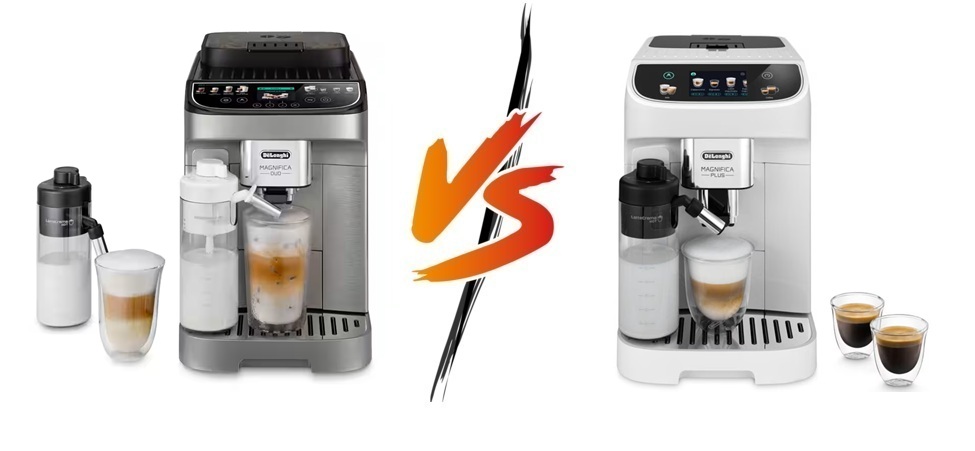
If you’re shopping for a fully automatic espresso machine, the De’Longhi Magnifica Duo and Magnifica Plus are two machines that look deceptively similar on paper. Both are compact bean-to-cup machines, both grind fresh beans immediately before brewing, both use De’Longhi’s LatteCrema system for automatic milk drinks, and both are designed around the same basic promise: get a good café-style drink with minimal effort without having to weigh coffee, tamp a portafilter, steam milk, or clean a mountain of equipment afterward.
But the similarities start to break down once you actually look at what each machine is trying to do.
The Magnifica Plus is the more traditional premium Magnifica. It concentrates on hot coffee drinks, with a 3.5-inch touchscreen that’s easy to use, 18 drink recipes, four user profiles and a milk system that basically works smoothly. It feels like a machine designed around making everyday coffee easier and more personal.
The Magnifica Duo is newer and offers more options. It adds cold extraction and iced drinks, plus a special milk system for cold foam specifically designed for cold foam. It has a smaller 2.4-inch display, but it also introduces 20 drink recipes, three user profiles, adjustable foam levels and special ways to make espresso, filter coffee, and cold brew. De’Longhi launched the Duo in 2026 specifically as a new generation of the Magnifica line, with cold brew and hot/cold milk preparation as its main improvements.
That difference makes this comparison more interesting than a simple “latest model vs previous one” contest. The Duo isn’t merely a Plus with a bigger drinks menu, and the Plus isn’t simply an inferior version of the Duo. They’re suit different types of coffee fans.
I’ve broken the comparison down into the areas that matter most when you live with a machine like this: how they’re built, their controls, coffee taste, grinding, milk drinks, cleaning, noise, and energy efficiency, and ultimately the value for your money.
De’Longhi Magnifica Duo vs Magnifica Plus Comparison Table
If you click the links below, under the product images, you will be redirected to Amazon.com. In case you then decide to buy anything, Amazon.com will pay me a commission. This doesn’t affect the honesty of this review in any way though.
| Specification | De’Longhi Magnifica Duo | De’Longhi Magnifica Plus |
|---|---|---|
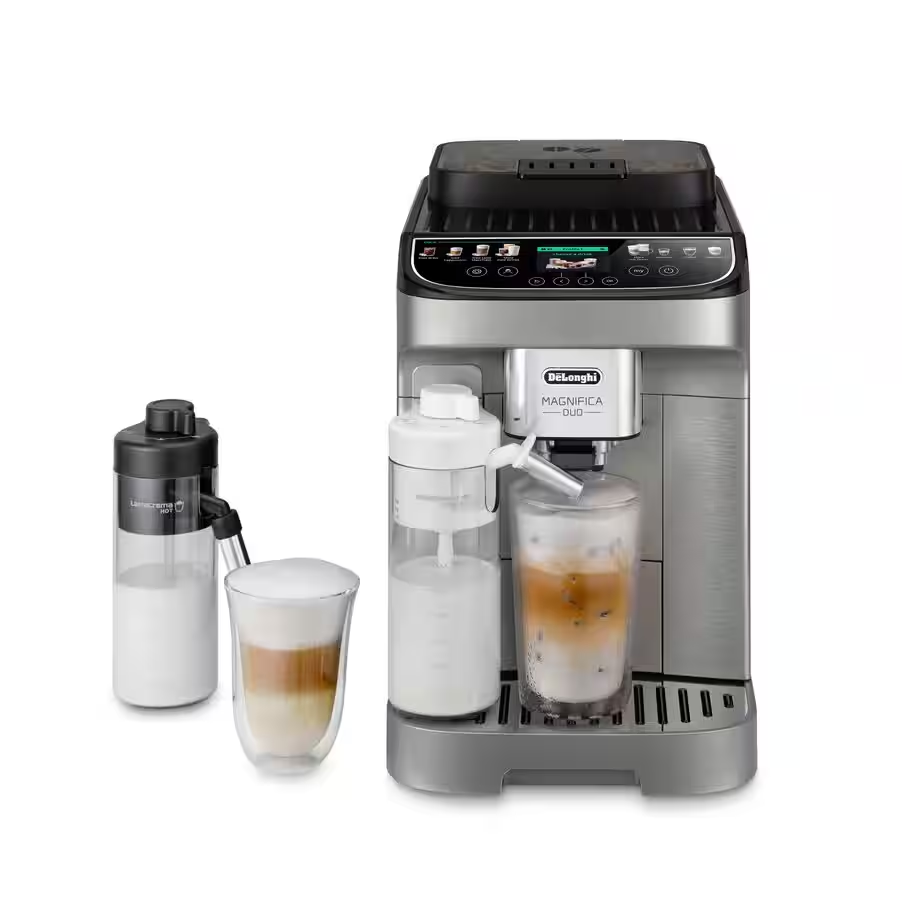 | 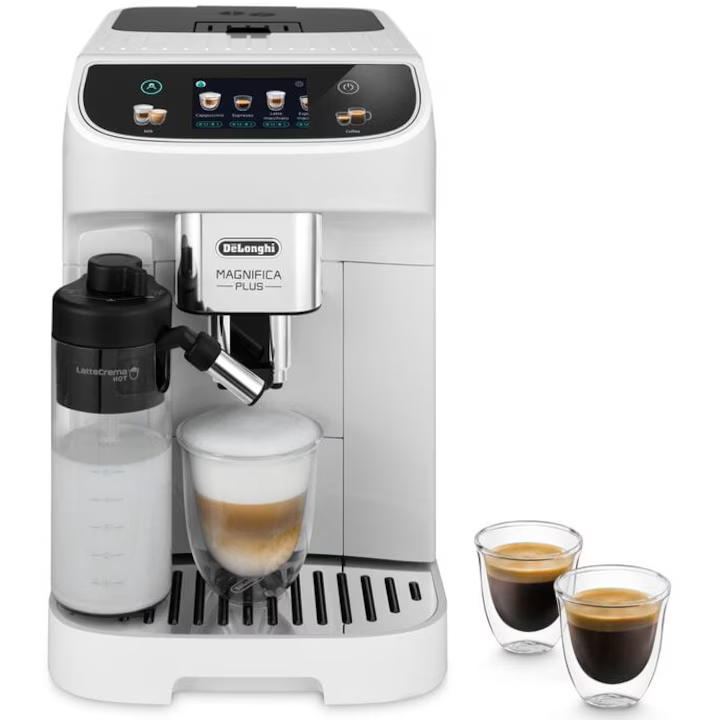 | |
| Check the best price on Amazon | Check the best price on Amazon | |
| Model | ECAM332.80.SXB | ECAM322.70.SB |
| Machine type | Bean-to-cup automatic coffee machine | Bean-to-cup automatic coffee machine |
| Display | 2.4-inch colour TFT display | 3.5-inch full-touch colour display |
| Number of recipes | 20 | 18 |
| User profiles | Up to 3 | Up to 4 |
| Coffee grinder | Conical burr grinder | Conical burr grinder |
| Grinder settings | 13 | 13 |
| Bean hopper capacity | 250 g | 250 g |
| Water tank capacity | Approx. 1.9 L | Approx. 1.9 L |
| Pump pressure | 15 bar | 15 bar |
| Rated power | 1,450 W | 1,450 W |
| Milk system | LatteCrema Hot + LatteCrema Cool | LatteCrema Hot |
| Hot milk drinks | Yes | Yes |
| Cold milk drinks | Yes | No |
| Cold brew | Yes | No |
| Filter-style coffee | Yes | No dedicated equivalent |
| Coffee intensity settings | 5 levels | Adjustable |
| Coffee sizes | 4 sizes | Adjustable |
| Temperature settings | 3 | Adjustable |
| Automatic milk-system cleaning | Yes | Yes |
| Automatic rinsing | Yes | Yes |
| Automatic descaling guidance | Yes | Yes |
| Dimensions | Approx. 24 × 44 × 36 cm | Approx. 24 × 44 × 36 cm |
| Main strength | Wider drink variety, including hot and cold drinks | Larger touchscreen and more refined hot-drink experience |
| Best suited to | Households wanting a broad range of coffee styles | Users mainly interested in hot espresso and milk drinks |
Key specification differences
The biggest difference is the drink range. The Magnifica Duo is built around versatility, with 20 recipes, cold-brew capability and both LatteCrema Hot and LatteCrema Cool. The Magnifica Plus has 18 recipes and concentrates more heavily on traditional hot coffee and milk drinks.
The interface also differs substantially. The Plus has a larger 3.5-inch full-touch colour display, while the Duo uses a smaller 2.4-inch colour TFT screen. The Plus also supports up to four user profiles compared with three on the Duo.
Interestingly, the core coffee hardware is very similar. Both have a 13-setting conical burr grinder, 250 g bean hopper, approximately 1.9 L water tank, 15-bar pump and 1,450 W power rating. So the choice between them isn’t primarily about one having a dramatically more powerful grinder or pump. It’s mainly about the user interface, drink selection and milk-system capabilities.
Design & Build Quality
At first glance, the De’Longhi Magnifica Duo and Magnifica Plus look like variations on the same basic idea and in many respects, they’re. Both are compact automatic espresso machines designed to fit into a normal home kitchen rather than take over the counter space. They’ve almost identical dimensions, similar proportions. And a similar layout, with the grinder and bean hopper on top, the brewing system inside the body and the coffee and milk systems at the front.
This similarity is a strength. Neither machine takes up too much counter space for what it can do. Both are about 24 cm wide, 44 cm deep and 36 cm high, which makes the width manageable. The depth is more significant, particularly in smaller kitchens, because you’ll need enough room not only for the machine itself but also to remove the water tank and access the rear or upper components when necessary.
Despite being compact, these machines aren’t lightweight. Both have enough weight to stay put on the counter when the grinder and mechanisms are working. That’s important because there are moving parts inside. You don’t want the appliance shifting when it grinds coffee or moves the brewing unit.
Neither machine is built like a commercial machine, which is worth noting. That exterior is mostly plastic, not thick metal panels. Some buyers might find the plastic disappointing, given the price, especially if they’re used to traditional machines with stainless steel. But plastic is common in this category. A superautomatic machine has removable parts like water tanks, bean hoppers, and a complex brewing mechanism. A lighter, moulded body makes it possible to include all those parts without making the machine enormous.
A better question is whether the plastic feels cheap. In both cases, the answer is generally no. They feel like well-engineered appliances, not flimsy gadgets.
Magnifica Plus: understated and familiar
The Magnifica Plus has a more conservative design. It looks like a De’Longhi machine, but the touchscreen makes it look more modern than older models.
The 3.5-inch full-touch colour display is probably the most visually important part of the Plus. It gives the machine a cleaner look because it doesn’t have a lot of buttons. Instead, the display handles selection, customization, and interaction.
That makes a big difference in the overall impression.
From a distance, the Plus looks minimalist. Up close, you notice the practical details. The coffee spout can be adjusted to accommodate different cup heights, while the drip tray sits underneath and can be removed when it needs emptying. The bean hopper is where you’d expect, making refills straightforward.
The machine’s proportions work well visually. It’s tall, not wide, which helps preserve counter space. The downside is that the 44 cm depth means it can still occupy a significant amount of space from front to back.
The Plus’s milk container adds some visual bulk when it’s attached, but that’s unavoidable with an automatic milk system. The advantage is the milk carafe can be removed when not in use.
One thing I particularly like about the Plus’s design is that it doesn’t try too hard to look futuristic. Many smart appliances look great at first but quickly feel dated. The Magnifica Plus is restrained. The touchscreen gives it a modern touch without making it look like a tablet.
That should help it age well visually.
Magnifica Duo: the more ambitious design
The Magnifica Duo has broadly the same physical footprint, but its design has to accommodate substantially more functionality.
The milk system is also a key difference.
The Duo comes with separate LatteCrema Hot and LatteCrema Cool milk containers. One is intended for hot milk drinks, while the other is designed to produce cold milk foam for iced beverages. This is one of the machine’s most important physical differences from the Plus.
So, the Duo is more complicated to use.
With the Plus, there’s one milk system to think about. With the Duo, you have two. Using both hot and cold drinks makes this trade-off worthwhile. You can keep the appropriate milk container ready for the drink you’re making and let the machine handle the preparation.
If you rarely drink cold coffee, however, those additional components can feel like unnecessary hardware.
This is one of the recurring themes of the Duo. De’Longhi didn’t just add recipes to an existing machine. The company has added additional functionality throughout the design, and that inevitably introduces more components and more things for the owner to manage.
The Duo’s styling reflects its additional features. It has a contemporary appearance, and the control area is clearly designed around its ability to make both hot and cold beverages. The machine still retains the same basic Magnifica proportions, though, so it doesn’t look radically different from the Plus.
That’s a good thing for anyone who likes the compact nature of the Magnifica platform.
Materials and perceived quality
Neither machine will satisfy someone wanting a premium metal espresso machine.
That’s not really what De’Longhi is trying to build here.
This machines use a lot of plastic, with some metallic and glossy elements. Some parts are more substantial, like those that are often removed and reinstalled.
The main body feels rigid enough. There isn’t the kind of excessive flexing or rattling that would make either machine feel poorly assembled.
Moving components also impact perceived quality. This grinder, brewing unit, pump and milk system all make mechanical noises because they’re physically doing things. A fully automatic coffee machine won’t feel like furniture.
There’s a certain amount of movement and mechanical sound that you simply have to accept.
The machine should feel stable when its components are working.
Both models handle this well.
Size and countertop practicality
The near-identical dimensions are one of the most practical aspects of the comparison.
At around 24 cm wide, both machines are relatively narrow for a fully automatic espresso machine. That’s useful in kitchens where counter width is limited.
The 44 cm depth is more of a challenge.
I’d recommend measuring your available space rather than assuming that a machine will fit because you have 24 or 25 cm of spare width. You need to think about how the water tank is removed, how much room there is above the bean hopper and whether cupboards interfere with any of those movements.
This matters if you plan to keep the machine under kitchen cabinets.
A machine can fit under a cabinet but still be hard to use if you can’t easily remove the water tank or refill beans.
The Duo and Plus are compact in width, but not in depth.
That’s a fair description of both.
Drip tray, water tank and everyday access
A superautomatic machine’s practical quality often comes down to the little things.
How easy is it to empty the drip tray?
Can you remove the coffee grounds container without spilling it?
Can you refill the water tank without moving the entire machine?
The bean hopper’s accessibility is also important.
While these specs may not be exciting, you’ll interact with them constantly.
De’Longhi machines follow the familiar Magnifica arrangement, making maintenance straightforward with removable components.
The drip tray and waste container require regular attention due to the spent coffee grounds and rinse water from the machine.
The water tank is sufficiently large for normal household use, minimizing frequent refilling. Depending on the drinks you’re making and how much automatic rinsing takes place, about 1.9 litres is enough to make the machine practical for several drinks before you need to think about water again.
The 250 g bean hopper is also practical.
This capacity is sufficient for one or two coffee drinkers, avoiding daily refills in most cases.
Is the Duo’s extra hardware an advantage or an inconvenience?
The two milk systems exemplify the trade-off between functionality and simplicity.
The Duo can prepare drinks the Plus can’t, in the same way. Cold foam and cold brew require different approaches from traditional hot milk drinks, and De’Longhi has built that functionality into the machine rather than asking you to improvise with ice and a separate milk frother.
However, the Duo’s components occupy more kitchen space.
This is important if storage space is limited.
The Duo is at its most logical when you’re actually using its additional features. If you make cappuccinos daily but never have iced coffee, the second milk system doesn’t add much.
With the Plus, the physical design is simpler because its milk system is focused entirely on hot drinks.
Build impression overall
After spending some time comparing the two designs, I wouldn’t describe either machine as genuinely luxurious in construction. They’re not competing in that category.
Both are well-designed domestic appliances prioritizing functionality over expensive materials.
The Magnifica Plus feels cleaner and more restrained. The large touchscreen adds a premium element, but the rest of the machine is straightforward.
The Magnifica Duo is more feature-driven. The design supports a broader range of drinks, with the dual milk system being a key example.
If you’re choosing purely on appearance, the decision is likely to come down to personal taste. The Plus is more elegant and uncluttered, while the Duo shows its versatility.
If you’re choosing based on practicality, the two machines are remarkably close in footprint and everyday accessibility.
What you need the machine to do is the key difference.
The Plus offers fresh beans, automatic espresso, hot coffee, and hot milk drinks in a compact body.
The Duo adds cold extraction and milk preparation capabilities to that foundation.
The Duo is more complicated, but the extra hardware serves a purpose.
Neither machine wins just because of its materials or exterior. Their build quality is more about intended use than materials. The Plus is a mature hot-drink machine with a polished interface. The Duo is a more ambitious machine, adding functionality without big size increase.
For a kitchen appliance that has to accommodate a grinder, brewing system, water reservoir, waste container and automatic milk technology inside a roughly 24 cm-wide body, both are impressively space-conscious designs.
The Magnifica Plus is preferable if you value simplicity and clean design. The Magnifica Duo gets the edge if you want the physical flexibility to move between hot and cold drinks without adding another appliance to the kitchen.
And that’s probably the fairest way to look at the build quality of these two machines. They’re not trying to impress you with the heft of a commercial espresso machine. They’re trying to hide a surprising amount of mechanical and electronic equipment inside a manageable domestic appliance. On that measure, both are thoughtfully designed, with the Duo simply pushing the concept further.
User Interface & Ease of Use
The De’Longhi Magnifica Duo and Magnifica Plus have some key differences that aren’t clear from their specs. Both machines are fully automatic, both are designed to turn fresh beans into coffee at the push of a button, and both remove most of the fiddly work associated with traditional espresso preparation. But they interact with you in different ways.
Magnifica Plus has a premium feel with its touchscreen. Its 3.5-inch full-touch colour display is one of the defining features of the machine, and the interface is designed to make the large number of drink options feel relatively approachable. Magnifica Duo uses a smaller 2.4-inch colour TFT display, focusing on separating hot and cold drinks.
Neither is better than the other. Plus feels like a sophisticated appliance, Duo feels like a coffee machine with smart controls.
For everyday use, that distinction becomes more important than the size of the screens suggests.
Magnifica Plus: the more luxurious interface
The Magnifica Plus has the more impressive user interface on paper, and once you start using it, the larger display does make a difference.
The 3.5-inch full-touch colour screen gives it a modern look, with space for menus, icons, and customisation options.
This is useful because Plus offers many drinks. De’Longhi lists 18 recipes, including espresso, coffee, and milk-based drinks. Instead of forcing the user to remember what every physical button does, the touchscreen can present the drinks in a much more understandable way.
This is a big advantage for households where not everyone wants to learn the machine.
Someone new to bean-to-cup machines can look at the screen, see the drinks, and pick one.
No need to figure out button combos.
The screen makes customisation feel natural. You can adjust through the interface, rather than using a mechanical dial.
With many options, this makes the experience less intimidating.
That advantage of visual feedback
Plus is approachable due to its visual interface.
A traditional automatic espresso machine can sometimes feel like operating a washing machine from 2005. You’ve a row of buttons, several lights and a manual that explains which combination of lights means “empty the grounds container.”
Plus is easier to understand.
The display can tell you what the machine is doing and guide you through various stages.
You still need to read the manual, but it helps with the learning curve.
This is even more useful when the machine needs attention.
Superautomatic coffee machines can ask you to do many things. You might need to fill the water tank, empty grounds, clean the milk system, or run a descaling cycle.
On-screen instructions are more helpful than a flashing light you need to look up.
User Interface & Ease of Use
The De’Longhi Magnifica Duo and Magnifica Plus have some key differences that aren’t clear from their specs. Both machines are fully automatic, both are designed to turn fresh beans into coffee at the push of a button, and both remove most of the fiddly work associated with traditional espresso preparation. But they interact with you in different ways.
Magnifica Plus has a premium feel with its touchscreen. Its 3.5-inch full-touch colour display is one of the defining features of the machine, and the interface is designed to make the large number of drink options feel relatively approachable. Magnifica Duo uses a smaller 2.4-inch colour TFT display, focusing on separating hot and cold drinks.
Neither is better than the other. Plus feels like a sophisticated appliance, Duo feels like a coffee machine with smart controls.
For everyday use, that distinction becomes more important than the size of the screens suggests.
Magnifica Plus: the more luxurious interface
The Magnifica Plus has the more impressive user interface on paper, and once you start using it, the larger display does make a difference.
The 3.5-inch full-touch colour screen gives it a modern look, with space for menus, icons, and customisation options.
This is useful because Plus offers many drinks. De’Longhi lists 18 recipes, including espresso, coffee, and milk-based drinks. Instead of forcing the user to remember what every physical button does, the touchscreen can present the drinks in a much more understandable way.
This is a big advantage for households where not everyone wants to learn the machine.
Someone new to bean-to-cup machines can look at the screen, see the drinks, and pick one.
No need to figure out button combos.
The screen makes customisation feel natural. You can adjust through the interface, rather than using a mechanical dial.
With many options, this makes the experience less intimidating.
That advantage of visual feedback
Plus is approachable due to its visual interface.
A traditional automatic espresso machine can sometimes feel like operating a washing machine from 2005. You’ve a row of buttons, several lights and a manual that explains which combination of lights means “empty the grounds container.”
Plus is easier to understand.
The display can tell you what the machine is doing and guide you through various stages.
You still need to read the manual, but it helps with the learning curve.
This is even more useful when the machine needs attention.
Superautomatic coffee machines can ask you to do many things. You might need to fill the water tank, empty grounds, clean the milk system, or run a descaling cycle.
On-screen instructions are more helpful than a flashing light you need to look up.
User profiles are on the Magnifica Plus
The Plus supports up to four user profiles, which is an advantage for households with several coffee drinkers.
At first, it sounds like something a salesperson would say. But when a family actually starts sharing the machine, it’s really useful.
Four people share a coffee maker.
A strong espresso is what one prefers, and it should be short.
Someone else wants a large coffee.
Another person likes their cappuccino with a lot of milk.
A milder latte is what the fourth person might want.
Somebody is constantly adjusting strength, size or milk settings without profiles.
Individual preferences are saved and recalled with profiles.
It’s especially handy when changing settings before every drink isn’t something you want to spend thirty seconds on.
The Plus works well for a household, not just one coffee enthusiast, due to its interface.
Magnifica Duo has a smaller display and a clearer purpose
The Magnifica Duo takes a different route.
That display on this machine is 2.4 inches, a colour TFT; it’s much smaller than the Plus’s 3.5-inch touchscreen. Display technology-wise, the Plus is the better choice.
The Duo doesn’t necessarily need to use its screen in the same way.
De’Longhi’s machine is centered around its ability to make both hot and cold drinks. It separates hot and cold beverage options, and uses illuminated controls to make the different modes easier to identify, which is organised around this hot and cold distinction.
It’s sensible to decide this way.
Having 20 drink recipes on a machine can be overwhelming if they’re all listed together in one huge menu.
The Duo gives you a more obvious mental shortcut.
Is something hot what I’m looking for now?
Do I want something cold?
The number of options that are actually worth considering becomes much smaller once that’s been determined.
Designing an interface that way is very practical.
A smaller screen doesn’t have to be a problem, and it’s not necessarily a disadvantage, it’s all about
Noticeable is the smaller screen on the Duo, but it’s not a serious usability problem, in my opinion.
This thing isn’t for browsing the internet.
You choose a coffee.
Most of the time, the interaction lasts only a few seconds.
De’Longhi gets more space for graphics on the Plus’s larger screen, which is nicer to look at, but the Duo’s smaller display works for what it needs to do, and that’s sufficient.
You could say a smaller display makes you interact with the machine more directly, it doesn’t feel like a tablet.
You choose your drink.
You adjust the relevant settings.
Start is pressed.
Coffee comes out.
That’s basically the job of a coffee machine.
Drink customisation
Both machines offer a good level of customisation, although the precise implementation differs.
The Duo offers five intensity levels, four drink sizes and three temperature settings. That’s a lot of adjustment given its focus on convenience.
The key is that these adjustments are accessible without needing to be a tech expert.
You don’t need to know the exact coffee amount.
You don’t need to understand how pressure works.
You don’t need to calculate the brew ratio.
You just tell the machine what you want.
That’s just the right amount of control for most users.
The Plus follows a similar approach. It offers plenty of personalization without getting into technical details.
This is one of the fundamental strengths of both machines.
They handle the complicated part and still give you control over the outcome.
Profiles vs presets
There’s a subtle difference between customisation and profiles that’s worth explaining.
A customization setting lets you change your current drink.
A profile saves your preferences so you don’t have to change them each time.
The Magnifica Plus’s four profiles are particularly useful in a multi-person household.
The Duo’s three profiles are still useful, but the Plus has an advantage if four people use it regularly.
Either machine has enough profiles for a couple.
For a larger family, the difference could matter.
Learning to use it
Neither machine is hard to learn.
That’s why people buy superautomatic espresso machines.
Traditional espresso setups require a learning process. You need to learn to grind coffee, dose it, and more.
The Magnifica machines eliminate most of that work.
The initial setup requires some attention. You need to fill the water tank, add beans, configure the machine and follow the cleaning and rinsing instructions.
But after that, using it’s simple.
The machine remembers what’s important.
You choose your drink.
It handles grinding and brewing.
It also prepares milk for milk drinks.
That simplicity makes superautomatics appealing to coffee lovers who don’t want to make coffee a hobby.
Machines and mistake handling
Interface design has another overlooked aspect: what happens when you make a mistake.
A good machine should tell you what’s wrong, not just stop working.
It should give you instructions on what to do.
The Magnifica Plus benefits from its larger display here because there’s more room for instructions and notifications.
Although the Duo’s display is smaller, its interface still guides you through maintenance and operation.
This matters because a coffee machine is an appliance you’ll probably use when you’re half awake.
At 6:30 in the morning, you don’t want to deal with an error light before you’ve had coffee.
Clear instructions are a big help.
The Duo and hot vs cold drinks
This is probably the most important usability feature that distinguishes the Duo.
The machine has been designed around the idea that hot and cold drinks are separate preparation categories.
So you don’t have to adjust a hot recipe for a cold drink.
The machine prepares drinks differently based on your selection.
This is particularly useful for drinks such as iced cappuccino, iced flat white and cold brew.
It doesn’t just add ice to a hot coffee.
This control system accounts for the different preparation methods.
That’s great from a usability standpoint, since the complexity is hidden.
That machine is doing more work, but the person standing in front of it isn’t.
Milk drinks are easy to make
Both machines make milk drinks convenient.
Automatic milk preparation can be intimidating when you’ve only used manual espresso equipment, but the LatteCrema systems make the process relatively straightforward.
You connect the milk container, select your drink, and the machine takes care of the rest.
The Plus has LatteCrema Hot.
The Duo has both LatteCrema Hot and LatteCrema Cool.
So the Plus has a simpler workflow for people who only drink hot milk beverages.
The Duo has the more versatile workflow for someone who alternates between hot and cold drinks.
The trade-off is clear: the Duo offers more possibilities, but also more components to learn.
Convenience in everyday use
After the initial learning period, the most important question becomes how many steps are involved in making your normal coffee.
Both machines perform well here.
If your routine is simply espresso every morning, either machine is extremely straightforward.
Cappuccino drinkers will also find both machines easy to use.
If you’ve several family members with different preferences, the profile functionality becomes more valuable.
But for those who often switch between hot and cold coffee, the Duo has an edge. Because it eliminates the need for separate preparation methods.
The key point is that the machines don’t force you to understand the technology behind the drink.
This is a big part of what makes them appealing.
The Plus has an advantage
The Plus excels in interface sophistication.
The 3.5-inch touchscreen provides more space to work with.
Menus can be more visual.
Drink selection feels more premium.
Instructions have more space.
And four user profiles are useful for larger households.
For those who value a premium interface experience, the Plus is more impressive.
It’s also arguably the better option for someone who wants a straightforward hot-coffee experience without having to think about cold-drink modes or multiple milk systems.
Where the Duo has the advantage
The Duo excels in functional organisation.
Its interface has to cope with more types of drinks, but separating hot and cold beverages gives that complexity a clear structure.
More, it hides much of its technical complexity.
You don’t need to understand cold extraction.
They don’t need to manually change brewing pressure.
You also don’t need to figure out how to produce cold foam.
They simply choose the relevant drink.
That’s exactly what good appliance design should do.
The Duo offers extensive customization with five intensity levels, four sizes, and three temperature settings. With its 20 recipes, this provides considerable flexibility without needing specialist knowledge.
Which machine is easier to use?
If we’re talking about the first five minutes of ownership, The Magnifica Plus has an edge due to its larger display, making the interface more welcoming and easier to explore.
If we’re talking about a full year of ownership, the answer becomes more dependent on how you drink coffee.
For someone who only drinks traditional hot coffee, the Plus is probably the simpler machine. Its interface is polished, its milk system is straightforward and there are fewer components to think about.
For those who drink both hot and cold coffee, the Duo’s interface is more compelling. It provides access to a wider range of drinks while keeping the preparation process simple.
That’s an important distinction.
Although the Duo is more complicated internally, it doesn’t feel more complicated to use.
This is one of its strongest design aspects.
Usability verdict
Both the Magnifica Plus and Magnifica Duo succeed in making bean-to-cup coffee approachable.
The Plus has a more luxurious interface. This larger 3.5-inch touchscreen, graphical presentation, and four user profiles make it feel more premium.
The Duo has a more versatile interface. Although the 2.4-inch display is less impressive, the separation between hot and cold drinks gives it a clear logic. You can access 20 recipes, customize strength, size, and temperature, and let the machine handle the technical differences.
For those buying primarily for espresso, coffee, and hot milk drinks, the Plus’s larger touchscreen and simpler workflow are attractive.
If you also drink iced drinks and cold brew, the Duo’s interface makes more sense as it gives these drinks a dedicated place.
Neither machine requires coffee expertise. This is their biggest success.
They take what would normally be a fairly technical preparation process and reduce it to a handful of understandable choices. The Plus uses a luxurious touchscreen experience, while the Duo uses a versatile hot-and-cold system.
For everyday ease of use, both are strong. The better choice depends on whether you value the Plus’s polished interface or the Duo’s broader range of drinks and preparation methods.
Coffee Quality & Brewing Peroformance
When you spend this much on a bean-to-cup coffee machine, the most important question is still the simplest one: how good is the coffee? Touchscreens, drink menus and automatic milk systems are useful;. But they don’t matter if the espresso tastes flat or the machine can’t get the best out of the beans.
Both the De’Longhi Magnifica Duo and Magnifica Plus take a similar approach to brewing. They’re designed to make the process almost completely automatic, from grinding the beans to dosing, extracting and dispensing the finished drink. Both use a 13-setting conical burr grinder, offer multiple strength and temperature adjustments, and have a 15-bar pump. On paper, they’re in the same class. But they have slightly different personalities in the cup.
The Magnifica Plus focuses on traditional hot coffee and espresso-based drinks, but the Magnifica Duo is more ambitious. The Duo adds options for different coffee styles, like filter-style coffee and cold brew, making it more versatile. Meanwhile, the Plus concentrates on getting the fundamentals right across its hot-drink menu.
Espresso quality
Espresso is the benchmark for most buyers. If it can produce a convincing espresso, it has a strong foundation for everything else.
Both Magnifica models do a good job of producing espresso that is consistent, convenient and noticeably better than what you would get from a basic pod machine. They grind whole beans immediately before brewing, giving the coffee a fresher character than pre-ground coffee in a capsule or container.
The 13-position grinder adjustment is particularly useful here. You can alter the grind depending on the beans and flavour you want. A finer grind can generally help produce a slower, more concentrated extraction, while a coarser setting can make the flow faster and the result lighter.
They don’t turn you into a barista, which isn’t the point. They are designed to remove much of that decision-making. But having enough adjustment available means you can still spend some time finding a setting that works well with your favourite beans.
The espresso from both machines is balanced and approachable, rather than intensely strong. It suits people who want easy morning coffee without experimenting with grind size, dose, and extraction time daily.
Magnifica Plus: consistent and straightforward
The Magnifica Plus has a slightly more focused approach to coffee preparation. Its strength comes from consistency, not trying to offer every brewing style.
Once you’ve set the grinder and drink settings, you can expect similar results from one cup to the next. That’s a big advantage of modern automatic coffee machines. You don’t have to weigh the beans, tamp the coffee, or manually control the extraction.
The Plus gives you control over coffee intensity, drink size, and temperature. You can move between a smaller, stronger espresso and a longer, milder coffee without changing the workflow.
For someone who mainly drinks espresso, lungo-style coffee, cappuccino, or latte drinks, this flexibility is probably enough.
The quality also depends heavily on the beans you put into the machine. The Magnifica Plus can make a mediocre supermarket bean taste pleasant, but it can’t turn poor-quality beans into specialty coffee. With fresher, better-roasted beans, the difference is much more obvious. The machine’s grinder and brewing system provide a solid platform, but the ingredients still matter.
Magnifica Duo: more brewing ambition
The Magnifica Duo takes it a step further. Instead of just offering espresso and milk-based recipes, it’s designed to handle different styles of coffee, including hot coffee and cold drinks.
This makes the brewing system more interesting because the machine doesn’t treat every drink as the same espresso extraction with different water or milk amounts.
The Duo can produce espresso-based drinks and filter-style coffee for hot coffee. This matters for households with different preferences. One person might want a short, concentrated espresso, while another prefers a larger, smoother cup.
The Duo’s cold-brew functionality is a bigger distinction. Cold brew isn’t just iced coffee poured over ice. The brewing approach is different; De’Longhi designed the Duo to automate it, not require separate preparation.
The results are worth viewing realistically, though. Independent testing found the Duo’s cold brew can be weaker or more acidic than expected. This doesn’t make the feature pointless; it shows the difference between making cold brew and achieving a rich result a dedicated enthusiast might expect.
For someone who wants a cold coffee in summer, the convenience is impressive. A serious cold-brew fan still has an advantage with dedicated equipment.
Strength and flavour adjustment
Both machines’ ability to adjust coffee intensity is one of the most useful features.
The Magnifica Duo has five intensity levels, multiple drink sizes, and temperature settings. This gives reasonable control without complicated menus.
That’s important because coffee preferences can vary dramatically. A person who drinks milk-based drinks may want a stronger base so the coffee flavour doesn’t disappear under milk. Someone drinking a long black might prefer less intense extraction with more water.
The Plus offers similar flexibility, but the Duo’s broader options give it an advantage for households with varied tastes.
Intensity and flavour are distinct. Increasing strength doesn’t change the beans’ character. It mainly changes how much coffee is used or how the drink is prepared. The beans remain the biggest factor for chocolatey, nutty, fruity, or floral flavours.
Temperature and drink consistency
Automatic machines can be surprisingly good or disappointing with temperature. Nobody wants a lukewarm cappuccino, but extremely hot coffee isn’t better. Excessive heat can make coffee taste harsh and can also make milk drinks less pleasant.
Both machines give users temperature control to find their preferred setting.
Consistency is arguably more important than having the absolute highest temperature. The real advantage of these machines is that you can establish your preferred setting and then repeat it every morning.
Both models perform well here. Once configured, they remove much variability from brewing. No need to judge if grounds are evenly tamped or extraction timed right.
Filter-style coffee versus traditional espresso
The Duo is particularly interesting beyond espresso.
Traditional automatic espresso machines are best for espresso-based drinks. Asking it to imitate filter coffee can sometimes result in a drink that tastes like a watered-down espresso rather than proper filter coffee.
The Magnifica Duo’s approach gives it a better chance of producing coffee closer to what people expect from a longer, smoother coffee.
It won’t replace a good pour-over or dedicated filter machine for enthusiasts. Those methods still provide more control over extraction and can bring out more nuanced flavours.
The Duo targets something else. Convenience is its appeal. You can have espresso one moment, a different style the next, without needing another appliance or separate process.
Coffee base. And milk drinks
Coffee quality isn’t just about black coffee. For many buyers, cappuccinos, lattes and flat whites are the drinks they will make most often.
Here, the quality of the espresso base becomes especially important. When combined with a lot of milk, a weak espresso can get lost, and an overly bitter one can make the drink unpleasant.
Both models produce a strong coffee base for milk drinks, and the LatteCrema systems help maintain consistency.
The Duo also supports both hot and cold drink preparation, which adds variety. This opens up more possibilities for iced and cold coffee drinks than the Plus.
The Plus is convincing if you want a hot cappuccino or latte with minimal effort.
How they compare with a manual setup
It’s worth keeping expectations realistic. Neither Magnifica competes with a high-end manual espresso machine and premium grinder.
A skilled barista can control the brewing process, including dose, grind size, extraction time, and water temperature. With good beans and experience, you can get a more nuanced espresso.
The Magnifica machines offer repeatability and convenience.
Press a button, and the machine does the work. No portafilter cleaning, grinder adjustments, or standing over the machine is needed.
This trade-off makes sense for most households. The coffee may not satisfy a hobbyist, but it’s capable for everyday drinking.
Which machine produces better coffee?
The answer depends heavily on what you mean by “better.”
The Magnifica Plus provides a strong experience for traditional hot coffee and espresso-based drinks. That brewing system is consistent, controls are adjustable, and automatic preparation makes it easy to repeat results.
The Duo is more versatile. It can handle espresso, longer coffee styles, and cold drinks, giving it a broader range. This doesn’t mean every drink will taste better. The cold-brew performance shows versatility can have compromises.
For a household that drinks mostly espresso, cappuccino and latte, the Plus has everything needed to make excellent everyday coffee without paying for features that may rarely be used.
The Duo is stronger for households with different preferences. Its additional brewing options mean you’re less restricted to one style of coffee.
Final verdict on coffee performance
The De’Longhi Magnifica Duo and Magnifica Plus are capable bean-to-cup machines delivering good coffee with little effort. Neither replaces a manual setup, but both succeed in making fresh coffee quickly and reliably.
The Plus is more focused. It does the fundamentals well and is particularly appealing if most of your drinks are traditional hot espresso and milk-based coffees.
The Magnifica Duo is the more versatile brewer. Its dedicated approaches to different coffee styles, combined with hot and cold drink options, make it better suited to households where coffee preferences extend beyond standard espresso drinks.
In simple terms, the Plus is about refining the everyday coffee experience, while the Duo is about expanding what you can make. The choice depends on the range of coffee you want to drink, not which machine makes better espresso.
Grinder Features & Performance
That grinder is one of the most important components in any bean-to-cup coffee machine. You can have a sophisticated brewing system and an impressive selection of drinks, but unless the grinder produces consistent grounds, quality is limited.
Both the De’Longhi Magnifica Duo and Magnifica Plus are well-equipped in their price category. They both have a conical burr grinder with 13 settings, giving users more control than a basic machine.
On paper, they’re similar. Both are designed around convenience rather than extensive manual experimentation, but you can still adjust them to suit your beans and preferences.
This is a good middle ground. You don’t need to understand everything about espresso grinding to use either machine, and experienced drinkers can fine-tune the results.
That grinder matters
It determines what the brewing system works with.
Coffee beans are more stable than ground coffee. Ground coffee has a much larger surface area, and extracts flavour and aroma quickly. That’s why freshly ground coffee generally has a noticeable advantage over coffee that has been ground well in advance.
Both grind the beans just before brewing. This is one of the biggest reasons they can produce better-tasting coffee than machines that rely on pre-ground coffee or pods.
The grinder must produce consistent particles. If the grounds vary too much, some particles can be over-extracted while others remain under-extracted. The result can be a cup that tastes simultaneously bitter and weak.
A good burr grinder reduces this problem with a controlled distribution.
Neither is for specialists who want precise control, but they’re solid for everyday espresso.
13 grinder settings
Both have 13 adjustment levels.
This is useful flexibility for a domestic machine. It means you aren’t locked into one grind size, which is particularly important because different coffee beans behave differently.
A dark-roasted bean may respond differently to the grinder and brewing process than a lighter roast. Freshness matters too. Beans that have been roasted recently can behave differently from beans that have been sitting in the hopper for several weeks.
The ability to move through multiple grind settings gives you some room to compensate.
If the coffee is flowing too quickly and tastes thin, a finer grind may help. If the extraction is too slow and the coffee tastes harsh or overly bitter, moving towards a coarser setting may improve the balance.
Don’t expect instant results when changing the grinder. This machine needs to work through the existing grounds before the new setting becomes fully apparent. This is normal, so understand it before adjusting repeatedly.
Magnifica Plus performance
The Magnifica Plus is straightforward.
It has a 13-setting grinder for reliable results with everyday beans. For someone who has found a coffee they like, the best approach is usually to make small adjustments and then leave the grinder alone.
This is a strength of the Plus. Grinding doesn’t feel like a hobby.
You select your drink, it grinds the beans, and brews. This simplicity is an advantage for households where nobody wants to be a barista.
This grinder works well with the broader settings. A stronger espresso can benefit from a different grind approach than a longer coffee, although the machine handles much of that process automatically.
You get a grinder that gives you control without requiring it.
Performance of the Magnifica Duo grinder
The Magnifica Duo uses the same basic 13-setting conical burr grinder concept; however, its wider range of brewing options makes the grinder’s role more interesting.
It isn’t limited to traditional espresso-style drinks. It is designed to produce different coffee styles, including longer and cold drinks. This means the machine must accommodate a broader range of brewing requirements.
To achieve this, the grinder itself doesn’t need to become dramatically more complicated. De’Longhi combines the grinder with different brewing programs instead.
This is an important distinction. The Duo’s advantage isn’t that its grinder is really better than the Plus’s. The grinder becomes part of a more versatile brewing system.
That’s useful for someone who likes switching between drinks. You can use the same beans in the hopper with different recipes and brewing programs throughout the day.
Conical burr vs blade grinding
These machines don’t rely on the inexpensive blade-grinding approach found in some basic coffee appliances.
A blade grinder chops the beans, rather than grinding them in a controlled way. That can create a mixture of very fine particles and larger chunks, making consistent extraction more difficult.
A conical burr grinder works differently. The beans pass between two burr surfaces, which crush and grind them into smaller particles. This distance between the burrs determines the grind size.
This is the kind of system you want for a bean-to-cup machine.
It offers consistency, compactness, and reliability, which is a practical combination. It also sort of works well with automatic dosing because the machine can grind a measured amount of beans immediately before preparing the drink.
Hopper capacity and everyday convenience
Both models use a bean hopper with a capacity of around 250 grams.
This size is useful for domestic use. You can fill the hopper and make several coffees before needing to refill it.
That number of drinks depends on how much coffee you use per drink. A household that mostly drinks small espressos will get more cups from the same amount of beans than someone who regularly chooses stronger or larger drinks.
These machines are more convenient than manual setups for everyday use because of the hopper. No need to measure beans before every cup.
There’s, however, one thing worth considering if you like switching between different coffees.
Changing to another variety isn’t instantaneous once beans are inside the hopper. Some of the previous beans will remain in the grinder and feed mechanism. For frequent switching between decaf and regular coffee, a machine with a removable hopper or dedicated second bean container might be more convenient.
However, this isn’t a major issue for most users. The 250-gram hopper is a good compromise between capacity and practicality on the countertop.
How much control do you get?
This is where expectations matter.
Thirteen grind settings is useful, but the Magnifica machines aren’t designed to give you the same level of control as a separate espresso grinder.
A dedicated grinder can offer extremely precise adjustment and can be paired with different brewing methods. The grinder is part of a closed automatic system with the Magnifica Duo and Plus.
This is intentional.
That target customer wants freshly ground coffee without managing every stage of preparation.
You can adjust the grind; however, you don’t have to. You can experiment with different beans, and the machine kind of works well without extensive calibration.
That’s probably the right balance for most home users.
Finding the right setting for the grind
To get the most from either machine, it’s worth spending a little time experimenting with the grinder.
Start with the manufacturer’s recommended setting and use your usual beans to make coffee. Pay attention to how quickly the coffee comes out, how the crema looks and, most, how it tastes.
A finer setting may help if the espresso tastes thin and lacks body. If it tastes excessively bitter or the flow seems unusually restricted, a slightly coarser setting may be worth trying.
Make only small changes and give the machine a few drinks to settle into the new setting.
This is better than changing several variables at once. If you alter the grind, strength, temperature and drink volume simultaneously, it becomes difficult to know what actually improved or harmed the result.
Noise and speed of grinding
Automatic grinders aren’t completely silent. Coffee beans create noise when ground. And the compact grinder mechanism inside these machines can be clearly heard during preparation.
The grinder operates for a short period, which is important. You don’t hear it continuously when making a drink.
Noise is more of a consideration for early morning or open-plan kitchen coffee makers, but not a major flaw.
These machines also don’t need manual grinder operation. Select a drink and the system handles it, making the brief noise a small trade for convenience.
Grinder cleaning
It doesn’t need as much cleaning as a professional grinder, but shouldn’t be ignored.
Coffee beans leave behind oil and particles. Darker roasted beans tend to be particularly oily, and over time that residue can build up.
Follow De’Longhi’s cleaning recommendations instead of taking the grinder apart.
It’s also worth choosing beans sensibly. Very oily beans can be less suitable for some automatic machines because they can leave more residue inside the grinding and feeding system.
Again, this isn’t unique to either Magnifica model. It’s simply part of owning a bean-to-cup machine.
Grinder comparison?
Neither the Magnifica Duo nor Magnifica Plus has a clear grinder advantage.
Both have a 13-setting conical burr grinder and a 250-gram bean hopper, making the grinding hardware similar.
The difference is what happens after grinding.
The Magnifica Plus uses its grinder as part of a focused hot-coffee system. It suits those who want reliable espresso and milk drinks without adjusting equipment.
The Magnifica Duo has the same grinding approach, but with a broader brewing platform. The grinder contributes to a more versatile experience with different coffee styles.
If you’re choosing between the two specifically because of grinding performance, there isn’t a compelling reason to select one over the other. The differences are in brewing options, interfaces, and drink menus.
Grinder performance verdict
Both Magnifica Duo and Magnifica Plus grinders balance control and convenience.
The 13 levels provide flexibility for different beans and improved extraction, while the automatic dosing and brewing system means you don’t need specialist knowledge to get started.
The 250-gram hopper suits normal household use, and the conical burr design provides consistent freshly ground coffee.
Neither machine offers the control of a premium grinder for experienced enthusiasts. But that’s not their goal.
They make good-quality freshly ground coffee accessible without making it a project.
Both perform well in this regard. The Magnifica Duo doesn’t have a really superior grinder to the Plus, but its wider brewing capabilities make better use of the same basic grinding platform. The Plus is excellent for those who prioritize espresso and hot milk drinks.
The grinder is one area where the machines are similar. Your decision should therefore be based on the wider coffee experience rather than expecting a major difference in grinding quality between them.
Milk Frothing & Specialty Drinks
Many people don’t buy bean-to-cup machines just for espresso. Cappuccinos, lattes, flat whites and other milk-based drinks are often what make the convenience of an automatic coffee machine worthwhile. You can press a button. And the machine handles almost everything, instead of grinding beans, pulling an espresso, and steaming milk separately.
The De’Longhi Magnifica Duo and Magnifica Plus have a lot in common in this area, but their approaches differ noticeably. Both use De’Longhi’s LatteCrema system to automate milk preparation, but the Duo is designed around a wider selection of drinks, including cold beverages, while the Plus is more focused on traditional hot coffee and milk drinks.
Neither machine treats milk frothing as an afterthought, which is important. The automatic milk system is a key part of the experience, and both models make consistent milk drinks without needing manual steaming skills.
LatteCrema: the key feature
De’Longhi’s LatteCrema system is the main technology behind the milk drinks on these machines.
The system automatically draws milk into the machine, creates foam, and prepares the drink, instead of having the user hold a milk jug under a steam wand and control the air.
This makes a big difference in everyday convenience.
Manual steaming can produce great results, but practice is required. You need to position the steam wand correctly, introduce the right amount of air, monitor the temperature, and stop at the right time. A small mistake can lead to large bubbles, thin foam, or overheated milk.
LatteCrema removes most of that learning curve.
You fill the milk container, select the drink, and let the machine handle the rest.
Magnifica Plus: a strong hot-milk specialist
The Magnifica Plus suits people who mainly drink traditional hot milk-based coffees.
The LatteCrema Hot system creates smooth, consistent milk foam for drinks like cappuccinos and lattes. The Plus also offers three milk foam textures, giving you some control over the final character of the drink.
This is useful because not all milk drinks should have the same foam.
A cappuccino generally benefits from a more substantial layer of foam, while a latte is usually better with a thinner, smoother texture that allows the espresso and milk to blend together.
Having different foam settings means the machine isn’t simply producing one generic “foamy coffee” regardless of the recipe.
The Plus therefore feels like a machine designed around the traditional café menu. If most of your drinks are cappuccinos, lattes and similar hot beverages, its milk system provides exactly the kind of automation you’d expect from a premium domestic bean-to-cup machine.
Magnifica Duo: more ambitious milk options
The Magnifica Duo has a broader approach.
It uses LatteCrema technology and adds both LatteCrema Hot and LatteCrema Cool capabilities. This gives the machine a wider range of milk-based drinks, especially if you enjoy iced or cold coffee.
This is a key difference between the Duo and the Plus.
Instead of being restricted to hot milk foam, the Duo is designed to handle cold drinks as part of its overall specialty-drink menu. This makes the Duo more interesting for households with seasonal coffee preferences.
You might want a hot cappuccino in January and an iced or cold milk coffee in July. With the Duo, the same machine can accommodate both without needing a separate milk frother or another coffee appliance.
The system is more complicated, but De’Longhi has kept the user experience relatively simple.
This quality of the milk foam
Automatic milk systems have improved, but there’s still a difference between producing foam and producing good foam.
Good foam should be smooth and fine-textured, not full of large, dry bubbles. It should integrate well with the espresso, rather than sitting separately on top.
Both Magnifica machines generally aim for that smoother, creamy texture.
This result depends on the milk used. Whole milk tends to produce a richer, creamier result, while lower-fat milk can create a lighter foam. Plant-based alternatives can be more variable, although barista-oriented versions of oat, soy and other plant milks often work better in automatic systems.
This is worth remembering when comparing experiences. Two people can use the same machine and get noticeably different results simply because they’re using different milk.
Cappuccino performance
Cappuccino is probably the drink that best show what an automatic milk system can do.
It prepares coffee and milk in sequence, creating foam without manual help.
On the Magnifica Plus, this is very much its comfort zone. Since it focuses on hot drinks, cappuccino is straightforward and predictable.
The Duo can do the same while offering a broader selection of specialty drinks.
Consistency is a key advantage for both. And once you find your preferred foam setting, you can have the same drink every day.
You won’t get exactly the same level of manual control that a skilled barista has, but you also won’t have to spend five minutes preparing your morning cappuccino.
Latte and milk-heavy drinks
Lattes put slightly different demands on a milk system.
A good latte needs a smooth mix of espresso and steamed milk, with lighter foam on top.
The Magnifica Plus handles this well, with adjustable foam textures that let you move away from denser cappuccino foam.
The Duo offers similar flexibility while adding the advantage of cold milk-based drinks.
For people who prefer milk-heavy coffee, this can make a bigger difference than an more espresso setting. The ability to customise the milk texture can affect how the entire drink tastes because the amount of foam changes the ratio between espresso, liquid milk and air.
Specialty drinks and menu variety
This is where the Magnifica Duo has a clear functional advantage.
The Duo offers around 20 recipes, compared with around 18 on the Magnifica Plus. The difference isn’t enormous on paper, but the more important point is what those additional options represent.
The Duo’s menu extends beyond the traditional hot espresso and milk-drink category. It incorporates cold drinks and different brewing styles, giving the machine a broader identity.
The Plus remains more focused. Its menu is built around hot coffee and milk-based drinks, and for many users that’s actually an advantage.
More recipes don’t automatically mean a better machine. A menu with dozens of options is only useful if you actually drink them.
If your daily routine is basically espresso in the morning, cappuccino after lunch and latte in the evening, the Plus already covers the important bases.
If different members of the household like different styles of coffee, the Duo’s broader selection becomes more valuable.
The Duo’s cold milk drinks
The Duo’s ability to work with cold milk is one of its most interesting features.
Cold coffee has got more popular but making good iced drinks at home can involve multiple steps. You might need to brew coffee, chill it, prepare milk separately and then combine everything over ice.
The Duo automates more of this process.
The LatteCrema Cool system gives the machine a way to produce cold milk foam instead of cooling hot milk foam.
This allows for cold cappuccino-style drinks and other specialties.
There’s still a practical limitation: automatic cold drinks can’t replicate every café specialty. The machine is built around convenience and repeatability, not unlimited recipe customisation.
For regular cold coffee drinkers, the convenience is hard to ignore.
Milk alternatives
The type of milk used is also important.
Cow’s milk is generally the easiest option for an automatic milk system due to its protein and fat content.
Plant-based milk can be more complicated. Oat, almond, and soy milk have different compositions, affecting their foaming.
Barista versions are usually a better choice because they’re specifically formulated for steaming and foaming.
This isn’t a major weakness of either Magnifica machine. It’s simply a limitation of milk chemistry. Even a good automatic frothing system can’t eliminate the differences.
Households that switch between dairy and plant-based milk should experiment to find the best texture.
Cleaning the milk system
Automatic milk preparation requires regular cleaning.
Milk residue should be cleaned from the system. This can cause unpleasant smells or hygiene issues.
Both machines need regular milk container and pathway cleaning.
This isn’t necessarily difficult. Automatic cleaning cycles help, and the milk container can be removed and cleaned separately.
That important point is to treat milk-system cleaning as part of the normal routine rather than something to do only when there’s an obvious problem.
Automatic systems can be easier to manage than manual steaming, with the machine handling preparation and cleaning.
Hot versus cold: the biggest difference
The main difference between these machines is their milk-drink capabilities.
The Magnifica Plus is a good choice for those who want excellent hot milk drinks. It has a LatteCrema Hot system, adjustable foam, and a broad hot-drink menu.
The Magnifica Duo adds cold milk drinks with LatteCrema Cool.
This makes the Duo more versatile, especially for iced coffee fans or those who want one machine for all seasons.
The Duo’s extra features don’t necessarily make each drink much better. The Duo’s advantage is its range, not a big leap in hot milk quality.
Which machine is better for specialty drinks?
It depends what you mean by specialty drinks.
If “specialty” means cappuccinos, lattes and other traditional hot milk coffees, both machines are well equipped. The Magnifica Plus is convincing because it focuses on this category and offers milk texture control.
The Magnifica Duo has more features for iced coffee, cold milk foam, and modern recipes.
The Duo’s menu appeals to households with multiple coffee drinkers. Different people can choose different recipes without needing to compromise on the type of coffee the machine can make.
Final verdict on milk frothing and specialty drinks
The Magnifica Plus and Duo show why automatic milk systems are important in premium machines.
The Magnifica Plus offers a polished hot-drink experience. Its LatteCrema Hot system, three milk-texture options and traditional specialty-drink menu make it particularly well suited to cappuccino and latte drinkers.
The Magnifica Duo expands on this concept. With both LatteCrema Hot and LatteCrema Cool, it can handle a wider range of hot and cold milk drinks and gives the machine a more flexible overall personality.
The Plus is more focused on traditional hot milk coffee, while the Duo is more versatile for households seeking variety.
Neither matches a skilled barista’s control, but that’s not the point. They offer consistency and convenience. You can make café-style milk drinks with little effort, repeat them, and avoid the manual steaming learning curve.
For everyday use, that’s arguably more important than having absolute control over every bubble of foam. The Magnifica Plus does the classic milk-drink experience very well, while the Magnifica Duo gives you more ways to use that experience.
Maintenance & Cleaning
Maintenance is one of those areas that can be easy to overlook when comparing bean-to-cup coffee machines. When you’re looking at drink menus, grinder settings, touchscreens and milk systems, cleaning doesn’t sound particularly exciting. In everyday use, though, it can has a big impact to the overall experience of owning it.
A machine that makes excellent coffee but needs to be taken apart. And cleaned all the time can quickly become frustrating. On the other hand, an automatic cleaning system that’s well-designed can make regular maintenance feel like a small part of the coffee-making routine.
Both the De’Longhi Magnifica Duo and Magnifica Plus take this approach. They’re designed to automate much of the cleaning process and offer guided maintenance, but neither is maintenance-free. This is still a bean-to-cup system with a grinder, brewing unit, water circuit and milk system, so you need to take care of it regularly for good performance and taste.
That main difference between them is their milk systems. The Magnifica Plus uses LatteCrema Hot, while the Magnifica Duo adds LatteCrema Cool as well. The Duo therefore has a slightly more complicated milk-drink setup, but the maintenance idea is the same.
Cleaning is a bigger deal with bean-to-cup machines
Bean-to-cup machines have a lot more going on inside than filter coffee makers.
When you make a drink, the machine grinds beans, moves grounds to the brewer, and water passes through, then the spent grounds go into a waste container. Milk goes through a separate system when you’re making cappuccinos or lattes.
That creates several different areas where residue can accumulate.
Coffee oils can build up around the brewing components and grinder. Spent grounds collect in the waste container. Water leaves mineral deposits in the water circuit, especially with hard water. Milk is more demanding because residue can spoil fast if not cleaned right.
Regular maintenance isn’t just about keeping the machine looking nice. It affects taste, hygiene, and reliability.
Automatic rinsing makes everyday use easier
One of the most useful features of modern De’Longhi machines is automatic rinsing.
The machine can run water through parts of the coffee system during startup and shutdown, helping remove residual coffee from the internal pathways.
This is useful because you don’t have to clean the internal coffee circuit by hand after each cup.
There’s a small trade-off. Automatic rinsing uses some water, so the water tank may empty slightly faster than you might expect. It can also mean that you need to keep an eye on the drip tray because rinse water is collected there.
It’s a trade-off worth making. A few seconds of automated rinsing is much easier than manually flushing the system after every drink.
The drip tray and coffee grounds container
You’ll use these components most often.
This drip tray collects water from normal use and rinsing. The grounds container collects used coffee pucks after brewing.
Both need regular emptying.
How often you empty them depends on how many drinks you make. A single coffee drinker may only need to deal with the waste container every few days, while a busy household could fill it much more quickly.
The key is not to wait until everything is completely overflowing. Regular emptying keeps the machine clean and prevents bad smells.
That drip tray is easy to overlook since it collects water not just from drinks. Some comes from the automatic cleaning.
It becomes second nature after a week or two. When you’re cleaning the kitchen, check the tray and empty it if needed.
Cleaning the milk system
That milk system needs more attention than almost any other part.
Milk residue can build up inside tubes and connectors, and unlike dry coffee residue, it can become a hygiene issue relatively quickly.
The Magnifica Plus and Duo have automatic milk-system cleaning to reduce this burden.
After preparing milk drinks, the system can perform a cleaning cycle that flushes the relevant pathways. This is an important convenience because it means you aren’t expected to manually disassemble the milk circuit every time you make a cappuccino.
But automatic cleaning doesn’t mean you never have to clean by hand.
That milk container and its parts need regular washing. If milk is stored in the container between drinks, it should also be handled appropriately and kept refrigerated when required.
The best habit is to use the automatic cleaning cycle when prompted, and wash the milk parts thoroughly now and then.
More milk functionality on the Duo
The Magnifica Duo supports both hot and cold milk drinks, which deserves extra consideration.
This broader range of capabilities also means more milk-related functions to clean.
LatteCrema Cool functionality doesn’t change the ownership experience much. But buyers should know that cold drink features require maintenance.
Regular cleaning becomes more important with frequent milk system use.
This isn’t a reason to avoid the Duo, though. In fact, the automatic cleaning functions make the process much easier than it might sound. It’s a trade-off for a more versatile machine.
Descaling and water quality
Water is also a major part of coffee machine maintenance.
If you live in an area with hard water, minerals can accumulate inside the machine over time. This is known as limescale, and excessive buildup can affect water flow, heating and overall machine performance.
Both machines use water filtration and descaling to manage this problem.
Using a suitable water filter can reduce mineral buildup and may also improve the taste of the coffee, particularly if your tap water has a noticeable mineral flavour.
The machine will generally guide you when descaling is required. It’s important not to ignore those warnings.
Descaling isn’t something you necessarily need to do on a fixed weekly or monthly schedule because the frequency depends on factors such as water hardness and how often the machine is used.
Following maintenance prompts is more sensible than guessing the ideal interval.
The brewing unit
The brewing unit needs occasional attention too.
This part compresses and brews ground coffee before ejecting spent grounds.
Coffee particles can accumulate around the brewing mechanism, so periodic cleaning helps maintain smooth operation.
De’Longhi’s design has an advantage: the brewing system is designed for routine maintenance. Removable components can be accessed and cleaned for specific maintenance procedures, without needing a technician for every task.
This is important for owning it long-term.
A machine that allows users to perform basic maintenance themselves is generally easier and cheaper to live with than one that requires professional servicing for routine cleaning.
Grinder maintenance
The grinder needs less frequent attention than the milk system, but don’t forget it.
Coffee beans leave residue, especially oily darker roasts. Over time, this can accumulate around the grinding mechanism.
It’s worth following De’Longhi’s instructions for grinder cleaning rather than attempting to dismantle parts unnecessarily.
Bean type also matters. Very oily beans can create more residue inside an automatic grinder and may not be ideal for machines designed around relatively dry roasted beans.
You don’t have to avoid dark roasts altogether, though. It simply means that bean choice can have an effect on maintenance requirements.
Cleaning the exterior
Both machines are relatively easy to maintain on the outside.
The most noticeable areas are likely to be the coffee spouts, touchscreen or control panel, drip tray and surfaces around the cup area.
Coffee splashes and milk residue are easier to remove when they’re fresh. So a quick wipe after use is usually better than allowing them to accumulate.
As domestic appliances, the Duo and Plus don’t need complicated exterior cleaning.
A soft, damp cloth is generally enough for routine care, while more involved cleaning should follow the manufacturer’s recommendations.
How much work is there really?
That important distinction is between daily, periodic and occasional maintenance.
Daily maintenance is mostly about emptying the drip tray and coffee grounds container when needed, keeping the milk system clean and wiping down visible surfaces.
Periodic maintenance involves thoroughly cleaning the milk components, brewing system, and other removable parts.
Occasional maintenance includes descaling and replacing or maintaining the water filter as the machine instructs.
None of this is hard, but consistency is key.
People often assume that “automatic” means “maintenance-free”, but that’s not true. This machine automates cleaning, but you still need to empty containers, clean removable components, and respond to maintenance prompts.
Which machine is easier to maintain?
The Magnifica Plus is slightly simpler because it focuses on hot drinks.
Its LatteCrema Hot system is sophisticated, but there aren’t as many different milk-related functions to manage as on the Duo.
The Magnifica Duo has more features, including cold drinks and LatteCrema Cool. That sort of means there’s a bit more equipment in the drink system.
But the difference isn’t huge. Both machines are designed for automatic operation and guided maintenance, so neither should be considered particularly difficult to own.
In fact, the Duo’s more features may be worth the small increase in maintenance effort if you’re actually going to use them.
It doesn’t make sense to choose the simpler machine just because it has fewer features if you’ll wish you had the Duo’s cold-drink capabilities later.
Maintenance versus convenience
Both machines are strong in that they automate tasks that would otherwise make owning a bean-to-cup machine more demanding.
The machine takes care of rinsing. It reminds you when maintenance is needed. That milk system has automatic cleaning. The brewing process is hands-off.
Compared to a traditional espresso setup, there’s less equipment to clean after making a coffee.
With a manual espresso machine, you might need to knock out the coffee puck, rinse the portafilter, wipe the steam wand, flush the group head, and clean the milk jug after every milk drink.
The Magnifica machines replace much of that work with automated cycles and removable parts.
That’s a big advantage for people who want good coffee without the hassle of daily preparation and cleanup.
Long-term ownership
Maintenance can greatly affect how long an automatic coffee machine lasts.
Keeping the water system descaled, the milk components clean, and the brewing mechanism free of excess coffee residue reduces performance problems.
It also helps keep the coffee quality up.
A machine that was producing excellent espresso when new can gradually produce weaker or less consistent drinks if the grinder, brewing system or water circuit becomes dirty or clogged.
Maintenance and coffee quality are connected. They’re related.
The good news is that both Magnifica models make it relatively easy to manage this relationship.
Final verdict on maintenance and cleaning
Neither the De’Longhi Magnifica Duo nor Magnifica Plus can honestly be described as maintenance-free, but both do a good job of keeping the work manageable.
The Magnifica Plus has a small advantage in simplicity because its focus is primarily on hot coffee and milk drinks. The Magnifica Duo has a broader range of milk and cold-drink functionality, which adds some complexity but also gives you considerably more versatility.
For both machines, the basic routine is straightforward: regularly empty the drip tray and grounds container, clean the milk system after use, wash removable components, follow descaling instructions, and pay attention to maintenance prompts.
The biggest mistake would be buying either machine expecting to press a button forever without cleaning anything. Bean-to-cup convenience doesn’t get rid of maintenance, but it makes it easier and more automated.
That’s a good compromise for everyday ownership. This machines handle many repetitive cleaning tasks, leaving you with a manageable amount of routine care.
Between the two, the Plus is marginally simpler if you want a more traditional hot-coffee setup. The Duo requires a bit more effort, but you get more drink capabilities in return. If you’re willing to spend a few minutes on routine maintenance, both machines should be easy to live with and maintain their coffee quality over time.
Conclusion
The De’Longhi Magnifica Duo and Magnifica Plus are capable bean-to-cup coffee machines with different priorities. Neither is simply a better version of the other. Your coffee habits and the features you’ll use determine the right choice.
The Magnifica Plus has a more focused approach. It emphasizes traditional hot coffee, with a 3.5-inch full-touch display, polished interface, user profiles, and a capable LatteCrema Hot milk system. The 13-setting conical burr grinder offers flexibility, and the automatic brewing system produces consistent espresso, cappuccinos, lattes, and other favourites.
The Magnifica Duo has a broader range of features. It has a 2.4-inch colour display, but offers more drinks and brewing options. The combination of LatteCrema Hot and LatteCrema Cool, along with options for different coffee styles and cold drinks, makes it appealing to households wanting variety.
Having more features doesn’t make the Duo superior. If you rarely drink cold coffee, many of those additional capabilities may go unused. In that situation, the Plus’s more refined interface and focused hot-drink experience could be more valuable.
But if you like trying different drinks or share the machine with others who have different tastes, the Duo’s menu is a practical advantage.
Both machines offer strengths like freshly ground coffee, adjustable grinding, automatic brewing, automatic milk preparation, and guided cleaning. They don’t replace a manual espresso setup’s control, but they make everyday use easier.
, the Magnifica Plus makes the most sense for someone who wants a polished, straightforward hot-coffee machine, while the Magnifica Duo is better suited to anyone who values variety, particularly hot and cold drinks. The decision comes down to which of those two approaches fits your daily coffee routine.