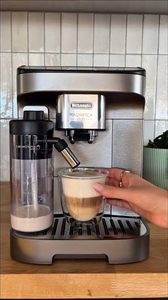
The De’Longhi Magnifica Duo is the kind of coffee machine that initially looks like it’s trying to do too much. It promises espresso, regular coffee, Americanos, cappuccinos, flat whites, lattes, iced drinks and even cold brew, while also grinding whole beans, handling milk automatically and remembering individual preferences. It sounds more like a small coffee shop than an espresso machine on paper.
After spending time looking at what the machine actually offers, however, I think that broad ambition is precisely what makes the Magnifica Duo interesting. It isn’t designed for the enthusiast who wants to weigh every dose, adjust a portafilter and manually steam milk. It’s designed for someone who wants genuinely fresh coffee, a reasonable degree of customization and a huge variety of drinks without turning the morning coffee routine into a project.
The current Magnifica Duo, like the ECAM332.80.SXB, combines a conical-burr grinder, 15-bar pump, 250-gram bean hopper, 1.8-litre water reservoir, and De’Longhi’s LatteCrema system. You also get 20 preset recipes, three user profiles, and a 2.4-inch display.
That’s a lot of machine for one countertop appliance.
If you click the button above you will be redirected to Amazon.com. In case you then decide to buy anything, Amazon.com will pay me a commission. This doesn’t affect the honesty of this review in any way though.
Specifications only tell part of the story, though. The bigger question is whether the Magnifica Duo is enjoyable to use. Does the espresso taste good? Is the grinder capable? Is the milk system genuinely convenient? Does cleaning become a daily chore? And, perhaps most, is the machine worth paying considerably more for than a simpler Magnifica model?
The Magnifica Duo gets close to the ideal experience of pressing a button for good coffee, in my opinion. It doesn’t replace a serious semi-automatic espresso setup, and there are compromises in extraction control and customization. But for a household that values convenience and variety, it is one of the more compelling fully automatic machines in its class.
Design & Build Quality
The De’Longhi Magnifica Duo makes a fairly strong first impression. It’s not the sort of appliance that disappears into the background of a kitchen. But and it doesn’t look like a commercial espresso machine. De’Longhi opted for a modern bean-to-cup design that feels premium yet approachable. The metallic exterior, dark plastic elements and clean front panel make it look like a sophisticated kitchen appliance, not specialist coffee equipment.
This distinction matters because the Magnifica Duo targets a different type of coffee drinker than manual espresso machines. Traditional espresso machines show off their mechanics, with visible portafilters, group heads, steam wands, and pressure gauges. The Magnifica Duo conceals most of that complexity. The grinder, brewing mechanism, and milk system are inside, leaving a relatively simple front interface., the design communicates exactly what the machine is supposed to do: make sophisticated coffee without requiring you to understand the machinery behind it.
The machine is substantial. The European version measures about 240 mm wide, 440 mm deep and 360 mm high, with a weight of roughly 9.4 kg. That makes it relatively compact considering everything packed inside it, although I wouldn’t describe it as a small coffee machine. The depth is worth noting. Forty-four centimetres is big on a kitchen counter, and you’ll need more room around the machine to remove the water tank, access the bean hopper and take out the drip tray.
In other words, the Magnifica Duo has a surprisingly small footprint for its capabilities, but don’t mistake “compact for a superautomatic” for “compact.”
This width is impressive. At around 24 cm, the machine doesn’t consume an enormous amount of lateral counter space. It can fit into kitchens where a wider espresso machine might be a problem. That tall, narrow form makes sense because the machine needs internal space for the grinder, brewing unit, water system, and milk technology.
The exterior is well-designed. The metallic finish gives the machine a more expensive appearance than an appliance made entirely from black plastic, while the darker elements provide some visual contrast. I like this approach because coffee machines tend to show splashes, fingerprints, and dried coffee. An entirely glossy surface can look fantastic for the first five minutes and then become a magnet for fingerprints. The Magnifica Duo’s finish is more practical.
That doesn’t mean it’s maintenance-free from a cosmetic perspective. Coffee gets around the dispensing area, and milk drinks can make a mess. But the design is forgiving. A quick wipe-down is generally enough to restore the machine’s appearance.
Build quality is what you’d expect for the price. It doesn’t have the heavy metal construction of a premium manual espresso machine and I don’t think you should expect it. The Magnifica Duo is mostly made of engineered plastics, which keeps weight and manufacturing costs down. And the parts you touch regularly feel strong enough for normal home use.
Superautomatic machines have more moving parts than conventional espresso makers, which makes this relevant. You’ve to remove and replace the water tank. This drip tray slides in and out. The coffee grounds container needs to be emptied. That brewing components need access now and then. The milk container is repeatedly attached and removed. It needs to handle many small interactions over time.
The Magnifica Duo generally feels designed with that reality in mind.
The layout is one of its strong points. The front dispensing area is easy to understand, and the coffee outlets are at a practical height for cups and glasses. Being able to adjust the outlet position is particularly useful because espresso cups, cappuccino cups and taller glasses have very different requirements. You don’t want coffee splashing onto a small cup, and you don’t want to struggle with a tall glass.
Given the Magnifica Duo’s focus on specialty and cold drinks, it’s even more important that it can handle different drink sizes. An espresso-focused machine can have a fixed dispensing area. It needs to fit small espresso cups and larger glasses for iced lattes or cold brews. So it needs a more flexible design.
The water tank is another example of sensible engineering. It has a 1.8-litre water capacity, which is a good balance between size and refilling. For one or two people, that’s generally enough for a useful number of drinks before you need to refill it.
The 250-gram bean hopper is also well suited for home use. It provides enough capacity that you’re not constantly pouring beans into the machine every morning, while still avoiding the enormous hopper sizes sometimes seen on commercial equipment.
But if you don’t drink coffee often, you might not want to fill the hopper completely. Coffee beans lose freshness when exposed to air, and a large hopper might make you leave them for too long. Someone who drinks several coffees every day probably won’t care, but a more occasional user may be better off keeping most of their beans in an airtight container and topping up the hopper as required.
One of the most important aspects of the physical design is accessibility. This is something that can be difficult to appreciate when looking at product photographs. A coffee machine can look beautiful on a retailer’s website while being incredibly annoying to live with.
The Magnifica Duo generally avoids that trap.
This removable components are designed around the reality that the owner needs to interact with them regularly. You can remove the water tank to fill it. This drip tray can be pulled out when it needs emptying. The grounds container is accessible without requiring you to dismantle the machine. They may not be glamorous, but they’re the things that determine whether you enjoy living with a coffee machine six months after buying it.
The bean hopper is conveniently positioned that refilling isn’t a chore. The grinder is key to the machine’s operation, so this matters. Unlike a capsule machine, you can’t simply ignore the coffee supply until the machine tells you something is wrong. Beans are a regular part of the workflow.
The milk system complicates the exterior design. The Magnifica Duo uses De’Longhi’s LatteCrema Hot & Cool technology and separate milk containers for its hot and cold drink capabilities. That adds some visible hardware to the front and side of the machine, but considering how much functionality is being squeezed into the appliance, I think De’Longhi has kept the overall appearance reasonably clean.
An interesting trade-off exists. A traditional steam wand would arguably give the machine a cleaner and more professional appearance, but it would also require substantially more skill from the user. The automatic milk system is less minimalist but more convenient. That’s the better choice for the intended audience.
The machine’s control panel also contributes to the overall design. Rather than using many mechanical buttons on the front, De’Longhi uses a relatively restrained digital interface. The 2.4-inch display helps maintain the impression that this is a modern appliance rather than an old-fashioned coffee maker.
I do think the display is one area where the design could be improved. With so many drinks and customization options available, a larger screen would make it feel more premium and could make navigating the menu easier. The interface is functional but not as sophisticated of everything happening behind it.
Countertop placement is also a consideration. Because the machine is fairly tall, you should think about the space between your counter and any cabinets above it. The machine needs access from above for the bean hopper and potentially for other maintenance tasks. A kitchen can technically have enough space for the machine while still making it awkward to refill because a cabinet is directly above it.
That’s one of those things I would check before purchasing rather than discovering after installation.
The Magnifica Duo benefits from not being too heavy. At around 9.4 kg, it’s substantial enough to feel stable during operation but not so heavy that moving it for cleaning becomes a major undertaking. That matters more than you might expect. Coffee machines accumulate dust, grounds, and spills underneath, so it’s useful to be able to move it periodically.
Overall, I think De’Longhi has made sensible compromises with the construction. The Magnifica Duo doesn’t pretend to be a commercial espresso machine. It’s a sophisticated domestic appliance with impressive coffee technology.
The plastics don’t bother me since it’s not about every component being metal. This question is whether it feels sturdy and its moving parts operate smoothly, whether the removable components are practical and whether the exterior can withstand years of normal kitchen use.
It performs well on those criteria.
This footprint is the biggest criticism. It’s deep and tall, and its presence is unmistakable. This is understandable given the technology packed into it.
The more I look at the design, the more I think the Magnifica Duo’s greatest strength is that it feels purpose-built around everyday use. Every physical component has a reason to exist. It’s not covered in unnecessary decoration, and the exterior isn’t overly complicated.
It’s a well-designed superautomatic, not an imitation of a professional espresso machine.
That makes it a particularly good fit for people who want a premium-looking appliance that can sit comfortably in a modern kitchen while doing a considerable amount of work behind the scenes.
User Interface & Ease of Use
Convenience is a major reason to choose a fully automatic coffee machine over a traditional espresso setup. The goal is to minimize the gap between wanting a coffee. And having it in your cup. The De’Longhi Magnifica Duo does well in this regard.
The machine is surprisingly approachable considering how much technology it contains. It grinds beans, doses coffee, controls water flow, manages temperature, handles milk, and switches between brewing approaches as needed. But from the user’s perspective, most of that complexity is hidden behind a straightforward digital interface.
That’s how I think a good superautomatic coffee machine should work.
A simple concept, a complicated machine
The Magnifica Duo has a 2.4-inch colour display and touch controls that guide the user through drinks and settings. De’Longhi kept the interaction intuitive: choose a drink, adjust if needed, and let the machine prepare it. It offers 20 hot and cold recipes, and allows drink customization and preference storage through three user profiles. (De’Longhi)
What I particularly appreciate is that the Magnifica Duo doesn’t force you to understand espresso terminology before you can use it.
No need to know what pre-infusion honestly means.
No need to understand pressure profiling.
You don’t need to know how to steam milk manually.
You don’t even necessarily need to understand the difference between every drink on the menu.
Want a cappuccino? Select cappuccino. Want an Americano? Select Americano. Want cold brew? Select cold brew.
The machine takes care of the technical side.
But many sophisticated appliances fail because they expose too much complexity to the user.
Drink selection
The biggest challenge De’Longhi faces with the Magnifica Duo is the sheer number of drinks.
Twenty recipes sounds fantastic in a specification sheet, but it can potentially make a user interface confusing. There’s a delicate balance between giving customers lots of choice and forcing them to navigate endless menus.
The Magnifica Duo handles this well.
Drinks are presented through the digital interface, no need to memorize button combinations. This makes it easier to experiment. You can explore drinks without consulting the manual each time.
This is useful when two people have different coffee habits.
One morning, you might want a simple espresso. This next day, you might want a flat white. On a hot afternoon, you might want an iced latte or cold brew.
The machine doesn’t require a different interaction for each drink.
The interface asks: what do you want?
The machine handles the How?
Customization without complexity
This is another area where the Magnifica Duo strikes a good balance.
Automatic machines can sometimes go too far in the opposite direction. You can end up with a product offering so many parameters that making a cup of coffee feels like configuring a computer.
The Magnifica Duo offers useful customization without too much involvement.
Depending on the recipe, you can adjust characteristics like coffee strength, quantity, and temperature. The controls vary by drink, which makes sense since an espresso and a latte don’t need the same settings.
This means the machine is flexible without making every coffee a technical exercise.
For someone who likes to experiment, there’s enough control to make a difference. For someone who just wants coffee, the default recipes are there.
That’s an excellent compromise.
Three user profiles are really useful
That inclusion of three user profiles is one of those features that initially sounds like marketing fluff but becomes surprisingly useful in a shared household.
Coffee preferences are very personal.
Someone might prefer a small, intense espresso.
Another person might like a larger, milder drink.
Someone else might want a cappuccino with lots of foam. And not much coffee.
If everyone has to configure their preferences manually every time, the personalization feature isn’t very useful.
The Magnifica Duo can remember individual preferences with three profiles, so different household members can have their preferred drinks without constantly changing the settings. (De’Longhi)
This is especially useful in the morning.
Nobody wants to stand in front of a coffee machine at 7 a.m. adjusting strength and volume while half-awake.
Ideally, you should be able to select your profile, select your drink and walk away.
The Magnifica Duo comes close to that experience.
The initial setup
The first-use experience is inevitably more complicated than everyday operation.
A machine like this needs to be configured before it can make coffee. You need to fill the water reservoir, add beans, set up the milk system, and go through the initial rinsing and preparation process.
There’s also a certain amount of reading involved.
I wouldn’t recommend unpacking a machine like this and pressing buttons without looking at the instructions. There are too many components and too many things happening internally for that to be a sensible approach.
Fortunately, it doesn’t take long to learn.
After the initial setup, everyday use becomes much simpler.
This is important to note. A machine doesn’t need to be simple to set up if it’s easy to use afterwards.
The Magnifica Duo is one of those machines.
The milk system is really user-friendly
Milk is often frustrating with automatic coffee machines.
With a traditional machine, you’ve to learn to position the steam wand, introduce air into the milk, create a whirlpool, control temperature, and clean the wand afterwards.
The Magnifica Duo removes almost all that.
The LatteCrema Hot & Cool system handles milk automatically; the machine determines how much milk and foam to deliver based on the recipe.
This makes cappuccinos and lattes accessible to people who haven’t learned traditional barista techniques.
That system can also handle cold foam for cold drinks, making the interface more impressive than a conventional automatic milk system. Instead of needing separate equipment for hot and cold milk, you select the drink and let the machine handle it.
This downside is you have another component to attach and clean.
But the trade-off is excellent from a usability perspective.
The cold-drink interface
The Magnifica Duo emphasizes cold drinks, which separates it from many conventional bean-to-cup machines.
Cold brew, iced coffee, and cold milk drinks require different preparation approaches than traditional hot espresso beverages. De’Longhi has tried to keep the user interaction consistent.
That means you don’t have to learn a separate machine just for iced coffee.
This detail makes the Magnifica Duo feel like a modern appliance, not just an espresso machine with extra buttons.
On-screen guidance
Another advantage of the digital interface is that the machine can communicate with the user.
When a component needs attention or a particular process needs to be performed, the display can provide instructions rather than leaving you wondering what went wrong.
This is especially useful for cleaning and maintenance.
A machine that simply flashes an unexplained warning light can be frustrating. You know something’s wrong. But you have to check the manual to find out what.
A machine that tells you what to do is much more user-friendly.
This is especially important for first-time superautomatic owners, who may initially find the number of removable components and maintenance procedures intimidating.
Where the interface could be better
The Magnifica Duo’s interface has its limitations.
The main limitation is the screen’s physical size.
At 2.4 inches, the screen is usable, but it doesn’t offer the premium touchscreen experience that some pricier competitors have.
This becomes more noticeable given how much functionality De’Longhi has packed into the machine.
Twenty drinks, multiple profiles, customizable settings and maintenance functions represent a considerable amount of information. A larger display could make browsing those options more visually appealing and potentially easier for users who aren’t particularly comfortable with digital interfaces.
The current display is functional rather than luxurious.
That’s an important difference.
I wouldn’t describe it as difficult to use. I think the interface could better reflect the machine’s sophistication.
Touch controls and everyday interaction
The touch controls are another sensible choice.
Physical buttons have advantages: they offer tactile feedback and can be easier to operate without looking. But they can clutter the front panel if there are too many functions.
Touch controls allow De’Longhi to keep the machine looking clean.
This downside is that touch controls lack the physical feedback of conventional buttons. You need to check the display to confirm your selection.
In practice, this isn’t a major problem because you’re generally standing in front of the machine when selecting a drink anyway.
How easy is it for a guest to use?
This is a crucial test for any automatic coffee machine.
Imagine someone visiting your house who has never seen the Magnifica Duo before.
Could they make themselves a coffee without you giving them a five-minute tutorial?
I’d say yes.
They may not immediately understand every drink or customization option, but the basic interaction is obvious enough that most people should be able to navigate it.
That’s a strong indication that De’Longhi has got the fundamentals right.
The line between convenience and automation
One thing I particularly like about the Magnifica Duo is that it doesn’t confuse automation with complexity.
The machine is highly automated internally, but the user experience remains relatively simple.
That’s not always the case with high-end appliances. Manufacturers sometimes assume that because customers paid more, they want more controls.
I don’t think that’s necessarily true.
Most people buying a superautomatic machine aren’t paying for the privilege of doing more work.
They’re paying to do less.
The Magnifica Duo understands that.
Workflow
The normal workflow is impressively short once you’re familiar with the machine.
If needed, choose a profile.
Select the drink.
Adjust strength or size if you want.
Place the appropriate cup underneath.
Start preparing.
That’s essentially it.
Milk drinks add a step with the milk container. But it’s still easier than manual steaming.
The machine handles grinding and brewing, so you don’t need to weigh beans, distribute grounds, tamp coffee, or clean a portafilter after each drink.
This difference is huge over a week.
A single manual espresso isn’t particularly difficult.
But making five or six drinks daily is different.
Automation doesn’t mean no responsibility
But there’s a caveat.
The Magnifica Duo is easy to use, but not hands-off.
You have to refill water.
You’ve to add beans too.
And you’ve to empty coffee grounds.
You also have to clean the milk system.
You’ve to do descaling and other maintenance when the machine asks.
The machine automates coffee prep, not ownership.
That’s reasonable.
If you expect a superautomatic coffee machine to never need cleaning, you’ll be disappointed no matter the brand.
User experience
The Magnifica Duo’s interface is successful because it simplifies the machine.
You get a lot of choices with the 20-drink menu. Customizable settings give you meaningful control. Three user profiles make it practical for households with different tastes. The automatic milk system removes the difficulty of steaming milk, and the digital display guides you when the machine needs attention.
This main criticism is the 2.4-inch display feels small for a machine with so much functionality. A larger interface could improve the premium experience.
But I would much rather have a relatively small, well-organized interface than a giant touchscreen buried beneath layers of unnecessary menus.
The Magnifica Duo gets it right: the machine should handle complexity, not the user.
That’s what makes it easy to live with.
For a first-time owner, the machine may initially seem sophisticated. After a few days, however, most of that sophistication fades into the background. You stop thinking about the grinder, milk texture, or brewing system. You simply select a drink and wait for it to appear.
That’s what I want from a premium bean-to-cup machine.
Coffee Quality & Brewing Performance
Coffee quality matters most with the De’Longhi Magnifica Duo, despite its impressive features. A machine can have an excellent interface, a clever milk system and a huge menu of drinks but if the coffee itself tastes flat, weak or inconsistent, none of those features are going to make much difference.
The Magnifica Duo produces very good coffee, especially with fresh, good-quality beans and some time to find the right settings.
But expectations need to be set correctly. This is a fully automatic bean-to-cup machine, not a high-end manual espresso setup. You don’t get the same control over dose, distribution, tamping, extraction time, and pressure as with a quality semi-automatic machine. A skilled home barista can extract more from a great coffee bean with a good grinder and espresso machine.
That’s not the competition, though.
It competes on convenience, consistency, and versatility. Its brewing performance is impressive in this category.
Freshly ground coffee is key.
The Magnifica Duo uses whole beans, not pre-ground coffee or capsules, which is a major advantage.
The machine grinds the beans immediately before brewing, which means the coffee retains considerably more of its aroma and flavour than coffee that has been sitting around in pre-ground form.
The integrated conical-burr grinder has 13 settings, so you can adjust the grind based on the beans and desired extraction.
That doesn’t give you the microscopic level of control available from a premium standalone grinder, but it is enough to make a meaningful difference.
And this is where I think new owners sometimes make a mistake.
They expect great coffee right away, no matter the beans.
That’s not realistic.
It can make good coffee, but not with stale or poor-quality beans. Old, over-roasted beans mean old, over-roasted coffee.
With fresh beans, its capabilities are more apparent.
Espresso is probably the best test of the machine’s brewing system because it exposes weaknesses more readily than milk-based drinks.
Milk, sugar, and flavorings can hide mediocre coffee.
A straight espresso can’t.
The Magnifica Duo’s espresso is satisfying. It uses automated grinding, dosing, and extraction, with pre-infusion to prepare the coffee. De’Longhi uses a high-pressure brewing system for its espresso drinks.
It produces a concentrated shot with reasonable body and crema.
The espresso isn’t identical to what you’d get from a carefully dialled-in commercial-style setup, but it has enough intensity and flavour to stand on its own.
What impressed me most is consistency.
Manual machines, even good ones, have many opportunities for mistakes. You can grind wrong, use the wrong dose, tamp unevenly, or stop the shot too soon.
It removes most of those variables.
With the right grind and strength, you can expect the next espresso to taste like the last.
For daily coffee makers, that consistency may be more valuable than control over extraction.
Finding the right settings
I’d say the beginning, maybe the first few cups, is where patience is key.
You shouldn’t judge the machine right away if the first espresso isn’t quite what you’re used to, it’s possible the taste will improve with the next shot. And it’s also worth considering that
What honestly matters is the grinder setting, coffee strength. And the type of bean used, as these all affect the final result.
Thin, watery coffee can be improved by trying a stronger aroma setting or a finer grind. But if extraction slows down too much or the coffee tastes too bitter, it’s best to back off on the grind.
Change one thing at a time, that’s the key.
Direct control is somewhat limited with an automatic machine, unlike a manual espresso setup where you’ve more control.
Spend a little time finding a setting that makes your preferred beans taste good, that’s the goal here, not to turn the Magnifica Duo into some kind of lab experiment.
The machine becomes remarkably easy to live with once that’s done.
Body, crema and flavour
The espresso from the Magnifica Duo usually has a rich enough body that it feels like real espresso, not just strong instant coffee.
Crema is also reasonably convincing.
Crema doesn’t automatically mean excellent espresso. Modern superautomatic machines can produce attractive crema, and what really matters is flavour balance.
Results are best when acidity, sweetness, and bitterness in coffee have a pleasant relationship.
Medium and medium-dark roasted beans work well in the machine for traditional espresso flavour. They produce enough body and intensity for straight espresso and milk drinks.
Lighter specialty roasts are interesting too, but they can be more finicky. What works on a manual setup may not work as well on a superautomatic machine, and that’s something to consider when experimenting with different beans.
Automatic brewing systems have limitations, and coffee beans don’t all respond the same way to different extraction methods, which isn’t a criticism of the Magnifica Duo.
Coffee beyond espresso
What’s interesting about the Magnifica Duo is it doesn’t just make espresso-style drinks.
The machine also offers coffee and Americano-style preparations, among other recipes. De’Longhi describes the Magnifica Duo as having separate technologies for espresso, coffee and cold brew rather than simply making every drink by extracting an espresso and adding water.
That distinction matters.
You want a strong shot of coffee, not a tiny espresso that’s been watered down with a huge amount of water, if a large cup is what gets you going in the morning.
The drinking experience is different with a proper coffee-style extraction.
The Magnifica Duo makes sense for households with different opinions on what constitutes “coffee.”
A person can have a short espresso.
Someone else can have a large coffee.
An Americano is fine for someone else.
They all come from the same machine.
American performance
Anyone switching from a traditional drip coffee maker will find the Americano particularly useful.
This drink gives you the strong flavor of espresso but with more water, making it lighter and easier to drink over time, it’s a longer drink.
A better Americano isn’t necessarily the advantage of the Magnifica Duo over a manual setup.
It makes one effortlessly.
There’s no need to separately boil water and mix it with espresso.
You select the drink and the machine handles the proportions.
Convenience is a big plus when making several drinks one after another.
The cold-brew experiment
This cold-brew function is what stands out as the most unusual part of the Magnifica Duo’s brewing performance, if I’m being honest.
Time is required for traditional cold brew.
To make it, you mix coffee and water, then let it steep for many hours, and finally filter it.
The Magnifica Duo has a very different approach overall.
De’Longhi claims it can make a cold-brew-style drink in under three minutes with its cold-brew tech, and it does this by using lower temps and pressure, which is what you need for cold extraction.
This process differs from traditional overnight immersion.
What matters isn’t whether the physics are the same.
What matters is if the drink is enjoyable.
This is where the Magnifica Duo makes a convincing case.
This drink is refreshing and less intense than a traditional hot espresso, making it well suited to ice. You get the flavour profile and experience of cold coffee without having to prepare a batch the night before.
Regular iced coffee drinkers may find this to be one of the machine’s most valuable features.
Cold coffee is more than just iced coffee
De’Longhi also didn’t treat cold drinks like an afterthought, which I appreciate.
The machine offers multiple cold recipes and the brewing process is designed around them. So you don’t just take a hot espresso. And pour it over ice.
This is important because ice changes the way coffee tastes. A hot espresso poured over a large amount of ice can become watery as the ice melts, while the balance between bitterness, acidity and sweetness can shift considerably.
The Magnifica Duo’s dedicated cold-drink approach is intended to account for that.
The result is a much more coherent cold coffee experience.
Managing temperature is another area where automatic machines have an advantage.
The machine controls water heating and delivery automatically, meaning the user doesn’t need to worry about manually managing brewing temperature.
You can also adjust the coffee temperature through the machine’s settings.
This is useful because different people have different expectations.
Some people want their coffee extremely hot.
And others prefer a drink they can consume right away.
This means you’re not stuck with De’Longhi’s default setting.
That said, there’s a limit to what a fully automatic machine can accomplish.
A manual espresso machine gives an experienced user far more opportunities to manipulate temperature and extraction. The Magnifica Duo deliberately hides those variables to keep the experience simple.
Again, that’s a trade-off rather than a defect.
But consistency is arguably its strongest suit
This more I consider the Magnifica Duo’s brewing performance, the more I think consistency is its strongest quality.
It’s nice to have a great espresso every now and then.
But a good espresso every morning is even better.
And a good espresso that can be produced by virtually anyone in the household without training is arguably better still.
The machine controls the major variables automatically, reducing the number of ways the user can accidentally ruin the drink.
That’s particularly useful in busy households.
You don’t have to teach another family member how to dial in a grinder or explain why the shot suddenly tastes bitter.
You can simply tell them which drink to select.
Milk is a different story
When making milk drinks, the quality of the coffee itself matters a lot.
If the espresso is mediocre, it can get lost in a lot of milk.
The Magnifica Duo’s espresso is strong enough to stand out in cappuccinos and lattes.
That’s important.
A milk drink should still taste like coffee.
If the espresso component is too weak, you end up drinking warm milk with a vague coffee flavour.
The Magnifica Duo generally avoids that problem, especially when the strength is adjusted appropriately.
For cappuccino and flat white-style drinks, I would generally favour a stronger coffee setting than I would for a straight espresso.
Manual machines still have an edge
There are limitations, and serious coffee enthusiasts will notice them.
The main difference is control.
With a manual setup, you can precisely measure the coffee dose, adjust grind size in tiny increments, control the amount of water and monitor extraction in real time.
You can also change your technique depending on the coffee.
The Magnifica Duo doesn’t offer that level of interaction.
You choose the parameters on the interface and the machine takes care of the rest.
For someone who enjoys coffee as a hobby, that can feel restrictive.
For everyone else, it’s probably liberating.
The machine isn’t trying to make you a barista.
It’s trying to make you coffee.
But the beans are important
If you’re going to spend this much money on a machine, I would strongly recommend spending some time experimenting with different beans.
This is perhaps the easiest way to improve the quality of the drinks without changing the machine itself.
Freshly roasted beans with a flavour you like can make a big difference.
The Magnifica Duo can handle different beans well enough that you can taste the difference.
A chocolatey, nutty medium roast will produce a completely different cappuccino from a bright, fruity light roast.
The ability to explore those differences is one of the major benefits of buying a bean-to-cup machine in the first place.
That overall experience
The Magnifica Duo doesn’t produce the absolute best espresso possible.
That’s not a criticism; it’s simply a consequence of its design philosophy.
Automation and repeatability are prioritized over manual control.
It produces a very good café-style coffee with a lot less effort than a traditional espresso setup.
The espresso has good body and respectable crema. Coffee and Americano recipes provide useful alternatives for people who prefer longer drinks. The grinder supplies freshly ground beans for every preparation. This dedicated cold-brew and cold-drink functions add versatility that most traditional bean-to-cup machines don’t offer.
Most, the machine is consistent.
Once you’ve chosen good beans and dialled in your preferred settings, you can make drink after drink without needing to think about the mechanics of extraction.
For a coffee enthusiast who enjoys controlling every variable, that might sound like a limitation.
For someone who wants excellent coffee before work without turning the kitchen into a laboratory, it’s arguably the machine’s greatest achievement.
The Magnifica Duo therefore occupies a very appealing middle ground. It doesn’t quite deliver the ultimate quality and control of a carefully operated manual espresso setup, but it gets close enough that the convenience becomes difficult to ignore.
And when you consider that it can move from espresso to a full-size coffee, cappuccino, Americano or cold brew with essentially the same level of effort, its brewing performance becomes even more impressive.
Grinder Features & Performance
That grinder is one of the most important components of any bean-to-cup coffee machine, and it’s arguably even more important in the De’Longhi Magnifica Duo. Because the machine is designed around the idea of going directly from whole beans to a finished drink at the touch of a button. You’re not buying the Magnifica Duo just to automate an espresso machine; you’re buying a system where the grinder is central.
De’Longhi hasn’t treated the grinder as an afterthought, fortunately. The Magnifica Duo has a conical-burr grinder with 13 settings. So users can control the grind. For a fully automatic domestic machine, that’s a useful range and it lets you adapt to different beans and preferences.
This grinder matters
The milk system looks impressive, but or the number of drinks available on the Magnifica Duo, coffee quality starts before brewing.
Grinding just before extraction preserves aroma and flavour rather than using pre-ground coffee that’s been exposed to air. This is one of the fundamental reasons bean-to-cup machines can produce substantially better coffee than basic pod or instant systems.
The Magnifica Duo’s grinder takes care of this automatically.
You put whole beans into the hopper, select your drink and the machine grinds the required amount immediately before brewing. There’s no separate grinder sitting beside the machine, no need to measure beans manually and no pile of coffee grounds left on the kitchen counter.
That makes a big difference to the overall workflow.
The machine doesn’t just automate brewing; it automates the preparation that comes before brewing as well.
The conical burr design
The Magnifica Duo uses a conical-burr grinder rather than a basic blade grinder.
That’s important because burr grinders are generally better suited to producing a relatively consistent particle size. Consistency matters in espresso because water passes through the coffee during extraction, and big variation in particle size can make it harder to achieve a balanced result.
A blade grinder essentially chops the beans, producing a mixture of larger pieces and fine particles. A burr grinder crushes the beans between two grinding surfaces, giving the manufacturer considerably more control over the resulting grind.
The Magnifica Duo isn’t using a premium standalone grinder with the kind of precision demanded by serious specialty-coffee enthusiasts, but it’s suitable for this machine.
13 grind settings
The 13 available grind settings are one of the grinder’s most useful features.
They give you enough room to adjust the machine when changing beans without overwhelming you with an enormous number of options.
This is an important balance.
A beginner doesn’t necessarily benefit from having 50 different grind settings. Too much choice can make it difficult to understand what is actually happening.
At the same time, having only two or three settings would make the grinder unnecessarily restrictive.
13 settings are a good middle ground.
If you’re using a particular coffee bean and finding that the espresso tastes weak or runs too quickly, you can try a finer setting. If the coffee tastes overly bitter or the machine is struggling to extract properly, a coarser setting can help.
The key is to make changes gradually.
You don’t want to make dramatic adjustments every time you brew a cup. This purpose of the grinder adjustment is to fine-tune the relationship between the coffee and the brewing system.
Don’t expect instant results from an adjustment
One thing worth understanding about automatic grinders is that changing the setting doesn’t necessarily mean the very next cup will perfectly represent the new grind.
Some of the previous grind can remain inside the grinder or brewing pathway, meaning there can be a small amount of transition between settings.
This is normal.
It’s also why I wouldn’t recommend constantly changing the grinder while trying to find the “perfect” setting.
Instead, make a small adjustment, prepare another drink and evaluate the result.
The process is much easier if you treat it as gradual calibration rather than a series of dramatic experiments.
Grind size and extraction
The reason grind adjustment sort of matters is relatively simple.
A finer grind generally increases the surface area of the coffee particles exposed to water and can slow the flow of water through the coffee bed. A coarser grind generally allows water to pass through more easily.
In an espresso context, that affects extraction.
If your coffee is flowing too quickly and tastes thin, a finer grind may help.
If the coffee is excessively slow, harsh or bitter, a slightly coarser setting may be more appropriate.
But grind size isn’t the only variable.
The coffee beans themselves matter enormously.
So do roast level, freshness, strength settings and the recipe you’re making.
That’s why the grinder should be thought of as one part of a larger system rather than a magic control that fixes every coffee problem.
That quality of the beans makes a big difference
The Magnifica Duo is only as good as the beans you put into it.
It’s obvious, but it sort of matters with a pricey machine like this.
Filling a pricey superautomatic with stale beans is like playing poor recordings on a high-end sound system.
This machine can extract what’s there.
It can’t create flavor that’s already gone.
Freshly roasted beans generally provide a much more interesting result and the differences between different coffee varieties become noticeable once the grinder and brewing system are doing their jobs properly.
Medium and medium-dark roasts are likely to appeal to people looking for traditional espresso characteristics: body, chocolate, caramel, nuts and relatively low acidity.
Lighter specialty roasts can also be used, but they may require more experimentation and may not produce the same results you would get from a manual espresso machine with a highly adjustable grinder.
The hopper holds 250 grams
The Magnifica Duo’s bean hopper holds about 250 grams of coffee in the European version.
It’s a sensible size for a home machine.
For a couple who drink several coffees daily, you won’t have to refill it all the time.
It’s large enough to be convenient, but not so large it feels like a small café.
But there’s a case against filling it up every time.
Beans lose freshness when they’re exposed to oxygen. If you only drink a couple coffees a week, it’s not ideal to leave 250 grams of beans in the hopper for a long time.
For heavy users, this isn’t a big issue since the beans get used up fast.
For occasional users, I’d add smaller amounts and keep the rest of the beans sealed.
Changing beans
A limitation of built-in grinders is that switching coffees isn’t convenient.
A separate grinder makes switching beans easier.
With a built-in grinder, some of the old coffee stays in the system. This means that if you change from one bean to another, the first drink or two may contain a mixture of the old and new coffee.
The Magnifica Duo isn’t the only one with this issue.
It’s just how built-in grinders work.
Most users won’t care.
But if you like switching between coffees daily, a separate grinder gives you more flexibility.
The Magnifica Duo is designed around convenience and consistency, not rapid coffee experimentation.
Grinder speed and noise
Grinding is when you really hear the machinery.
You can hear the grinder.
It’s just how it’s.
But it’s not too loud.
Independent hands-on testing has described the Magnifica Duo as relatively quiet for its category, with the grinder and pump producing noticeable but manageable noise.
I would describe the grinder as more “brief kitchen noise” than “annoying appliance noise.”
The fact that grinding only takes place for a relatively short period helps.
You hear the grinder, but not the whole time the machine is making the drink.
That’s important in a household where people may be sleeping nearby.
It isn’t silent enough to guarantee that nobody will wake up, but it’s not unusually loud for a bean-to-cup machine.
Grinder consistency is arguably more important than ultimate grinding precision in a machine like this.
Remember, the Magnifica Duo is designed to automate the entire process.
The grinder needs to produce consistent grounds. And a repeatable dose so that the brewing system can perform predictably.
That’s where the integrated approach makes sense.
This grinder, brewing unit and software are effectively working as one system.
The machine doesn’t expect you to take the grounds out, inspect them and make manual adjustments.
The grinder produces the coffee, and then the brewing system takes it and the machine keeps going.
That integration is one of the reasons superautomatic machines can be so convenient.
Strength control versus grinder adjustment
It’s worth noting the difference between grind setting and coffee strength.
These are not the same thing.
Grinder setting affects the ground coffee’s physical characteristics.
The machine’s strength or aroma setting determines the coffee amount used for a preparation.
This means you shouldn’t automatically change the grinder every time you want a stronger coffee.
For more intensity, strength control is usually the better first adjustment.
Use the grinder when improving extraction is the goal.
That’s an important distinction for new owners because randomly changing both controls at once makes it difficult to understand why the coffee changed.
How does it compare to a standalone grinder?
This is where expectations need to remain realistic.
A good standalone espresso grinder can offer much finer adjustment, greater control and, depending on the model, better consistency.
It can also allow you to switch beans more easily.
A dedicated grinder is therefore the obvious choice for somebody who considers grinding and espresso preparation part of the hobby.
The Magnifica Duo’s integrated grinder wins out on convenience.
No separate appliance is needed.
There are no beans to weigh.
No grinding into a dosing cup is required.
There’s no transferring grounds to a portafilter.
No need to clean a separate grinder each time you make coffee.
The Magnifica Duo takes care of it.
For the intended customer, that convenience is arguably more important than having the last few percentage points of grinding precision.
Grinder maintenance
The grinder adds another component that needs long-term attention.
Coffee leaves behind fine particles and oils, and some beans are oilier than others.
Very dark, heavily roasted beans can be especially problematic for automatic machines because their oils can accumulate more readily around the grinder and brewing system.
That’s another reason I’d favour relatively fresh, appropriately roasted beans rather than extremely oily supermarket beans.
Regular maintenance keeps the grinder running consistently.
Don’t use the bean hopper as a permanent storage container for any available coffee. Keeping the machine reasonably clean and avoiding unsuitable beans can contribute to more reliable operation.
The real-world experience
What I like most about the Magnifica Duo’s grinder is that it disappears into the experience.
That’s a compliment.
With a standalone grinder, you’re very aware of it.
It’s loud.
You measure out beans.
You make adjustments.
You distribute the grounds.
You clean the grinder.
With the Magnifica Duo, you mostly don’t think about any of that.
You press the drink button, hear a short grind, and then the machine brews.
The grinder’s job is to provide fresh coffee at the right grind size.
It does its job well enough that only those deeply into espresso preparation will notice the limitations.
Final assessment
The Magnifica Duo’s integrated conical-burr grinder won’t replace a high-end standalone espresso grinder for serious enthusiasts. The 13 settings offer useful but not great control, switching beans is less convenient than with a separate grinder, and experienced users will notice the lack of fine adjustment.
But as part of a fully automatic coffee machine, it’s a very good solution.
The grinder produces fresh coffee for every drink, offers enough adjustment for different beans, has a 250-gram hopper, and integrates smoothly with the brewing system.
Most, it’s low-maintenance for the user.
You can experiment with beans and settings if you want, but you don’t need to be a coffee expert to get good results.
That’s the Magnifica Duo’s philosophy.
The grinder isn’t meant to be the star.
It’s there to quietly prepare fresh coffee, consistently and automatically, so that the rest of the machine can turn it into espresso, coffee, cappuccino or one of the many other drinks on offer.
For a superautomatic machine, that’s exactly what I would want.
Maintenance & Cleaning
A major concern with fully automatic espresso machines is what happens after the coffee is made. A machine can produce excellent drinks, but if keeping it clean becomes a chore, that convenience starts to lose some of its appeal. The De’Longhi Magnifica Duo handles maintenance well, but it’s not completely hands-off. Several parts still need regular attention, particularly if you use the milk system often.
Most of the cleaning is straightforward and the machine does a lot of the routine work. Automatic rinsing, removable components, dishwasher-safe parts and on-screen prompts all make the process less intimidating than it might initially seem.
Automatic rinsing takes care of the basics
The first thing I noticed about the Magnifica Duo’s cleaning routine is how much of the basic work happens automatically. That machine’s automatic rinsing cycles clear coffee residue from the internal coffee path, keeping the system fresher between drinks.
This is particularly useful when turning the machine on or off. The Magnifica Duo takes care of much of this itself, so you don’t have to manually flush water through the system every time. You need to make sure the drip tray is in place, since the rinse water needs somewhere to go.
It’s a small feature, but it makes a difference in everyday use. With a traditional espresso machine, you may need to flush the group head, wipe the portafilter, knock out the coffee puck, and clean several surfaces after every session. Here, much of that routine is simplified to emptying containers and wiping down surfaces.
Of course, automatic rinsing shouldn’t be confused with a complete cleaning cycle. It helps with routine residue, but proper maintenance is still necessary.
The milk system needs the most attention
Keeping the Magnifica Duo clean is relatively easy if you mainly drink black coffee. The milk system requires more maintenance.
The machine uses De’Longhi’s LatteCrema Hot & Cool system for hot and cold milk drinks. This is one of the machine’s biggest strengths, as it allows you to make various drinks, from cappuccinos and lattes to cold foam drinks. Milk is also more demanding from a hygiene perspective than coffee.
After using the milk carafe, you need to run the cleaning process and rinse the milk-contact components properly. The machine provides automated assistance, which is helpful, but your involvement is still required.
This isn’t a criticism of De’Longhi specifically. Automatic coffee machines that handle fresh milk require regular cleaning. Milk residue can quickly become unpleasant if left sitting inside tubes or around connectors.
One thing I like about the Magnifica Duo is that the milk components are removable and dishwasher-safe. That makes deeper cleaning much easier. You can remove the relevant parts and give them a thorough wash, rather than trying to clean tiny internal passages by hand every time.
The milk carafes are easy to remove
This removable milk system is also practically convenient. You can detach the carafe after making milk drinks, rather than leaving it connected to the machine.
That is useful if you only drink milk-based coffee occasionally. You can keep the milk refrigerated and connect the carafe when you want a latte or cappuccino.
I would still recommend treating the milk carafe as something that needs attention immediately after use. Leaving leftover milk in the container for hours isn’t a good habit, even if you plan to use the machine later.
The Hot & Cool system means there are potentially more components involved than with a basic espresso machine. That is simply part of what you’re getting in return for the broader drink selection.
The drip tray and grounds container
The drip tray needs regular attention. Automatic rinsing means some water ends up in the tray even when you haven’t spilled anything, so it gradually fills during normal operation.
How often you need to empty it depends on how heavily you use the machine. A single coffee drinker may get several days out of it, while a household making multiple drinks will need to check it more often.
The coffee grounds container needs to be emptied periodically. One advantage of a fully automatic machine is that you do not have to knock out a portafilter after every espresso. This machine collects the used coffee grounds internally instead.
When the container is full, you remove it, empty the grounds, and put it back.
This job takes less than a minute and becomes part of the normal routine. It is worth getting into the habit of checking both the drip tray and grounds container together rather than waiting for the machine to become completely full.
Dishwasher-safe parts make a real difference
The Magnifica Duo’s use of dishwasher-safe removable components is a strong point. De’Longhi highlights dishwasher-safe parts as a convenience feature.
That may sound minor, but it matters over months and years of ownership. Coffee machines have plenty of awkward little components where coffee oils, milk residue, and mineral deposits can build up. Being able to remove parts and clean them thoroughly without scrubbing by hand is an advantage.
It also makes deep cleaning less likely to be put off. If cleaning is difficult, people tend to put it off. If a component can be removed and washed properly, it’s easier to stay on top of maintenance.
The brewing system is also important
But the visible parts get most of the attention, internal components need care too.
The Magnifica Duo automates much of the brewing. But it still needs cleaning. Coffee oils can build up over time, and these can eventually affect both taste and machine performance.
Automated cleaning helps, and regular maintenance is still important.
This is especially noticeable if you use the machine frequently. A machine that makes several drinks a day accumulates more residue than one that makes only a few cups a week.
Following instructions and responding to prompts is better than waiting for quality to drop.
Descaling is part of owning the Magnifica Duo
Water quality matters too. In areas with hard water, mineral deposits can build up inside the machine over time. That’s where descaling comes in.
The Magnifica Duo has a descaling process to remove deposits. Frequency depends on water hardness and usage, so there’s no one-size-fits-all schedule.
Using the settings and following maintenance is sensible.
A water filter can be used too, depending on market and config. Filtering the water can help reduce mineral buildup and may improve the overall experience, especially in hard-water areas.
I find this part less exciting, but it is also one of the most important. Ignoring descaling because the machine still appears to work normally can eventually lead to reduced performance.
Cleaning is quick but frequent
This most accurate way to describe the Magnifica Duo’s maintenance requirements is that they’re easy rather than nonexistent.
Most cleaning jobs are easy. Emptying the container takes seconds. The drip tray is simple to empty. Rinsing milk components is straightforward. This machine handles basic rinsing and cleaning.
Consistency is the challenge.
If you make many milk drinks daily, you need to attend to the milk system. The drip tray and container need regular monitoring.
This is still much less work than maintaining a traditional manual espresso setup, but it would be misleading to describe the Magnifica Duo as completely maintenance-free.
What about hygiene?
For a machine that handles fresh milk, hygiene should be taken seriously. That combination of automated milk-system cleaning and removable, washable components gives the Magnifica Duo a good foundation, but the owner must do their part.
I would avoid leaving milk inside the carafe unnecessarily, especially overnight. I would also make a habit of rinsing milk-contact components according to the manufacturer’s instructions rather than relying entirely on the automatic cleaning cycle.
The coffee side is similar. Wiping away coffee residue and keeping the areas around the dispensing spouts clean can prevent buildup and keep the machine looking much better.
Long-term ownership
Maintenance protects the investment. The Magnifica Duo is a fairly sophisticated machine, with an integrated grinder, automatic brewing system, dual milk functionality, pumps, sensors, and electronic controls.
Regular cleaning can’t guarantee nothing goes wrong, but it can help prevent avoidable problems caused by coffee oils, milk residue, or mineral deposits.
It also keeps performance consistent. A clean coffee path, grinder, and milk system keep drinks tasting the same.
My maintenance experience
The Magnifica Duo gets it mostly right. It doesn’t remove cleaning responsibility, but it automates enough to make maintenance manageable.
The milk system is key. Maintenance is easy if you drink mostly espresso or black coffee. Regular LatteCrema users need to accept more cleaning.
Removable parts are a big advantage, and automatic rinsing makes it less complicated. Don’t replace maintenance with these conveniences.
Overall, I would say the Magnifica Duo is easier to live with than many traditional espresso machines, but it rewards owners who keep it clean. That’s a fair trade-off for a machine capable of producing such a wide variety of drinks at the push of a button.
Milk Frothing & Specialty Drinks
Milk-based drinks stand out for the De’Longhi Magnifica Duo compared to basic automatic espresso machines. It isn’t simply an espresso maker with a basic milk nozzle attached. De’Longhi’s LatteCrema Hot & Cool system handles both hot and cold milk foam. That gives the Magnifica Duo a much broader range of drinks than you would normally expect from a bean-to-cup machine.
LatteCrema Hot & Cool system
What really sets it apart is the LatteCrema system. It froths milk automatically and pours it into your cup; no manual steaming or texture control needed.
This makes daily use really convenient. Select a drink, put your cup under the spout, and the machine takes care of the rest. You can also adjust the foam, which is useful since people like their foam differently.
The Magnifica Duo is designed to work with both dairy and plant-based milk, although the final result can naturally vary depending on the milk you use. Some plant-based milks, like barista-style oat or soy, make more stable foam than others.
Hot milk drinks
The machine’s hot drink selection is really strong. With the selected recipe, you can make cappuccinos, lattes, and other milk-based drinks without manual measuring.
Cappuccinos are a good test for automatic milk systems; they need enough foam to differ from lattes. It produces a thick, creamy foam instead of just heating the milk.
Lattes have less foam, and the system handles that well too. You can create a smoother, milkier drink without having to manually control the steam wand.
This consistency is probably the biggest advantage over making milk drinks manually. Once you find a setting you like, you can make a similar drink next time.
Cold foam and iced drinks
The “Hot & Cool” part of LatteCrema is particularly interesting because the Magnifica Duo isn’t limited to traditional hot coffee.
It can make cold foam for iced drinks, which is a big advantage over many bean-to-cup machines. De’Longhi also promotes the Magnifica Duo’s ability to prepare cold brew and other iced recipes quickly, with some cold drinks taking only a few minutes to prepare.
This makes it more versatile in warmer weather. You don’t need to switch methods for iced coffee; you can stay with this machine.
The cold foam is more than just cold milk in iced coffee. The machine creates a separate foamy texture, which makes the finished drink feel more like something you would order from a modern coffee shop.
Specialty drinks without the learning curve
This is where the Magnifica Duo makes the most sense for people who want variety without becoming coffee hobbyists.
Traditional espresso machines require grinding, dosing, tamping, pulling shots, steaming milk, and cleaning afterward for cappuccinos and lattes. None of those steps is particularly difficult individually, but together they can become a lot of work.
The Magnifica Duo simplifies this to selecting a recipe and making a few adjustments if needed.
You get around 20 preset recipes to try. The menu varies, but it includes espresso drinks, milk drinks, iced drinks, and cold brew options.
Milk texture and customization
The ability to adjust the foam is important because milk texture has a huge effect on the drinking experience. A cappuccino benefits from more foam, while a latte usually works better with a smoother, thinner layer.
It lets you personalize drinks instead of using the same format for every recipe. You can also customize strength and quantity to find a combination you like.
It won’t replace a professional steam wand’s control, but that’s not the point. The machine is designed to prioritize consistency and convenience.
That downside: milk still means cleaning
There’s one unavoidable trade-off. A sophisticated milk system means more cleaning.
After milk drinks, you need to clean the machine and keep the milk parts clean. Removable parts and dishwasher-safe components make it easier, but you still need to remember.
This matters if you make milk drinks daily. Espresso drinkers can largely avoid the extra work, while latte and cappuccino fans will need to build milk-system cleaning into their routine.
Overall milk and specialty drink performance
The Magnifica Duo’s milk capabilities are one of its biggest strengths. LatteCrema Hot & Cool makes good foam, the selection is big, and it makes specialty drinks easy.
That main compromise is that more functionality means more maintenance, particularly around the milk system. But for those who want these drinks without manual prep, the Magnifica Duo is really versatile.
Conclusion
De’Longhi Magnifica Duo is an impressive all-rounder for anyone who wants café-style variety without the work normally associated with a traditional espresso setup. Its biggest strength is the combination of convenience and versatility. With a built-in grinder, automatic brewing, and a LatteCrema Hot & Cool milk system, it also offers many hot and cold recipes, and it can handle more than a basic bean-to-cup machine.
Coffee quality is consistently good, and the grinder lets you adjust strength and extraction. The milk system is also a highlight, especially for cappuccino, latte, iced coffee, and cold foam fans. Being able to make both hot and cold drinks from one machine makes it appealing to households with different tastes.
It’s not completely maintenance-free, though. The milk system needs regular cleaning, and the drip tray, grounds container, brewing parts, and water system need attention over time. Fortunately, De’Longhi made these tasks manageable with automatic rinsing, guided cleaning, and dishwasher-safe parts.
The machine also takes up less counter space than you might expect given the amount of technology packed inside it. Its interface is straightforward, and the ability to save preferences through multiple user profiles is useful for households where everyone likes their coffee prepared differently.
The Magnifica Duo is best for people who want convenience without sacrificing variety. If you mainly drink simple espresso, there are cheaper machines that may make more sense. But if you want one appliance capable of producing espresso, milk drinks, iced beverages, cold foam, and cold brew with minimal effort, the Magnifica Duo makes a strong case for itself.
Overall, it’s a versatile and user-friendly automatic coffee machine that combines convenience, customization, and variety.