
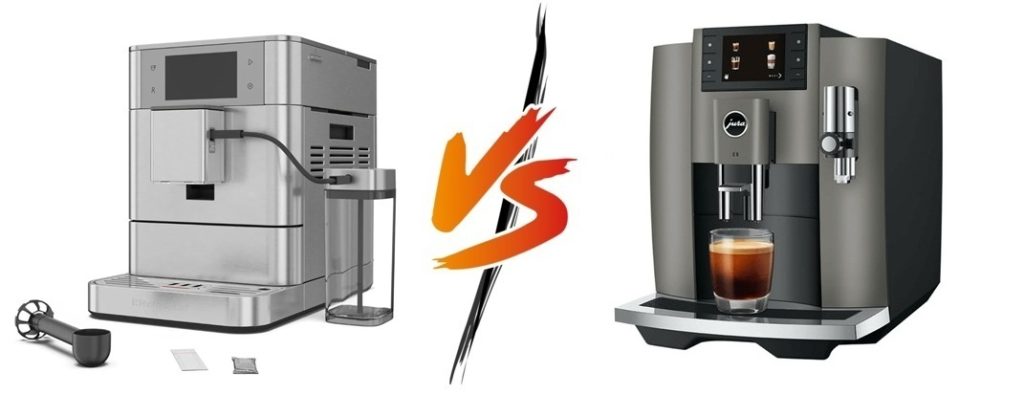
When you start your search for a high-end espresso machine that’s built for daily use, two names that often rise to the top are KitchenAid’s KF8 and Jura’s E8. Both promise fresh-ground coffee, precision brewing, and the convenience of an automatic machine. But they approach these goals in very different ways.
Before we dig into specific features, it helps to get a gut feel for each machine.
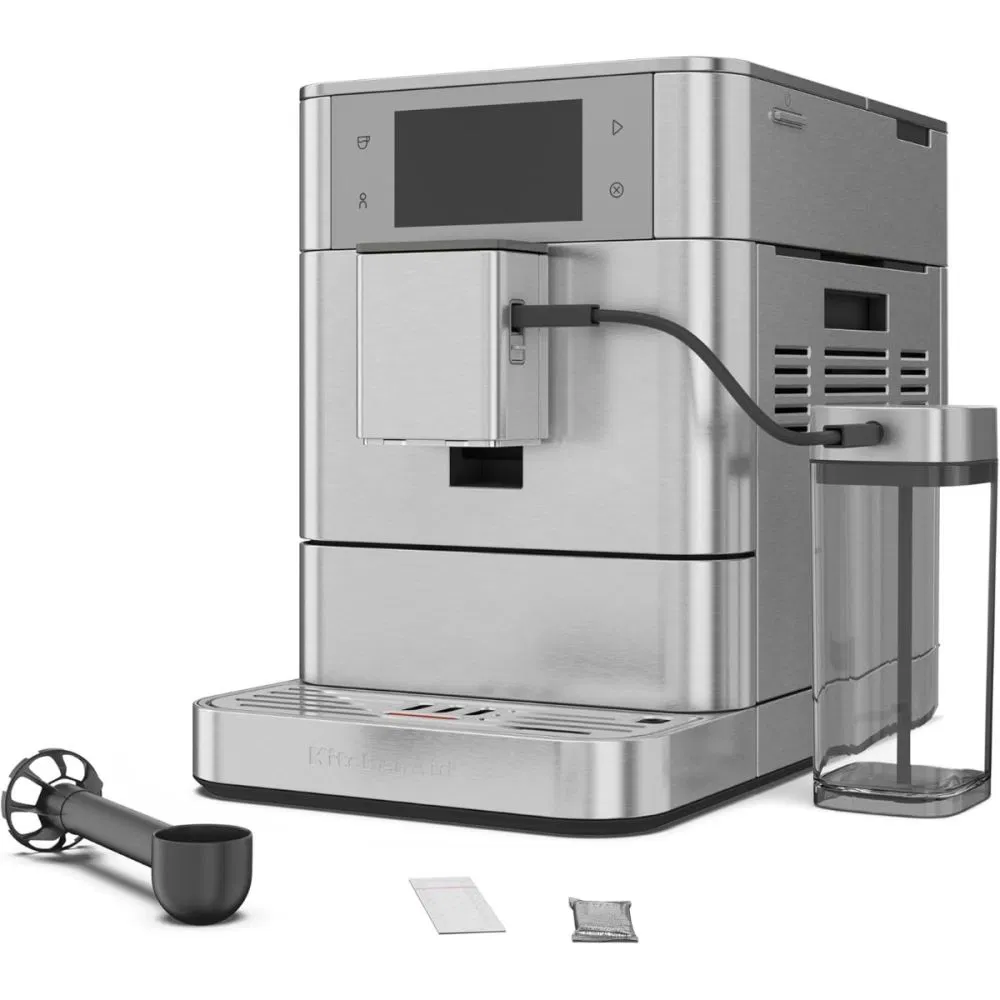
From the moment you take the KitchenAid KF8 out of the box, two things stand out: its substantial weight and its premium build. KitchenAid has clearly put emphasis on a rugged, industrial aesthetic. At the same time, it doesn’t feel stiff or clinical — there’s warmth to the design.
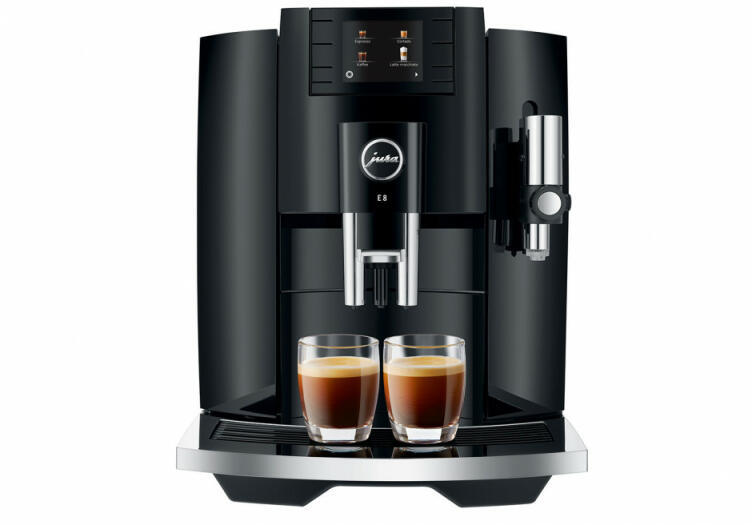
The Jura E8, on the other hand, feels more refined and modern. It’s sleeker, more compact, and looks like something you’d see in a high-end hotel lobby. Jura machines in general lean into a polished, almost minimalist look. The E8 is no exception.
Both machines are heavy and feel substantial. Neither feels “plasticky” or cheap. But the KF8 feels slightly more utilitarian and robust, while the E8 feels more premium and sophisticated.
Table of Contents
KitchenAid KF8 vs Jura E8 Comparison Chart
If you click the links below, under the product images, you will be redirected to Amazon.com. In case you then decide to buy anything, Amazon.com will pay me a commission. This doesn’t affect the honesty of this review in any way though.
| Specification | KitchenAid KF8 | Jura E8 |
|---|---|---|
 |  | |
| Check the best price on Amazon | Check the best price on Amazon | |
| Machine Type | Fully automatic espresso machine | Fully automatic espresso machine |
| Dimensions (W × H × D) | Approx. 10.9 × 14.4 × 16.5 in | Approx. 11.0 × 13.8 × 17.6 in |
| Weight | Approx. 28–30 lbs | Approx. 22–24 lbs |
| Body Materials | Stainless steel & metal panels | High-grade plastic with metal accents |
| Pump Pressure | 15 bar | 15 bar |
| Heating System | Thermoblock heating system | Thermoblock heating system |
| Brew Group | Removable | Sealed (non-removable) |
| Grinder Type | Conical burr grinder | Conical burr grinder (Jura Precision Grinder) |
| Grinder Adjustment | Stepped grind settings | Stepped grind settings |
| Bean Hopper Capacity | Approx. 9–10 oz | Approx. 9.9 oz |
| Water Tank Capacity | Approx. 74 oz (2.2 L) | Approx. 64 oz (1.9 L) |
| Milk System | Automatic milk frother | Automatic milk system with fine foam technology |
| Milk Temperature Control | Yes | Limited (mostly automated) |
| Drink Customization | High (manual adjustment of parameters) | High but more automated |
| Number of Drink Options | Multiple espresso & milk-based drinks | Wide variety of one-touch specialty drinks |
| Display Type | Color touchscreen + physical buttons | TFT color display + rotary dial |
| User Profiles | Limited / manual | Supported (varies by model version) |
| Cleaning Programs | Semi-automatic | Fully automatic |
| Milk System Cleaning | Manual-assisted | Automatic rinse & cleaning |
| Water Filtration | Optional filter | Jura CLARIS filter system |
| Auto Shut-Off | Yes (programmable) | Yes (energy-saving mode) |
| Noise Level | Moderate to loud (grinder) | Quiet (especially grinder) |
| Power Consumption | Standard for class | Optimized with energy-saving modes |
| Country of Manufacture | Designed in USA | Made in Switzerland |
| Typical Price Range | Premium / upper-tier | Premium / flagship-tier |
| My individual reviews | KitchenAid KF8 review | Jura E8 review |
Design & Build Quality
Design and build quality are often underestimated when people shop for espresso machines, but after living with one on your counter every day, they matter a lot. These machines aren’t small, cheap, or easily hidden away. They become permanent fixtures in your kitchen, so how they look, how they feel to use, and how well they’re built all play a big role in long-term satisfaction. The KitchenAid KF8 and the Jura E8 take noticeably different approaches here, even though both aim squarely at the premium market.
KitchenAid KF8: Solid, Industrial, and Purpose-Driven
The first word that comes to mind when you see the KitchenAid KF8 in person is substantial. This machine looks and feels heavy-duty. It has the kind of presence you expect from a brand that built its reputation on stand mixers designed to last decades. The KF8 doesn’t try to be flashy or futuristic. Instead, it leans into a more industrial, almost professional aesthetic.
A large portion of the exterior uses metal, particularly stainless steel, and it shows. The panels feel thick and rigid, with no flex when you press on them. The drip tray is heavy and slides in and out smoothly without rattling. The water reservoir walls are sturdy, not thin or brittle, and the bean hopper lid closes with a reassuring firmness. These are small details, but together they give the sense that the KF8 was built to withstand daily use without complaint.
Visually, the KF8 is more angular than the Jura E8. The edges are sharper, the surfaces flatter, and the overall shape feels more mechanical. Some people will love this look, especially if they appreciate commercial-style equipment or already own other KitchenAid appliances. Others may find it a bit boxy or utilitarian, especially in a modern or minimalist kitchen.
In terms of finish, KitchenAid offers the KF8 in classic, neutral colors that won’t clash with most kitchens. The finish resists fingerprints fairly well, which is something you’ll appreciate if you make multiple drinks a day. Smudges still happen, but they’re easier to wipe off than on glossier machines.
Ergonomically, the KF8 is well thought out. The water tank is large and easy to grip when removing it for refilling. The drip tray sits at a comfortable height for standard mugs and can be adjusted slightly to accommodate taller cups. The control layout is logical, even if the interface itself takes time to learn. Every physical component feels like it was designed with durability first and elegance second.
One thing worth noting is size. The KF8 takes up a fair amount of counter space, both in width and depth. It’s not outrageously large for a fully automatic espresso machine, but it’s not compact either. If you have limited counter space or shallow counters, this is something to measure carefully before buying.
Jura E8: Sleek, Refined, and Intentionally Polished
If the KitchenAid KF8 feels like a professional tool, the Jura E8 feels like a luxury appliance. Jura’s design philosophy is immediately obvious the moment you unbox the E8. Everything looks smoother, more refined, and more intentional from an aesthetic standpoint.
The E8 uses high-quality plastic for much of its exterior, but this is not a negative in practice. The plastic is thick, solid, and well-finished, with no creaking or hollow sounds when you touch it. Metal accents are used strategically rather than everywhere, which keeps the machine lighter and visually cleaner without sacrificing durability.
One of the E8’s biggest strengths is how cohesive it looks. The curves flow naturally from one surface to the next. Buttons, spouts, and panels feel integrated rather than attached. The display sits neatly in the front without looking like an afterthought. From almost any angle, the machine looks deliberate and balanced.
Jura also does an excellent job with proportions. The E8 is slightly more compact than the KF8, especially in depth, which makes it easier to fit into smaller kitchens. Despite its smaller footprint, it doesn’t feel cramped or undersized. The cup clearance is generous, and the drip tray doesn’t feel shallow or flimsy.
The finish on the E8 is particularly impressive. Jura offers subtle, elegant color options that reflect light softly rather than sharply. Fingerprints are less noticeable than on brushed metal surfaces, and the machine maintains a clean look with minimal wiping.
From a usability perspective, the E8’s build quality supports its ease of use. The water tank slides out smoothly and locks back into place without effort. The grounds container fits snugly and doesn’t shift around during operation. Even the bean hopper lid feels carefully weighted and well-sealed, which helps keep beans fresh and reduces rattling noise.
Durability and Long-Term Confidence
Both machines inspire confidence, but in different ways. The KF8 feels like something you could knock into accidentally without worrying about damage. Its weight and metal construction give it a tank-like quality. You get the sense that it’s designed to handle years of heavy use, even if it’s not treated gently.
The Jura E8 inspires confidence through precision rather than brute strength. Everything fits perfectly. Nothing feels overbuilt, but nothing feels fragile either. It feels like a machine engineered to tight tolerances, where each part does exactly what it needs to do and no more.
Over time, this difference in philosophy may matter depending on how you use your machine. If you’re rough on appliances, move them often, or value sheer toughness, the KF8’s construction may appeal more. If you prefer a refined, well-finished appliance that looks elegant and operates smoothly, the E8 will likely feel more satisfying.
Aesthetic Impact on the Kitchen
An often-overlooked part of design is how the machine fits into your daily environment. The KF8 makes a statement. It looks serious, functional, and unapologetically like a piece of equipment. In some kitchens, that’s a positive. In others, it may dominate the space more than you’d like.
The E8 blends in more easily. It still looks premium, but it doesn’t draw attention in the same bold way. It feels more like a luxury appliance than a tool, which makes it easier to integrate into a wide range of kitchen styles.
Design & Build Quality Verdict
The KitchenAid KF8 and Jura E8 are both very well-built machines, but they cater to different tastes. The KF8 prioritizes durability, metal construction, and a rugged presence. The E8 prioritizes elegance, cohesion, and refined engineering.
Neither approach is wrong. The right choice depends on whether you value industrial strength or polished design more. What’s clear is that both machines justify their premium status in build quality alone, and neither feels like a compromise in this category.
User Interface & Ease of Use
User interface and ease of use are where fully automatic espresso machines either shine or frustrate. These are machines you’ll interact with multiple times a day, often before you’ve had your first cup of coffee. If the controls are confusing, slow, or poorly laid out, that annoyance adds up quickly. The KitchenAid KF8 and the Jura E8 both aim to make high-quality coffee accessible, but they take very different paths in how they handle user interaction.
KitchenAid KF8: Feature-Rich but Less Intuitive
The KitchenAid KF8 combines a color touchscreen with physical buttons, which on paper sounds like the best of both worlds. In practice, it’s a mixed experience. The screen itself is clear and responsive, with decent brightness and contrast even in a well-lit kitchen. Icons are reasonably large and easy to read, and there’s enough information on screen to understand what the machine is doing at any given time.
Where the KF8 stumbles slightly is in how information is organized. The main drink selection menu is straightforward enough, but once you move beyond basic espresso or coffee, the navigation becomes more layered. Adjusting settings like brew temperature, pre-infusion time, or grind strength often requires diving into submenus. None of this is overly complicated, but it’s not immediately obvious either.
The physical buttons help, especially for basic functions like starting or stopping a brew cycle. They’re well-placed and have a satisfying tactile feel. This is something KitchenAid tends to do well. You always know when a button press has registered, which is reassuring when you’re making coffee early in the morning and not fully awake.
Customization is a major focus of the KF8’s interface. You can fine-tune a lot of variables, which will appeal to users who like control. The downside is that this level of control comes at the cost of simplicity. New users may feel slightly overwhelmed at first, especially if they’re used to machines that just ask you to press one button and walk away.
Another issue is flow. The KF8 sometimes feels like it makes you take extra steps to do simple things. For example, changing a drink size or strength mid-selection isn’t always as quick as it should be. The machine is capable, but it doesn’t always anticipate what the user wants to do next.
That said, once you’ve spent a week or two with the KF8, most of these issues fade. Muscle memory kicks in, and you start navigating the menus without thinking. The interface isn’t bad, it just isn’t instantly intuitive. This is a machine that rewards patience and familiarity.
Jura E8: Designed for Effortless Interaction
The Jura E8’s interface is one of its strongest features, and it’s clear that Jura has spent a lot of time refining how users interact with their machines. The E8 uses a combination of a central rotary dial and a TFT color display, and this setup works exceptionally well.
The rotary dial is the star of the show. You turn it to scroll through drink options, press it to select, and the machine responds instantly. There’s no lag, no guessing whether your input registered. It’s fast, precise, and intuitive in a way that touchscreens often aren’t, especially when your hands are wet or slightly sticky from milk.
The display itself is crisp and uncluttered. Jura does an excellent job of presenting information without overwhelming the user. Drink names are clear, icons are simple, and the machine guides you step-by-step when necessary. If it needs water, beans, or cleaning, it tells you plainly and at the right time.
One of the E8’s biggest advantages is how easy it is to make adjustments on the fly. Want a stronger coffee? Turn the dial. Want a larger cup? Adjust it before brewing starts. These changes are visible immediately on the screen, and the machine remembers your preferences if you want it to.
There’s a sense that the E8 is always one step ahead of the user. It anticipates common actions and minimizes the number of inputs required. This is especially noticeable when making multiple drinks in a row. The machine doesn’t force you to re-enter settings or confirm choices unnecessarily.
For households with multiple users, the E8’s interface is a big win. Even someone who has never used the machine before can walk up, turn the dial, and make a drink with very little instruction. That kind of accessibility matters more than you might think over the long term.
Learning Curve and Daily Use
The learning curve for these two machines is noticeably different. The KF8 asks more of the user upfront. You’ll spend time exploring menus, understanding how different settings affect the brew, and figuring out where everything lives in the interface. For some people, this is part of the fun. For others, it can feel like unnecessary friction.
The Jura E8, by contrast, feels immediately comfortable. You can ignore advanced settings entirely and still get excellent coffee. When you’re ready to explore customization, it’s there, but it never gets in the way of basic use.
Daily use also highlights differences in speed and responsiveness. The E8 feels quicker in almost every interaction. Menu transitions are fast, selections register instantly, and the machine gets to work without delay. The KF8 isn’t slow, but it feels more deliberate and slightly less fluid.
Feedback and Communication
Both machines provide feedback to the user, but again, they do it differently. The KF8 uses visual prompts and icons that sometimes require interpretation. You may need to look closely at the screen to understand what the machine is asking for.
The Jura E8 communicates more clearly. Messages are concise and direct. When maintenance is needed, it explains what needs to be done and often guides you through the process. This reduces guesswork and makes ownership less stressful, especially for users who don’t enjoy troubleshooting.
Accessibility and Comfort
Physical comfort also plays a role in ease of use. The KF8’s touchscreen requires precise taps, which may not be ideal for everyone. The Jura’s rotary dial, on the other hand, is easy to use regardless of hand size or dexterity.
For users with limited vision or mobility, the E8’s interface is likely more accessible. The text is clearer, the controls are tactile, and the overall interaction feels more forgiving.
User Interface & Ease of Use Verdict
The KitchenAid KF8 offers depth and customization, but it asks the user to invest time in learning its interface. It’s best suited for people who enjoy adjusting settings and don’t mind a slightly more complex control scheme.
The Jura E8 prioritizes clarity, speed, and intuitive interaction. It’s easier to use out of the box, faster in daily operation, and more accommodating to multiple users with different levels of experience.
If ease of use is a top priority, the Jura E8 clearly has the advantage. The KF8 is capable and powerful, but the E8 simply makes the process of getting great coffee feel more natural and effortless.
Coffee Quality & Brewing Performance
Coffee quality is ultimately the reason these machines exist. You can forgive a clunky menu or a bulky footprint if the espresso in the cup is consistently excellent. This is where both the KitchenAid KF8 and the Jura E8 justify their premium pricing, but they do so in slightly different ways. Both machines produce high-quality coffee, yet the character of that coffee, and how reliably it’s delivered, reveals meaningful differences.
KitchenAid KF8: Bold Extraction and Hands-On Control
The KitchenAid KF8 is clearly designed with the idea that great coffee comes from giving the user control over the brewing process. From the moment you start pulling shots, it’s obvious that this machine is capable of producing rich, full-bodied espresso with real depth.
The KF8 uses a powerful pump system paired with a well-insulated thermal brew group. In practical terms, this means stable water temperature throughout the extraction process. Temperature stability is critical for espresso. Too cool, and the shot tastes thin and sour. Too hot, and bitterness dominates. The KF8 does a very good job of holding its temperature, even when pulling multiple shots back-to-back.
Crema quality is another strong point. With fresh beans and a properly adjusted grind, the KF8 consistently produces thick, golden crema. It’s not just visually appealing, it also contributes to mouthfeel and aroma. The crema tends to be dense rather than airy, which gives the espresso a more traditional, café-style texture.
Flavor-wise, the KF8 leans slightly toward boldness. Medium and dark roasts come through with strong chocolate, nut, and caramel notes. The machine extracts confidently, which makes these roasts taste full and satisfying. Lighter roasts can also shine, but they require a bit more tweaking. Adjusting pre-infusion time and brew temperature makes a noticeable difference, and the KF8 rewards users who are willing to experiment.
Pre-infusion is particularly effective on this machine. A longer pre-infusion helps evenly saturate the coffee puck before full pressure is applied, leading to more balanced extraction. When dialed in correctly, shots from the KF8 have good clarity without sharp acidity.
Consistency is solid overall, but it does depend on user input. If you change beans or grind settings frequently, you may notice small variations until everything is dialed back in. This isn’t a flaw so much as a consequence of offering more control. The KF8 behaves a bit like a semi-automatic machine in that sense. It’s capable of excellent results, but it asks the user to participate.
Jura E8: Smooth, Balanced, and Remarkably Consistent
The Jura E8 approaches coffee quality from a different angle. Its goal is not to give the user maximum control, but to deliver consistently excellent results with minimal effort. And in that respect, it succeeds extremely well.
Jura’s proprietary brewing system is designed to optimize extraction automatically. Water temperature, pressure, and contact time are carefully calibrated by the machine itself. The result is espresso that is smooth, well-balanced, and very forgiving across different bean types.
One of the most impressive aspects of the E8 is its consistency. Shot after shot, the flavor profile remains stable. Whether you’re making one espresso or five in a row, the machine maintains temperature and pressure with very little variation. This makes the E8 especially appealing for households where multiple people use the machine throughout the day.
Crema from the E8 is excellent. It tends to be slightly lighter in texture than the KF8’s, but still rich and aromatic. The crema integrates well with the espresso rather than sitting heavily on top, which contributes to a smoother mouthfeel.
In terms of flavor, the E8 shines with balance. It handles medium and dark roasts beautifully, producing espresso that’s rich without being aggressive. Bitterness is well-controlled, and acidity is present but never sharp. Lighter roasts are also handled well, with the machine extracting enough complexity to highlight fruity or floral notes without turning sour.
One thing the E8 does particularly well is long coffee drinks. Americanos and café-style coffees taste clean and well-extracted, without the watered-down character that some automatic machines produce. The brewing system seems to adapt well to larger volumes of water, maintaining flavor integrity.
Temperature and Pressure Control
Both machines do an excellent job with temperature, but the way they manage it differs. The KF8 allows more manual adjustment, which is great for users who want to fine-tune their brew. The E8 manages temperature automatically and very effectively, making it nearly impossible to brew a bad cup unless the beans themselves are poor.
Pressure delivery is strong and stable on both machines. The KF8’s shots feel slightly more assertive, with a heavier body. The E8’s pressure profile feels smoother, resulting in a more rounded cup.
Back-to-Back Brewing Performance
If you frequently make multiple drinks in a row, performance consistency matters. Both machines handle this well, but again, the E8 has a slight edge. It recovers quickly between shots and maintains flavor consistency even during longer brewing sessions.
The KF8 performs well too, but you may notice small variations if you’re adjusting settings or switching between drink types. This isn’t a deal-breaker, but it’s something to be aware of.
Coffee Quality Across Drink Types
Espresso is only part of the picture. Both machines also brew lungo, coffee, and specialty drinks. The KF8 tends to produce stronger, more intense coffee across the board. If you like your drinks bold, you’ll appreciate this character.
The E8 produces coffee that’s smoother and more approachable. It’s less intense, but also less likely to overwhelm the palate. This makes it a better fit for a wider range of tastes, especially in multi-user households.
Coffee Quality & Brewing Performance Verdict
The KitchenAid KF8 delivers excellent coffee with a bold, expressive character. It rewards users who enjoy adjusting settings and experimenting with different beans. If you like to be involved in the brewing process and want a machine that responds to fine-tuning, the KF8 is deeply satisfying.
The Jura E8 delivers outstanding coffee with remarkable consistency and ease. It’s less about experimentation and more about reliability. If you want great espresso every time without thinking about it, the E8 excels.
In pure quality terms, both machines are capable of excellent results. The difference lies in style. The KF8 feels like a machine for enthusiasts who want to shape their coffee. The E8 feels like a machine that quietly does everything right, no matter who’s using it.
Grinder Features & Performance
The grinder is one of the most critical components in any espresso machine. You can have perfect temperature control and an excellent brewing system, but if the grind quality is inconsistent, the coffee will never reach its full potential. In fully automatic machines like the KitchenAid KF8 and Jura E8, the grinder has an even bigger role because it operates behind the scenes, making decisions for the user on every single cup. Both machines include built-in burr grinders, but they differ in refinement, adjustability, and overall performance.
KitchenAid KF8: Powerful, Capable, and Slightly Raw
The KitchenAid KF8 is equipped with a built-in burr grinder designed to handle a wide range of beans and brewing styles. From the first use, it’s clear that this grinder prioritizes power and consistency. The motor feels strong, and it has no trouble grinding even oily dark roasts, which can sometimes cause issues in lesser machines.
The grind consistency is generally very good. For espresso, the KF8 produces fine, relatively uniform grounds that allow for solid extraction and good crema. There is some variation, which is expected with an integrated grinder, but it’s not enough to negatively affect cup quality in everyday use.
Grind size adjustment on the KF8 is stepped rather than stepless. This means you select from predefined grind levels rather than dialing in micro-adjustments. For most users, this is perfectly adequate. The available range covers everything from very fine espresso grinds to coarser settings suitable for long coffee drinks. However, for users who like to obsess over tiny changes in extraction time, the stepped system may feel slightly limiting.
One thing to keep in mind is that grind adjustments on the KF8 are best made while the grinder is running. This helps prevent beans from getting stuck between the burrs. KitchenAid does mention this in the manual, but it’s easy to forget if you’re used to external grinders. It’s not difficult, just something that requires attention.
In terms of speed, the KF8’s grinder is reasonably quick. It grinds a dose of coffee in a short amount of time, but it’s not the fastest on the market. The grinding process feels deliberate and mechanical rather than refined. You hear the motor working, and the sound is noticeable, especially in a quiet kitchen.
Noise is probably the KF8 grinder’s weakest point. It’s not excessively loud, but it’s clearly louder than the Jura E8. Early morning users may find it a bit intrusive, particularly if the kitchen opens directly into living or sleeping spaces.
Jura E8: Refined, Quiet, and Highly Consistent
The grinder in the Jura E8 feels like the result of years of refinement. Jura has long focused on grinder technology, and it shows here. The E8’s grinder is impressively quiet for a fully automatic espresso machine. The sound it makes is more muted and less sharp than the KF8’s, which makes a noticeable difference in daily use.
Grind consistency is excellent. The E8 produces very uniform grounds, especially at espresso-fine settings. This contributes directly to the machine’s consistent extraction and balanced flavor profile. Shots tend to flow smoothly and predictably, with less variation from cup to cup.
Grind adjustment on the E8 is also stepped, but the steps feel more precisely calibrated. Each adjustment makes a clear difference in extraction time and flavor. The adjustment mechanism itself is easy to access and intuitive to use, even for beginners.
One advantage of the E8’s grinder is how well it handles a variety of beans. Light roasts, medium blends, and dark, oily beans all grind smoothly without excessive clumping or resistance. The grinder seems particularly adept at minimizing fines, which helps reduce bitterness and over-extraction.
Speed is another area where the E8 shines. Grinding is fast and efficient, contributing to the machine’s overall feeling of responsiveness. Combined with its quieter operation, this makes the entire brewing process feel smoother and less disruptive.
Bean Hopper Design and Capacity
The bean hopper on the KF8 is generous in size and well-sealed. It can hold enough beans for several days of regular use, which is convenient if you don’t want to refill it constantly. The lid fits tightly, helping preserve bean freshness and prevent moisture from getting in.
The Jura E8’s bean hopper is slightly smaller, which may require more frequent refilling if you drink a lot of coffee. However, the lid is also well-sealed, and Jura’s design helps reduce bean exposure to air and light. For users who like to switch beans often, the smaller hopper can actually be a benefit, as it encourages fresher beans and easier changes.
Impact on Flavor and Extraction
Both grinders do a good job of supporting their respective brewing systems, but they influence flavor differently. The KF8’s grinder contributes to a bolder, more assertive cup. The grounds tend to promote strong extraction, which suits users who enjoy intense flavors and heavy body.
The E8’s grinder supports a smoother extraction. The uniform grind and reduced fines result in coffee that’s clean and well-balanced. This is especially noticeable in lighter roasts and long coffee drinks, where clarity matters more.
Maintenance and Longevity
Maintenance of the grinder is minimal on both machines, as they’re not designed to be disassembled by the user. That said, the E8 seems to require less attention overall. Its grinder stays cleaner and performs consistently over time with less noticeable buildup.
The KF8’s grinder may benefit from occasional use of grinder cleaning pellets, especially if you use oily beans frequently. This helps maintain performance and reduce residue.
Grinder Features & Performance Verdict
The KitchenAid KF8 offers a powerful, capable grinder that produces good results and supports a wide range of brewing styles. It’s slightly louder and less refined, but it delivers the strength and consistency needed for bold espresso.
The Jura E8’s grinder stands out for its quiet operation, excellent consistency, and refined performance. It enhances the machine’s overall ease of use and contributes to its reputation for reliable, high-quality coffee.
If grinder noise, smooth operation, and consistency are top priorities, the Jura E8 has a clear advantage. If you value power, capacity, and a more robust feel, the KitchenAid KF8’s grinder will still serve you very well.
Milk Frothing & Specialty Drinks
For many people, milk-based drinks are where an espresso machine truly earns its place in the kitchen. Lattes, cappuccinos, flat whites, and macchiatos are daily staples, not occasional treats. That makes milk frothing performance and specialty drink execution just as important as espresso quality itself. The KitchenAid KF8 and Jura E8 both offer automatic milk systems, but they differ significantly in how they approach milk texture, customization, and overall convenience.
KitchenAid KF8: Adjustable and Capable, with a Hands-On Feel
The KitchenAid KF8 is clearly designed for users who want some control over their milk drinks. Its automatic milk frothing system is capable of producing high-quality foam, but it doesn’t completely hide the process from the user. Instead, it gives you options and expects you to engage with them.
Milk texture on the KF8 is generally very good. The foam is creamy and dense, with micro-bubbles that work well for classic cappuccinos and lattes. When properly set up, the KF8 can produce foam that closely resembles what you’d get from a manual steam wand, especially in terms of mouthfeel.
One of the KF8’s biggest strengths is adjustability. You can fine-tune both milk temperature and foam density. This is a real advantage if you’re particular about your drinks. For example, if you prefer a flat white with minimal foam and warmer milk, the KF8 lets you dial that in. If you want a dry cappuccino with thicker foam, that’s also possible.
Specialty drinks are handled competently. The KF8 can prepare lattes, cappuccinos, and other milk-based drinks automatically. The machine dispenses espresso and milk in the correct order, and the results are consistent once you’ve found your preferred settings.
That said, the KF8 does require a bit more attention. The milk system needs to be properly connected, and after each use, it should be rinsed to prevent milk residue buildup. The machine provides guidance, but the process isn’t fully automated. If you skip cleaning too often, you’ll notice a decline in milk quality fairly quickly.
Another thing to note is that the KF8’s milk frothing process is slightly slower than the Jura E8’s. This isn’t a major issue, but it’s noticeable if you’re making multiple drinks in a row. The machine takes its time heating and frothing the milk, which contributes to good texture but adds a few extra seconds per drink.
Jura E8: Effortless, Consistent, and Café-Quality Foam
The Jura E8’s milk system feels like it was designed with convenience as the top priority. Jura’s fine foam technology is excellent, and it shows in the quality of the milk foam this machine produces. The foam is light, silky, and incredibly consistent.
One of the most impressive aspects of the E8’s milk frothing is how little effort it requires. You connect the milk tube, place your cup, select your drink, and the machine handles everything. There’s no need to adjust settings constantly or babysit the process.
The foam texture is particularly well-suited to modern milk drinks. Cappuccinos come out with a thick but velvety foam layer. Lattes have smooth, integrated milk with just enough foam on top. Flat whites are handled well, with minimal foam and a creamy texture.
Temperature control is also excellent. The E8 consistently produces milk at a drinkable temperature that doesn’t scorch or overpower the espresso. This balance contributes to the overall smoothness of the drinks.
Another advantage of the E8 is speed. Milk drinks are prepared quickly and efficiently, which makes a difference during busy mornings or when serving guests. The machine transitions smoothly between espresso and milk dispensing without long pauses.
Specialty Drink Variety
Both machines offer a wide selection of specialty drinks, but the experience differs. The KF8 provides flexibility and customization. You can adjust recipes to suit your taste, which is great if you enjoy experimenting or tailoring drinks for different people.
The E8 focuses on simplicity and consistency. Its predefined recipes are well-calibrated and deliver excellent results without adjustment. For most users, this is more than enough.
If you enjoy exploring different drink styles and tweaking parameters, the KF8 offers more freedom. If you want reliable results with minimal input, the E8 excels.
Milk System Cleaning and Hygiene
Milk systems are notoriously difficult to keep clean, and this is where many machines fall short. The KF8 requires regular manual rinsing and cleaning of the milk components. The machine does prompt you to clean, but the process involves more steps than on the Jura.
The E8, by contrast, has a more automated approach. It performs automatic milk system rinses and clearly prompts you when deeper cleaning is needed. This reduces the risk of milk residue buildup and keeps the system hygienic with less effort.
Performance with Different Milk Types
Both machines handle different milk types reasonably well. Whole milk produces the best foam on both, as expected. Skim and low-fat milk still froth adequately, though the foam is lighter.
Plant-based milks like oat and almond can be more challenging, but both machines handle them better than many competitors. The E8 tends to produce more consistent results with alternative milks, likely due to its fine foam system and precise control.
Milk Frothing & Specialty Drinks Verdict
The KitchenAid KF8 offers a flexible and capable milk frothing system that appeals to users who want control over their drinks. It produces high-quality foam and handles a wide range of milk-based drinks, but it requires more attention and regular cleaning.
The Jura E8 delivers an effortless, polished milk drink experience. Its foam quality is excellent, its operation is fast and intuitive, and maintenance is easier. For most users, especially those who drink milk-based beverages daily, the E8 offers a more convenient and reliable experience.
If you enjoy customizing and don’t mind a bit of hands-on involvement, the KF8 is satisfying. If you want café-quality milk drinks at the press of a button, the Jura E8 is hard to beat.
Maintenance & Cleaning
Maintenance and cleaning are the less glamorous side of owning a fully automatic espresso machine, but they’re absolutely critical. These machines handle coffee oils, fine grounds, hot water, and milk on a daily basis. If cleaning routines are ignored or poorly designed, performance drops quickly and longevity suffers. The KitchenAid KF8 and Jura E8 both recognize this reality, but they take very different approaches to how much work they ask of the user.
KitchenAid KF8: Traditional Maintenance with User Responsibility
The KitchenAid KF8 follows a more traditional maintenance philosophy. It provides tools, guidance, and automated reminders to some extent, but it expects the user to take an active role in keeping the machine clean. For some people, this isn’t a downside. It can actually be reassuring to know exactly what’s happening inside the machine.
One of the key aspects of the KF8’s maintenance routine is access to the brew group. The brew group can be removed manually, allowing you to rinse it under running water. This is something many coffee enthusiasts appreciate. Being able to physically remove and inspect the brew group gives you confidence that coffee residue isn’t building up in hidden places.
Weekly or biweekly rinsing of the brew group is recommended, depending on usage. This process is simple and doesn’t require tools, but it does require consistency. If you forget to clean it regularly, performance can decline over time, especially in terms of flavor clarity.
The drip tray and used grounds container are easy to remove and clean. Both are solidly built and dishwasher-safe, which helps. The KF8 doesn’t complain too often about these components filling up, so you need to stay aware of when they need attention.
Milk system cleaning is where the KF8 demands the most involvement. After each milk-based drink session, the milk frothing components should be rinsed. KitchenAid provides cleaning accessories and instructions, but the process involves a few steps. It’s not difficult, but it’s not something you can ignore if you want consistent milk quality and good hygiene.
Descaling is another important part of KF8 maintenance. Depending on your water hardness and whether you use a water filter, the machine will prompt you to descale periodically. The descaling process is straightforward but takes time and requires a descaling solution. The machine guides you through the steps, but it’s not something you can rush.
Overall, the KF8’s maintenance routine feels hands-on. It rewards users who are disciplined and attentive, but it doesn’t do much to shield you from the realities of machine care.
Jura E8: Automation and Guidance at Every Step
The Jura E8 takes a much more automated approach to maintenance and cleaning. Jura’s design philosophy is clearly focused on minimizing user effort while maintaining high hygiene standards. This is one of the E8’s biggest strengths.
Unlike the KF8, the Jura E8 does not allow the user to remove the brew group. Instead, the machine performs automated cleaning cycles using specialized cleaning tablets. While some enthusiasts prefer manual access, Jura’s system is extremely effective and widely trusted.
The E8 performs automatic rinsing cycles when it turns on and off, which helps prevent coffee residue buildup. These cycles happen quietly in the background and don’t require user input. Over time, this proactive approach makes a noticeable difference in cleanliness.
When deeper cleaning is required, the E8 clearly notifies you on the display. The instructions are easy to follow, and the machine handles most of the process itself. You simply add a cleaning tablet when prompted and let the machine do the rest.
Milk system cleaning is particularly well-handled on the E8. After milk-based drinks, the machine automatically rinses the milk system. It also prompts you when a more thorough cleaning is needed. This greatly reduces the risk of milk residue buildup and unpleasant odors.
Jura also uses water filtration as a core part of its maintenance strategy. The E8’s water filters help reduce scale buildup, which in turn reduces the need for frequent descaling. In many cases, users can go a long time without needing to descale at all.
User Experience and Maintenance Fatigue
One of the biggest differences between these two machines is how maintenance feels over time. With the KF8, maintenance is something you actively do. You remember to clean, rinse, and inspect parts. If you enjoy caring for your equipment, this can be satisfying.
With the E8, maintenance happens mostly in the background. The machine tells you exactly when something needs attention and walks you through it. This reduces maintenance fatigue, especially for users who make multiple drinks daily.
For busy households or offices, the E8’s approach is far more forgiving. It’s harder to neglect cleaning because the machine actively manages it for you.
Long-Term Reliability and Hygiene
Both machines are built to last, but how you maintain them will affect longevity. The KF8’s manual brew group cleaning can be an advantage in the long term if done properly. It allows you to catch issues early and keep the internals clean.
The E8 relies on automation and sealed systems. This works very well, but it also means you’re trusting the machine to handle everything correctly. Jura’s track record in this area is strong, and many users report excellent long-term reliability.
Maintenance & Cleaning Verdict
The KitchenAid KF8 offers a hands-on maintenance experience that appeals to users who like control and visibility. It requires discipline and regular attention, especially for the milk system, but it rewards good habits with reliable performance.
The Jura E8 excels in automated maintenance. Its cleaning cycles, clear prompts, and effective milk system rinsing make ownership easier and less demanding. For most users, especially those who value convenience, the E8 offers a more stress-free experience.
If you’re comfortable taking an active role in machine care, the KF8 is perfectly manageable. If you want the machine to handle as much as possible on its own, the Jura E8 is the better choice.
Energy Efficiency & Noise Levels
Energy efficiency and noise levels are easy to overlook when comparing espresso machines, but they have a real impact on daily life. These machines often stay plugged in all day, cycling on and off as you make drinks. They’re also frequently used early in the morning or late at night, when noise matters more than you might expect. The KitchenAid KF8 and Jura E8 both perform well here overall, but again, they take different approaches that affect the ownership experience.
KitchenAid KF8: Traditional Power Use with Noticeable Presence
The KitchenAid KF8 operates much like a traditional high-powered kitchen appliance. It’s designed to be ready when you are, and that means it maintains a certain level of energy use even when idle. The machine includes an automatic standby or sleep mode, which helps reduce power consumption after a set period of inactivity. You can usually adjust this timer, which is a nice touch for users who want more control over energy use.
From an efficiency standpoint, the KF8 is solid but not exceptional. It heats water quickly and maintains temperature well, which is good for brewing performance but does require energy. If you’re someone who turns the machine on in the morning and leaves it on until the afternoon, the KF8 will draw more power than a machine that aggressively manages standby behavior.
Noise is where the KF8 is more noticeable. During grinding, the sound is distinctly mechanical and fairly loud. It’s not unpleasant, but it’s sharp enough that you’ll be aware of it in adjacent rooms. Early morning grinding can easily wake light sleepers, especially in open-plan homes.
Brewing noise is more moderate. The pump produces the typical hum and vibration you’d expect from a powerful espresso machine. It’s consistent and predictable, but it’s not subtle. Milk frothing also adds to the sound profile, with a hiss and mechanical noise that’s clearly audible.
The KF8 doesn’t rattle or feel unstable while operating, which is important. The noise it makes is a result of power rather than poor construction. Still, if quiet operation is high on your priority list, the KF8 may feel a bit intrusive.
Jura E8: Quiet Operation and Smart Energy Management
The Jura E8 is noticeably quieter in everyday use. Jura has clearly invested in vibration dampening and sound insulation, especially in the grinder. When the grinder runs, the sound is muted and lower-pitched compared to the KF8. It’s still audible, but far less disruptive.
This difference is especially noticeable in the early morning. Grinding beans on the E8 is unlikely to wake anyone sleeping nearby. Brewing noise is also more subdued, with smoother pump operation and less vibration transferred to the counter.
Milk frothing on the E8 is similarly refined. The sound is softer and more controlled, making the entire drink preparation process feel calmer and less mechanical.
In terms of energy efficiency, the E8 is more proactive. It features an automatic energy-saving mode that reduces power draw when the machine is not in use. The transition into standby is smooth and doesn’t require user intervention.
The E8 also heats up efficiently. It reaches brewing temperature quickly, which reduces the amount of time it spends drawing maximum power. This is especially useful for users who turn the machine on only when they want a drink.
Daily Use Scenarios
In real-world use, these differences matter more than you might expect. If you live alone and don’t mind a bit of noise, the KF8’s sound profile may not bother you at all. If you share your space with others, especially in an apartment or open-plan home, the E8’s quieter operation can make a significant difference.
Energy efficiency also plays a role over time. While neither machine will dramatically increase your electricity bill, the E8’s smarter standby behavior can result in slightly lower long-term energy use, especially for heavy users.
Heat Management and Idle Behavior
Both machines manage heat well, but the E8 feels more controlled in how it handles idle periods. It cools down efficiently and doesn’t retain unnecessary heat, which helps with both energy use and internal component longevity.
The KF8 maintains readiness, which is convenient but slightly less efficient. This is a trade-off between performance and efficiency, and KitchenAid clearly prioritizes performance.
Noise & Energy Verdict
The KitchenAid KF8 offers solid energy management and powerful performance, but it’s louder and slightly less efficient than the Jura E8. Its noise is the byproduct of strength and robustness, not poor design.
The Jura E8 excels in quiet operation and smart energy use. It’s better suited for shared spaces and users who value a calm, unobtrusive coffee-making experience.
If noise and efficiency are important factors for you, the Jura E8 clearly has the edge. The KF8 remains perfectly acceptable, but it makes its presence known.
Conclusion
Choosing between the KitchenAid KF8 and the Jura E8 ultimately comes down to how you want to experience your daily coffee routine. Both machines are premium, well-engineered, and capable of producing excellent espresso and milk-based drinks. There is no bad choice here, but there is a clearer choice depending on your priorities.
The KitchenAid KF8 feels like a machine built for people who enjoy being involved. It has a sturdy, almost industrial presence and offers a level of control that invites experimentation. If you like adjusting settings, fine-tuning extraction, and understanding how small changes affect flavor, the KF8 can be very rewarding. It feels durable, powerful, and designed to last, provided you’re willing to stay on top of cleaning and maintenance.
The Jura E8, by contrast, is about effortlessness and consistency. It excels at delivering great coffee with minimal input. The interface is intuitive, the grinder is quiet and refined, and the milk system produces café-quality foam with almost no effort. Maintenance is largely automated, and the machine guides you clearly whenever attention is needed. For many users, this translates into a more relaxed and enjoyable ownership experience.
In daily life, these differences matter. The E8 fits seamlessly into busy mornings, shared households, and situations where multiple people use the machine. The KF8 shines when there’s time to slow down and engage with the process.
If your goal is the easiest path to consistently excellent coffee, the Jura E8 is the stronger overall choice. If you value control, durability, and a more hands-on relationship with your espresso machine, the KitchenAid KF8 will not disappoint. Both represent serious investments, but either one can become the centerpiece of a satisfying home coffee setup for years to come.