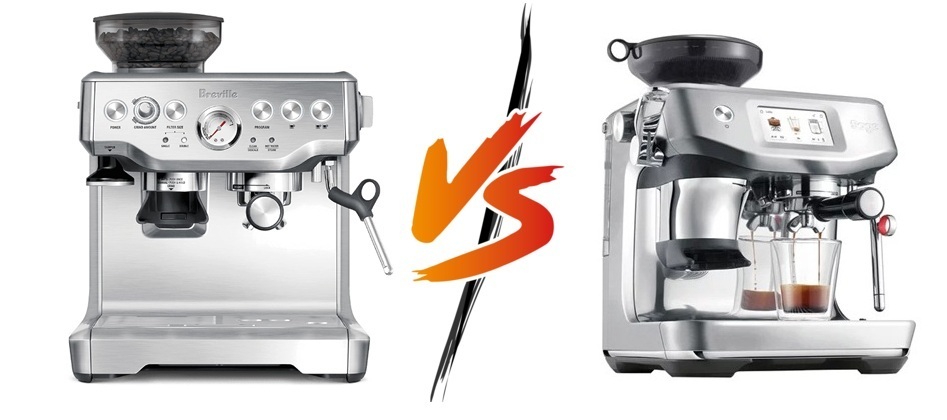
Breville has built a strong reputation for making espresso machines that bridge the gap between professional café equipment and home-friendly appliances. For many coffee lovers, the brand represents a practical way to enjoy fresh espresso without investing in large commercial machines or separate grinders. Two models that often come up in conversations are the Breville Barista Express and the Breville Barista Touch Impress.
At first glance, both machines seem to offer a similar promise: freshly ground coffee, real espresso extraction, and the ability to prepare café-style drinks like lattes and cappuccinos from your kitchen counter. However, once you look closer, it becomes clear that they take very different approaches to the coffee-making process.
The Barista Express focuses on manual control and a traditional espresso workflow. The Barista Touch Impress, on the other hand, introduces touchscreen controls, guided brewing, and automation designed to simplify the entire process.
In this detailed comparison, we’ll explore how the two machines differ across design, performance, usability, and overall value.
Breville Barista Express vs Breville Barista Touch Impress
If you click the links below, under the product images, you will be redirected to Amazon.com. In case you then decide to buy anything, Amazon.com will pay me a commission. This doesn’t affect the honesty of this review in any way though.
| Feature | Breville Barista Express | Breville Barista Touch Impress |
|---|---|---|
 |  | |
| Check the best price on Amazon | Check the best price on Amazon | |
| Machine Type | Semi-automatic espresso machine | Semi-automatic espresso machine with guided automation |
| Heating System | Thermocoil heating system | ThermoJet heating system |
| Heat-Up Time | ~30–60 seconds | ~3 seconds |
| Pump Pressure | 15-bar Italian pump | 15-bar pump |
| Grinder Type | Integrated conical burr grinder | Integrated conical burr grinder |
| Grind Settings | 18 grind size settings | Adjustable grind size with guided dosing |
| Puck Preparation | Manual dosing and tamping | Assisted puck system with automatic tamp guidance |
| User Interface | Physical buttons, dials, and pressure gauge | Color touchscreen interface |
| Drink Presets | Manual drink preparation | Multiple preset drinks (espresso, latte, cappuccino, etc.) |
| Custom Drink Profiles | Manual adjustments only | Fully customizable and savable drink profiles |
| Milk Frothing | Manual steam wand | Automatic milk texturing with adjustable foam |
| Milk Temperature Control | Manual | Adjustable via touchscreen |
| Milk Foam Control | Manual | Adjustable foam levels |
| Portafilter Size | 54 mm stainless steel portafilter | 54 mm stainless steel portafilter |
| Water Tank Capacity | ~2 liters (67 oz) | ~2 liters (67 oz) |
| Bean Hopper Capacity | ~250 g (½ lb) | ~250 g (½ lb) |
| Pre-Infusion | Low-pressure pre-infusion | Low-pressure pre-infusion |
| Cleaning Alerts | Indicator lights | On-screen guided cleaning alerts |
| Descaling Program | Manual guided by indicator lights | Touchscreen step-by-step descaling program |
| Integrated Water Filter | Yes | Yes |
| Cup Warmer | Yes (top warming tray) | Yes (top warming tray) |
| Dimensions (Approx.) | 12.5 × 13.8 × 15.9 in | ~12.7 × 12.8 × 16 in |
| Weight | ~23 lbs (10.4 kg) | ~26 lbs (11.8 kg) |
| My individual reviews | Breville Barista Express review | Breville Barista Touch Impress review |
Quick takeaway
- Barista Express: More manual control, traditional espresso workflow, lower price.
- Barista Touch Impress: Faster heating, touchscreen interface, assisted puck preparation, and automatic milk texturing.
Both machines share core espresso fundamentals like integrated grinders, pre-infusion, and 54 mm portafilters, but the Touch Impress focuses on automation and ease of use, while the Express focuses on hands-on control.
Design & Build Quality
Design and build quality are often overlooked when people compare espresso machines, but they matter more than you might expect. An espresso machine sits on your kitchen counter every day. You interact with it constantly, from filling the water tank to locking in the portafilter and steaming milk. A well-designed machine feels solid, intuitive, and durable. A poorly designed one quickly becomes frustrating to use.
Both the Breville Barista Express and the Breville Barista Touch Impress are built by the same manufacturer and share Breville’s overall design philosophy. They use stainless steel construction, compact footprints, and integrated grinders. But despite those similarities, the machines feel quite different in everyday use.
The Barista Express represents an earlier generation of Breville machines that emphasize traditional espresso workflows and physical controls. The Barista Touch Impress reflects a more modern approach, combining premium materials with touchscreen technology and guided automation. Understanding these differences can help you decide which style better fits your kitchen and your expectations.
Overall construction and materials
Both machines use brushed stainless steel as the primary exterior material. This is one of the reasons Breville machines often feel more premium than many entry-level espresso machines that rely heavily on plastic.
On the Barista Express, the stainless steel casing covers most visible surfaces, including the front panel and the cup-warming tray on top. The finish is durable and generally resists fingerprints fairly well. While some internal components are plastic, the parts you interact with daily feel sturdy. The portafilter, for example, is heavy and well balanced, which adds to the feeling of using a real espresso machine rather than a lightweight appliance.
The Barista Touch Impress takes this idea further. The stainless steel panels feel thicker and more refined, and the overall machine feels slightly more premium. The edges are smoother, the seams between components are tighter, and the general finish quality is excellent. The touchscreen display is seamlessly integrated into the front panel, which gives the machine a more modern and cohesive appearance.
Even though both machines are built for home use rather than commercial environments, they feel robust enough for daily coffee making. With normal care, either one should last for years.
Size and counter presence
In terms of footprint, both machines are designed to fit comfortably on a standard kitchen counter without dominating the space.
The Barista Express measures roughly 12.5 inches wide, around 13 inches deep, and about 16 inches tall. That size works well for most kitchens, but the height can be an issue if your cabinets are low. The bean hopper and cup-warming tray sit on top of the machine, so you need enough clearance to remove the hopper lid when refilling beans.
The Touch Impress is slightly larger and heavier. The additional internal components and touchscreen interface add some bulk. However, the overall shape remains compact compared to many semi-automatic espresso machines with built-in grinders.
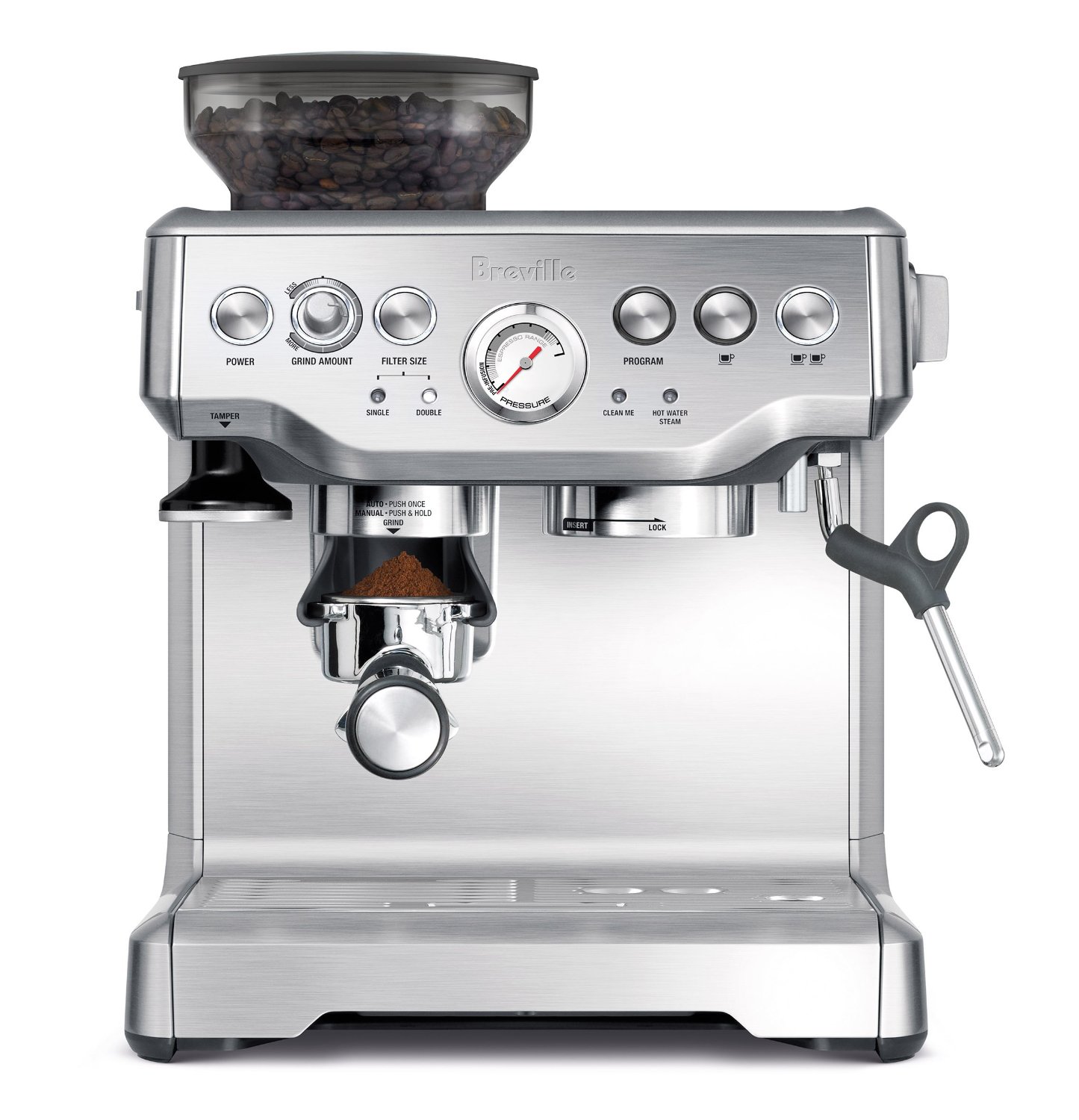
Visually, the difference is noticeable. The Barista Express looks like a traditional espresso machine, with knobs, buttons, and gauges spread across the front panel. It has a slightly industrial aesthetic, almost like a scaled-down café machine.
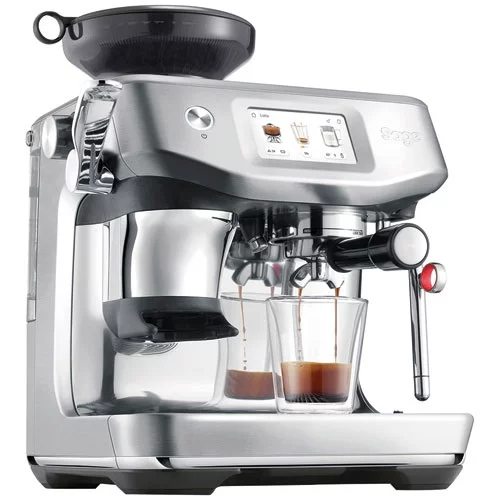
The Touch Impress looks more like a modern smart appliance. The large touchscreen draws your attention immediately, and the rest of the machine has a cleaner, more minimalist design. If your kitchen has modern appliances and clean lines, the Touch Impress tends to blend in very nicely.
Control layout and front panel design
One of the most obvious design differences between these two machines is the front control layout.
The Barista Express uses a combination of buttons, dials, and an analog pressure gauge. The pressure gauge sits prominently in the center of the machine and shows the extraction pressure while a shot is being pulled. For many coffee enthusiasts, this gauge is both useful and satisfying to watch. It gives immediate feedback about whether your grind size and tamping pressure are correct.
On either side of the gauge, you’ll find simple buttons for single and double shots, along with a power button and indicators for cleaning and maintenance. The steam control dial is positioned on the right side of the machine and is used to activate the steam wand.
The grinder controls are also physical. You adjust grind size using a dial on the side of the machine, and a grind amount knob on the front controls how long the grinder runs.
This layout makes the machine feel very hands-on. Every adjustment is mechanical, and nothing is hidden behind digital menus.
The Barista Touch Impress, by contrast, replaces most physical controls with a touchscreen interface. The screen allows you to select drinks, adjust settings, and start cleaning cycles. The menu system is simple and uses icons for different beverages, making it easy to navigate.
Because of the touchscreen, the front of the machine looks much cleaner. Instead of multiple knobs and buttons, you mostly interact with the screen and a few physical components like the portafilter and steam wand.
From a design perspective, the Touch Impress feels more streamlined and modern, while the Express has a more traditional espresso machine personality.
Portafilter, group head, and brewing components
Both machines use a standard 54 mm portafilter, which is slightly smaller than the 58 mm portafilters commonly found in commercial machines. For home use, however, the difference is minimal.
The portafilters themselves are solid and well constructed. They have a comfortable handle and lock firmly into the group head during brewing. The group head design is similar on both machines and provides a secure seal during extraction.
With the Barista Express, the process is very manual. You grind the coffee into the portafilter, tamp it yourself, and then insert it into the group head. This gives you full control over the puck preparation process.
The Touch Impress changes this experience by introducing its assisted puck preparation system. The machine guides grinding and tamping so the coffee puck is prepared more consistently. While this involves internal mechanical components rather than external design changes, it still affects how the machine feels to use.
For users who enjoy the traditional process of preparing espresso, the Express offers a more authentic experience. For users who want convenience and consistency, the Touch Impress design makes the workflow easier.
Water tank and drip tray design
Both machines place the water tank at the back of the machine. The tank is removable and large enough to support multiple drinks before needing a refill.
On the Barista Express, the water tank holds around two liters and slides out easily from the rear. The plastic is thick and durable, and the lid is simple to remove for refilling.
The Touch Impress uses a similar system but with slightly improved ergonomics. The tank slides out smoothly and includes a built-in water filter system that helps reduce scale buildup.
The drip trays on both machines are also well designed. They are large enough to catch spills from the portafilter and steam wand. When the tray fills up, a small indicator pops up to signal that it needs to be emptied.
Breville also includes storage compartments beneath the drip tray on many machines, including the Express. This space is useful for storing cleaning tools and spare filter baskets.
Bean hopper and grinder integration
Another design element shared by both machines is the integrated grinder. The bean hopper sits on top of the machine and feeds beans directly into the burr grinder.
The hopper on the Barista Express holds around half a pound of coffee beans. It includes a simple twist-lock mechanism so you can remove it for cleaning or changing beans.
The grinder adjustment dial sits next to the hopper and allows you to adjust grind size easily. This setup is straightforward and easy to understand.
The Touch Impress also places the hopper on top, but the grinder integrates more closely with the automated brewing workflow. The machine can monitor grind dosing and make adjustments automatically, which reduces the need for constant manual tweaking.
From a design standpoint, both grinders are compact and well integrated into the machines.
Overall durability and long-term design considerations
Both machines are designed for home use, but they are built with longevity in mind.
The Barista Express has been on the market for many years and has developed a reputation for reliability. Its simpler mechanical design means there are fewer electronic systems that could potentially fail over time.
The Touch Impress includes more advanced technology, including a touchscreen and automated systems. While these features add convenience, they also introduce more complexity. That does not necessarily mean the machine is less reliable, but it does mean there are more components involved.
In terms of everyday durability, both machines feel solid. The stainless steel construction, sturdy portafilter, and stable base all contribute to a well-built appliance.
Ultimately, the design and build quality of these machines reflect two different philosophies. The Barista Express focuses on classic espresso machine design with manual controls and mechanical simplicity. The Barista Touch Impress focuses on modern usability and in tegrated technology while maintaining the same premium materials and overall build quality.
User Interface & Ease of Use
The user interface and overall ease of use are where the differences between the Breville Barista Express and the Breville Barista Touch Impress become most obvious. While both machines are designed for home users rather than professional baristas, they approach usability from two very different angles.
The Barista Express focuses on a traditional espresso machine workflow. It gives you direct control over most aspects of the brewing process, which can be rewarding if you enjoy learning how espresso works. However, it also means there is a learning curve.
The Barista Touch Impress takes a much more guided and automated approach. Its touchscreen interface walks you through drink preparation step by step, making the process far more beginner-friendly.
Neither approach is inherently better. It really depends on how involved you want to be in the coffee-making process.
The philosophy behind each interface
Before getting into the details of buttons and screens, it helps to understand the philosophy behind each machine.
The Barista Express is designed to help you learn the craft of making espresso. The machine provides the necessary tools but expects the user to figure out the right settings through practice. It assumes that you are willing to experiment with grind size, dose, and tamp pressure.
The Touch Impress, by contrast, is designed to remove much of that trial and error. Instead of forcing you to learn through mistakes, the machine actively guides you toward the correct settings. The touchscreen acts almost like a digital barista coach.
This difference in philosophy affects every part of the user experience.
Control layout on the Barista Express
The Barista Express uses a traditional control panel with physical buttons, dials, and indicator lights.
On the front panel, you’ll find:
- A power button
- Buttons for single and double espresso shots
- A grind amount dial
- A central pressure gauge
- Indicator lights for cleaning and maintenance
On the side of the machine, there is a grind size dial that allows you to adjust the coarseness of the coffee grounds.
The steam control knob is located on the right side of the machine and activates the steam wand for milk frothing.
This layout is simple and fairly intuitive once you understand what each control does. However, the machine does not actively guide you through the brewing process. You need to learn how to interpret the pressure gauge, shot timing, and coffee taste on your own.
For example, if your espresso shot runs too quickly, the machine will not tell you what went wrong. You have to recognize the issue and adjust the grind size manually.
This trial-and-error approach can be frustrating for beginners. On the other hand, it can also be satisfying for people who enjoy learning espresso techniques.
Learning curve with the Barista Express
Using the Barista Express effectively requires understanding a few basic espresso principles.
You need to learn how grind size affects extraction speed. You also need to figure out how much coffee to grind into the portafilter and how firmly to tamp it.
The pressure gauge on the front panel provides some helpful feedback. Ideally, the needle should land within a specific range during extraction. If it falls too low, your grind may be too coarse. If it spikes too high, the grind may be too fine.
But the machine itself doesn’t explain any of this. Most users end up learning through online tutorials, experimentation, and practice.
The first week or two with the Barista Express often involves a lot of adjustments. You may pull several mediocre shots before dialing in the perfect one.
Once you understand the process, however, the workflow becomes second nature.
Many coffee enthusiasts actually prefer this style of interface because it feels more authentic. Instead of relying on automation, you are actively involved in every step of the brewing process.
Touchscreen interface on the Barista Touch Impress
The user interface on the Barista Touch Impress is completely different.
Instead of physical buttons, the machine features a full-color touchscreen display on the front panel. This screen acts as the main control center for the entire machine.
When you turn it on, the display shows a selection of drink icons. These typically include options such as:
- Espresso
- Long black
- Latte
- Cappuccino
- Flat white
Selecting a drink brings up a guided preparation screen that walks you through the process.
The interface is designed to be simple and visual. Instead of complicated menus, you interact with clear icons and sliders.
For example, you can adjust:
- Coffee strength
- Milk texture
- Milk temperature
Once you find a combination you like, you can save it as a custom drink.
The touchscreen is responsive and easy to navigate. Even people who have never used an espresso machine before can usually figure it out within a few minutes.
Guided brewing and feedback
One of the most helpful features of the Touch Impress interface is the guided brewing system.
As you prepare a drink, the machine provides instructions on the screen. These prompts help you complete each step in the correct order.
For example, the machine might prompt you to:
- Insert the portafilter
- Grind the coffee
- Tamp the puck
- Lock the portafilter into the group head
During the grinding process, the machine can even detect whether the coffee dose is correct. If the dose is too small or too large, it will recommend adjustments.
This kind of feedback is incredibly useful for beginners who might otherwise struggle to dial in their espresso.
Instead of guessing what went wrong, you receive clear guidance from the machine.
Drink customization and personalization
Another major advantage of the Touch Impress interface is how easy it is to customize drinks.
Using the touchscreen, you can adjust multiple variables for each beverage.
For example, you can change:
- The coffee dose
- Shot length
- Milk foam level
- Milk temperature
If you prefer hotter milk or stronger espresso, you can tweak the settings and save the result as a personal recipe.
This feature is especially useful in households where different people have different coffee preferences.
One person might prefer a strong latte with very hot milk, while another might want a milder cappuccino with lighter foam. The machine can remember both profiles.
On the Barista Express, achieving this level of customization requires manual adjustments every time you make a drink.
Daily workflow comparison
The daily experience of making coffee with these machines is noticeably different.
With the Barista Express, the process is hands-on from start to finish. You grind the beans, tamp the coffee, start the shot manually, and steam the milk yourself.
This workflow takes a little longer and requires attention to detail. However, many people enjoy the ritual of making coffee this way.
The Touch Impress simplifies the process significantly. Once you select a drink on the screen, the machine guides you through the preparation steps. Automated systems handle much of the fine tuning.
As a result, drinks are usually faster and more consistent.
This difference is particularly noticeable during busy mornings. If you’re making multiple drinks for family members, the automation on the Touch Impress can save a lot of time.
Accessibility for beginners
For people who have never used an espresso machine before, the Touch Impress is far easier to learn.
The touchscreen interface reduces confusion by explaining each step visually. The machine actively helps you correct mistakes rather than forcing you to figure everything out on your own.
The Barista Express is still beginner-friendly compared to many professional machines, but it does require more patience. New users often spend several days experimenting before they feel confident.
In other words, the Express teaches you how espresso works. The Touch Impress focuses on delivering good results immediately.
Long-term usability
Interestingly, the user interface preference can change over time.
Some beginners who start with the Express eventually appreciate the manual control it provides. Once you understand espresso fundamentals, the lack of automation can actually feel freeing.
On the other hand, some experienced coffee drinkers appreciate the convenience of the Touch Impress. When you just want a quick latte without thinking about grind adjustments, the automated workflow is incredibly convenient.
Both machines are usable in the long term. They simply cater to different types of coffee drinkers.
The Barista Express rewards curiosity and experimentation. The Barista Touch Impress rewards convenience and consistency.
Choosing between them ultimately comes down to how much involvement you want in the coffee-making process.
Coffee Quality & Brewing Performance
When comparing espresso machines, design and usability are important, but the real test is the coffee itself. No matter how attractive or easy to use a machine may be, it ultimately needs to produce excellent espresso. In this area, both the Breville Barista Express and the Breville Barista Touch Impress perform very well, but they reach that result in slightly different ways.
Both machines are capable of producing café-quality espresso at home when used properly. They feature integrated grinders, pressurized brewing systems, and temperature control designed specifically for espresso extraction. However, the level of consistency and the amount of user input required can vary quite a bit between the two.
Understanding how these machines handle brewing temperature, pressure, extraction timing, and shot consistency will give you a clearer picture of how they perform in real-world coffee preparation.
Espresso fundamentals and why they matter
To understand brewing performance, it helps to briefly review what makes good espresso.
A proper espresso shot typically requires:
- Finely ground coffee
- Water temperature around 90–96°C (195–205°F)
- High pressure, usually around 9 bars
- Extraction time of roughly 25–30 seconds
When these factors are balanced correctly, the result is a concentrated shot with a thick body, rich aroma, and a layer of crema on top.
Small changes in grind size, coffee dose, or water temperature can significantly affect the taste. That is why espresso machines need precise temperature control and stable pressure during extraction.
Both Breville machines are designed to maintain these conditions as consistently as possible.
Heating systems and temperature stability
One of the most important aspects of brewing performance is temperature stability.
The Barista Express uses Breville’s thermocoil heating system combined with digital temperature control. This system heats water quickly and maintains a steady brewing temperature during extraction.
In everyday use, the machine usually heats up within about 30 seconds to a minute. Once it reaches operating temperature, it remains stable enough for consistent espresso shots.
The machine also uses pre-infusion. During pre-infusion, the pump briefly wets the coffee grounds at lower pressure before applying full pressure. This step helps saturate the coffee puck evenly and reduces the chance of channeling, which can cause uneven extraction.
The Touch Impress uses Breville’s newer ThermoJet heating system. This system heats water even faster and reaches brewing temperature in just a few seconds.
Because the heating system is more responsive, the machine can deliver consistent temperature control with minimal waiting time between drinks. This is particularly useful when making multiple beverages back to back.
In practice, both heating systems perform well. The ThermoJet system is simply faster and slightly more efficient, but the thermocoil system in the Express still produces excellent results.
Pressure and extraction control
Espresso extraction relies on pressure to push water through the finely packed coffee grounds.
The Barista Express uses a 15-bar pump, although the actual brewing pressure during extraction is closer to the ideal range of around 9 bars. The extra capacity ensures the pump can maintain stable pressure even when the grind is fine or the puck is dense.
One of the standout features of the Express is its analog pressure gauge. This gauge shows the pressure level during extraction, which can be very helpful when dialing in the grind.
If the pressure is too low, the espresso shot will likely run too quickly. If it is too high, the shot may struggle to flow through the puck.
Watching the gauge gives you a visual cue about what adjustments are needed.
The Touch Impress also uses a high-pressure pump system, but instead of relying on a manual pressure gauge, the machine manages extraction parameters internally. Because the machine assists with puck preparation, pressure tends to stay within an optimal range more consistently.
For users who do not want to monitor gauges or manually adjust settings, this automated approach can make espresso preparation much easier.
Shot consistency and repeatability
Consistency is one of the biggest challenges in home espresso preparation.
Even small changes in grind size or tamp pressure can alter the flavor of the shot. That is why repeatability is such an important factor when evaluating brewing performance.
With the Barista Express, consistency largely depends on the user. If you grind the same dose, tamp evenly, and maintain the same grind size, the machine will produce very similar results from shot to shot.
However, beginners often struggle to maintain that level of precision. Slight differences in tamping pressure or grind adjustments can cause noticeable changes in flavor.
The Touch Impress is designed to reduce these variables. Its assisted puck preparation system helps ensure that the coffee dose and tamp pressure remain consistent.
Because of this guidance, shots tend to be more repeatable even for inexperienced users.
In practical terms, this means you are more likely to get a good espresso shot every time without constant adjustments.
Flavor profile and espresso quality
When properly dialed in, the espresso produced by both machines can be excellent.
The Barista Express is capable of producing rich, full-bodied espresso with good crema and balanced flavor. If you use freshly roasted beans and adjust the grind correctly, the results can easily rival those of many café drinks.
The flavor profile tends to be smooth and well-rounded. Notes of chocolate, caramel, or fruit from specialty beans come through clearly when extraction is correct.
However, because the machine relies on manual adjustments, it can take a few attempts to find the ideal grind size and shot timing.
The Touch Impress delivers a similar flavor quality but with greater consistency right out of the box. The automated systems help ensure the puck is prepared properly, which leads to balanced extraction more reliably.
Shots tend to have a thick crema layer and strong aroma, especially when using high-quality beans.
While experienced users may still prefer the control offered by the Express, many people find that the Touch Impress produces excellent espresso with far less effort.
Brewing speed and workflow efficiency
Another aspect of brewing performance is how quickly the machine can prepare drinks.
The Barista Express requires several manual steps before brewing begins. You need to grind the beans, level the coffee in the portafilter, tamp the puck, and then start the extraction.
This process is not slow, but it does require attention.
The Touch Impress speeds things up by guiding and simplifying many of these steps. The machine heats almost instantly thanks to the ThermoJet system, and the puck preparation system streamlines the grinding and tamping process.
As a result, the time between turning on the machine and enjoying a finished drink is noticeably shorter.
For busy mornings or households with multiple coffee drinkers, this faster workflow can make a big difference.
Flexibility for different coffee styles
Both machines are primarily designed for espresso-based drinks, but they also allow some flexibility in brewing styles.
The Barista Express gives users full manual control over shot length and extraction timing. If you prefer longer or shorter shots, you can easily adjust the brew button or stop the shot manually.
This flexibility is useful for experimenting with different beans or brewing styles.
The Touch Impress offers similar flexibility through its digital settings. Instead of manually stopping the shot, you adjust parameters on the touchscreen.
You can modify shot length, coffee strength, and other settings to create different drink profiles.
While the methods differ, both machines allow customization to suit personal preferences.
Real-world performance over time
Long-term performance is another important consideration.
The Barista Express has been on the market for many years and has proven to be a reliable performer. Many users report consistent espresso quality even after years of regular use, provided the machine is cleaned and descaled properly.
The Touch Impress is a newer model but benefits from Breville’s experience with previous touchscreen machines. Its automated systems are designed to maintain consistency over time while reducing user error.
In everyday use, both machines maintain strong brewing performance as long as they are properly maintained and paired with fresh coffee beans.
Overall brewing experience
From a pure coffee quality perspective, both machines are capable of producing excellent espresso.
The main difference lies in how that quality is achieved.
The Barista Express relies on the user’s skill to dial in the perfect shot. This hands-on approach can be very rewarding and allows for a great deal of experimentation.
The Touch Impress focuses on automation and guidance to deliver consistent results with minimal effort.
In other words, the Express rewards practice and technique, while the Touch Impress prioritizes convenience and reliability. Both approaches can lead to great coffee, but the experience of getting there is quite different.
Grinder Features & Performance
A built-in grinder is one of the defining features of many Breville espresso machines. Freshly ground coffee is essential for good espresso, and having the grinder integrated into the machine simplifies the entire brewing process. Instead of measuring beans, grinding separately, and transferring the grounds, everything happens in one workflow.
Both the Breville Barista Express and the Breville Barista Touch Impress include conical burr grinders designed specifically for espresso preparation. While they share this basic concept, the grinders differ in their level of precision, automation, and user guidance.
The Barista Express focuses on manual adjustments and a straightforward grinding system. The Touch Impress takes a more advanced approach, integrating the grinder into a guided puck preparation system that helps optimize dose and consistency. These differences have a noticeable impact on how easy it is to dial in espresso and how consistent the results are over time.
Why grinder quality matters for espresso
Espresso is extremely sensitive to grind size. The coffee must be ground very finely so that pressurized water can extract flavor properly within about 25 to 30 seconds.
If the grind is too coarse, water flows through too quickly and the espresso becomes weak and under-extracted. If the grind is too fine, water struggles to pass through the coffee puck, which can lead to bitterness or uneven extraction.
Because of this narrow margin for error, espresso grinders must be precise and consistent. The particle size distribution of the grounds directly affects the flavor, body, and crema of the final shot.
That is why a good grinder is often just as important as the espresso machine itself.
Burr grinder design and grinding mechanism
Both machines use stainless steel conical burr grinders. Burr grinders are widely preferred over blade grinders because they crush coffee beans between two abrasive surfaces instead of chopping them randomly.
This produces more uniform particles, which leads to more consistent extraction.
Conical burrs are also known for being relatively quiet and efficient compared to flat burr grinders, especially in compact home machines.
The burr sets used in these Breville machines are designed specifically for espresso grinding. They can produce the fine powder required for proper extraction while still allowing some adjustment for slightly coarser grinds if needed.
While the fundamental grinding mechanism is similar in both machines, the way you interact with the grinder differs quite a bit.
Grind size adjustment on the Barista Express
The Barista Express gives users direct control over grind size through a manual adjustment dial located on the side of the machine.
This dial offers 18 grind settings that range from relatively coarse to very fine. For espresso brewing, most users will find themselves working within a smaller portion of that range.
Adjusting the grind size is straightforward. Turning the dial changes the distance between the burrs, which alters the size of the coffee particles.
However, the adjustment steps are somewhat large compared to high-end standalone espresso grinders. This means that sometimes the perfect grind setting may feel like it falls between two available options.
For example, one setting might cause the shot to run slightly too fast, while the next setting might slow it down a bit too much.
Experienced users often compensate for this by adjusting the dose or tamp pressure slightly.
Despite these limitations, the grinder on the Barista Express performs well for a built-in system. With a bit of experimentation, most users can dial in a grind size that produces excellent espresso.
Grind dosing and timing
Another important aspect of grinder performance is how the machine controls the amount of coffee that gets ground.
The Barista Express uses a grind amount dial on the front panel. This dial adjusts how long the grinder runs, which determines the amount of coffee that falls into the portafilter.
In practice, this means you control the dose indirectly through grind time.
Once you find the right setting for your beans, the grinder will produce roughly the same amount of coffee each time. However, slight variations can still occur depending on factors like bean freshness and humidity.
Because the system relies on timing rather than weight, some users choose to weigh their coffee grounds separately when aiming for very precise dosing.
For most home users, though, the built-in dosing system works well enough for everyday espresso preparation.
Grinder integration in the Touch Impress
The grinder in the Barista Touch Impress builds upon the same core technology but adds a more advanced level of integration with the brewing system.
Instead of relying solely on manual grind timing, the machine uses sensors and software to help determine whether the coffee dose is correct.
As part of the Impress puck preparation system, the machine can detect whether the puck is underfilled or overfilled after grinding. If the dose is not ideal, the machine recommends adjustments for the next grind.
This feedback loop makes it much easier to dial in the grinder settings.
For beginners, this guidance removes a lot of the guesswork that often comes with espresso preparation. Instead of wondering why a shot tastes off, the machine actively helps you correct the problem.
Grind consistency and particle distribution
Consistency is one of the most important measures of grinder performance.
A good grinder produces grounds that are relatively uniform in size. When particle sizes vary too widely, some coffee extracts too quickly while other particles extract too slowly. This leads to uneven flavors.
The conical burr grinder in the Barista Express produces fairly consistent grounds for an integrated system. While it may not match the precision of high-end standalone grinders, it is more than capable of producing espresso-quality grounds.
The Touch Impress uses a similar burr design but benefits from slightly improved grinding control and integration with the puck preparation system.
Because the machine helps maintain consistent dosing and tamping, the overall extraction tends to be more stable.
In other words, while the grinding mechanism itself is similar, the automated workflow helps ensure the grounds are used more consistently.
Bean hopper design and capacity
Both machines feature a bean hopper located on top of the grinder.
The hopper on the Barista Express holds roughly half a pound of coffee beans, which is enough for several days of regular espresso brewing. It includes a locking mechanism that allows you to remove the hopper for cleaning or switching beans.
The hopper lid also seals fairly well, helping to keep beans fresh.
The Touch Impress uses a similar hopper design with comparable capacity. However, the hopper integrates more closely with the machine’s automated grinding system.
In daily use, both hoppers function well and are easy to refill.
Noise levels during grinding
Grinding coffee beans inevitably produces some noise, especially when dealing with hard roasted beans.
The grinder in the Barista Express is reasonably quiet compared to many standalone grinders, but it is still clearly audible. The grinding process usually takes around 10 to 20 seconds depending on the dose.
The Touch Impress grinder is slightly quieter, partly due to improved internal insulation and smoother motor operation.
While the difference is not dramatic, the Touch Impress generally feels a bit more refined during grinding.
Mess and cleanliness
Grinding directly into the portafilter is convenient, but it can sometimes create small amounts of stray coffee grounds.
On the Barista Express, grounds occasionally spill over the edge of the portafilter basket, especially if the grind amount is slightly high.
Many users get into the habit of tapping or leveling the portafilter before tamping to prevent spills.
The Touch Impress design reduces this issue by integrating grinding more closely with the puck preparation system.
Because the machine monitors the dose more carefully, the process tends to be cleaner and more controlled.
Overall grinder performance
Both machines offer capable built-in grinders that eliminate the need for a separate grinding device.
The Barista Express provides solid grinding performance with straightforward manual controls. It allows users to experiment with grind size and dosing while learning the fundamentals of espresso preparation.
The Touch Impress builds on this foundation with more advanced automation and feedback. Its guided system helps ensure consistent dosing and puck preparation, which improves overall shot reliability.
In terms of raw grinding capability, the two machines are fairly similar. The biggest difference lies in how the grinder interacts with the brewing workflow.
The Barista Express gives you full manual control over grinding adjustments, while the Touch Impress uses automation to simplify the process and reduce user error. Both approaches can produce excellent espresso, but they cater to different types of coffee drinkers.
Milk Frothing & Specialty Drinks
For many people, espresso is only part of the experience. Drinks like lattes, cappuccinos, flat whites, and macchiatos depend just as much on properly textured milk as they do on a good espresso shot. The ability to create smooth, creamy microfoam can turn a simple espresso machine into a full café-style beverage station at home.
Both the Breville Barista Express and the Breville Barista Touch Impress are designed to handle milk-based drinks, but they take very different approaches to the process. One focuses on traditional manual steaming, giving the user full control over milk texture. The other uses automation to produce consistent milk foam with minimal effort.
Understanding how each machine handles milk frothing can make a big difference when choosing between them, especially if you plan to make milk drinks regularly.
The role of milk in espresso drinks
Milk-based drinks rely on a specific type of foam known as microfoam. Unlike large bubbles created by basic frothers, microfoam consists of extremely fine bubbles that create a smooth, glossy texture.
This texture blends evenly with espresso, producing drinks that feel creamy rather than airy. Proper microfoam is also what allows baristas to create latte art patterns on the surface of drinks.
Creating good microfoam requires the right combination of steam pressure, milk temperature, and technique. The steam wand injects hot steam into the milk while the user controls the angle and position of the wand. This introduces air into the milk and creates the desired foam texture.
While professional baristas develop this skill through practice, home espresso machines often try to simplify the process in different ways.
Manual steam wand on the Barista Express
The Barista Express uses a traditional manual steam wand similar to those found on many café espresso machines.
The wand is positioned on the right side of the machine and can rotate slightly for easier positioning inside the milk jug. To start steaming, you simply turn the steam control dial, which releases pressurized steam through the wand.
Because the system is manual, the user controls every aspect of the steaming process. This includes:
- How much air is introduced into the milk
- How quickly the milk heats up
- The final texture of the foam
- The temperature of the milk
This level of control can produce excellent results once you learn the proper technique.
Learning the milk steaming process
When using the Barista Express, the milk frothing process typically involves two phases.
The first phase is aeration. During this stage, the steam wand tip is placed just below the surface of the milk to introduce air. This creates small bubbles that form the foam structure.
The second phase is texturing. After enough air has been introduced, the wand is lowered slightly deeper into the milk to create a swirling motion. This motion helps break down larger bubbles and produce smooth microfoam.
Getting this technique right can take a little practice. Many beginners initially produce milk with large bubbles or overly thick foam.
However, once you understand the process, the manual steam wand becomes a powerful tool. You can create milk textures suitable for different drinks, from dense cappuccino foam to silky latte microfoam.
Advantages of manual milk frothing
One of the biggest advantages of the manual steam wand on the Barista Express is flexibility.
Because you control the steaming process directly, you can experiment with different textures and milk temperatures. This is especially useful if you enjoy creating latte art or customizing drinks.
Manual steaming also allows you to adapt to different types of milk. Whole milk, skim milk, oat milk, and almond milk all behave differently when steamed. Being able to adjust the technique helps produce better results with each type.
Many coffee enthusiasts also enjoy the ritual of steaming milk manually. It adds another layer of involvement to the coffee-making process and can make the experience feel more authentic.
Limitations of manual steaming
While manual control is appealing to experienced users, it can also be intimidating for beginners.
Learning to steam milk properly takes time and patience. The first few attempts may result in overheated milk, uneven foam, or large bubbles.
Additionally, the process requires attention. You need to monitor the milk temperature, listen for the correct sound during aeration, and adjust the wand position as the milk expands.
For someone who simply wants a quick latte in the morning, this extra effort can feel inconvenient.
This is where the Touch Impress offers a very different experience.
Automatic milk texturing on the Touch Impress
The Barista Touch Impress includes an automatic milk frothing system that handles most of the steaming process for you.
Instead of manually controlling the steam wand, you place the wand in the milk jug and select your drink on the touchscreen interface. The machine then steams the milk automatically.
During this process, the machine controls both the temperature and the foam level. Sensors monitor the milk and stop the steaming process once the desired settings are reached.
This automation dramatically simplifies milk preparation.
Even users with no previous experience can produce well-textured milk on their first attempt.
Customizing milk settings
Although the Touch Impress automates the steaming process, it still allows for customization.
Through the touchscreen interface, you can adjust:
- Milk temperature
- Foam level
- Drink strength
For example, you might prefer hotter milk in your latte or lighter foam in a flat white. The machine allows you to adjust these parameters and save them as part of a custom drink profile.
This feature is particularly useful in households where multiple people use the same machine.
Each person can create their preferred drink settings without having to manually adjust the steaming process every time.
Milk texture and quality
In terms of final milk quality, both machines can produce excellent results.
The manual steam wand on the Barista Express is capable of creating café-quality microfoam once you learn the technique. Skilled users can produce milk suitable for latte art with smooth, glossy texture.
The Touch Impress produces slightly more consistent results thanks to its automated control system. Because the machine monitors temperature and foam levels, it avoids many of the common mistakes that beginners make.
However, some advanced users feel that automated systems can be slightly less flexible when it comes to very specific foam textures.
In practice, the difference is fairly small. For most people, the automatic system produces milk that is more than good enough for high-quality lattes and cappuccinos.
Specialty drink preparation
Both machines are designed to support a wide range of espresso-based drinks.
With the Barista Express, preparing specialty drinks requires a manual workflow. For example, making a latte involves pulling an espresso shot, steaming milk separately, and combining the two.
This process is straightforward but requires the user to handle each step individually.
The Touch Impress simplifies this workflow by offering built-in drink presets.
On the touchscreen, you can select drinks such as:
- Latte
- Cappuccino
- Flat white
- Americano
Once a drink is selected, the machine guides you through the process of brewing the espresso and steaming the milk.
This guided approach makes it much easier to create café-style drinks without memorizing recipes or timing the steps yourself.
Workflow efficiency for milk drinks
The difference in workflow becomes especially noticeable when preparing multiple drinks.
With the Barista Express, each drink requires grinding, brewing, and steaming milk manually. If you are making several drinks in a row, this can take a bit of time.
The Touch Impress speeds things up by simplifying the milk frothing process. Because the steaming is automated, you can focus on preparing the next drink while the machine handles the milk.
For busy households or frequent entertaining, this convenience can be a significant advantage.
Cleaning the steam system
Steam wands require regular cleaning to maintain performance and hygiene.
On the Barista Express, you need to wipe the steam wand with a damp cloth after each use and briefly purge steam to clear any milk residue from the nozzle.
This process only takes a few seconds but needs to be done consistently.
The Touch Impress includes similar cleaning requirements, but the machine also provides on-screen reminders to help ensure proper maintenance.
Some models in this series also include automatic steam wand purging, which helps keep the wand clean between uses.
Overall milk frothing experience
When it comes to milk frothing and specialty drinks, both machines deliver strong performance but cater to different preferences.
The Barista Express offers a traditional steaming experience with full manual control. This approach rewards practice and allows users to develop real barista skills.
The Touch Impress focuses on convenience and consistency. Its automatic milk texturing system removes much of the learning curve while still producing high-quality foam.
In practical terms, the Express is ideal for users who enjoy learning the craft of espresso preparation, while the Touch Impress is perfect for those who want reliable café-style drinks with minimal effort.
Maintenance & Cleaning
Owning an espresso machine involves more than just making coffee. Regular maintenance and cleaning are essential if you want the machine to keep performing well over time. Coffee oils, fine grounds, milk residue, and mineral buildup from water can all affect flavor and machine performance if they are allowed to accumulate.
Both the Breville Barista Express and the Breville Barista Touch Impress are designed with home users in mind, so Breville has included several features that make routine cleaning easier. Still, each machine requires a set of daily, weekly, and occasional maintenance tasks.
The good news is that most of these tasks take only a few minutes. Understanding what needs to be cleaned and how often will help ensure that either machine continues producing excellent coffee for years.
Why espresso machines require regular cleaning
Espresso machines operate under high pressure and temperature, which makes them particularly sensitive to buildup inside the brewing system.
Coffee beans contain oils that are extracted during brewing. Over time, these oils can coat internal components such as the portafilter basket, shower screen, and group head. If not removed, they can become rancid and affect the taste of your coffee.
Milk frothing systems present another challenge. Milk proteins and sugars can dry inside the steam wand, creating blockages or unpleasant odors if the wand is not cleaned properly.
Finally, mineral deposits from water can accumulate inside the heating system. This process, known as scale buildup, reduces heating efficiency and may eventually damage internal components.
Routine cleaning prevents these problems and helps maintain consistent brewing performance.
Daily cleaning tasks
Daily maintenance is fairly simple for both machines and focuses mainly on keeping the brewing area and steam wand clean.
After each shot of espresso, it’s a good idea to knock out the used coffee puck from the portafilter and rinse the basket with warm water. This removes leftover grounds and oils before they have a chance to dry.
On the Barista Express, users typically rinse the portafilter and wipe the group head area with a cloth if any grounds remain. Running a brief flush of hot water through the group head can also help clear out loose coffee particles.
The drip tray should also be checked daily, especially if you make several drinks. Both machines include drip trays that collect excess water and coffee spills during brewing and cleaning cycles.
The steam wand requires immediate attention after every milk drink. On the Barista Express, this means wiping the wand with a damp cloth and purging a small burst of steam to clear milk from the tip.
The Touch Impress follows a similar routine, although the machine often prompts you to purge the steam wand automatically after steaming milk. These reminders are helpful for preventing milk residue buildup.
Overall, daily cleaning tasks usually take less than a minute and quickly become part of the normal coffee-making routine.
Weekly cleaning routines
In addition to daily maintenance, both machines benefit from slightly deeper cleaning on a weekly basis.
One of the most important tasks is cleaning the portafilter baskets thoroughly. Coffee oils can accumulate inside the small filter holes, which may affect extraction quality.
Many users soak the baskets and portafilter in warm water with a small amount of espresso machine cleaner. This dissolves the oils and keeps the metal surfaces clean.
The drip tray should also be washed with warm soapy water periodically. Although it can simply be emptied during daily use, washing it helps prevent odors and residue buildup.
On the Barista Express, it’s also a good idea to brush the grinder chute occasionally. Fine coffee particles can accumulate in this area over time.
The Touch Impress requires similar attention to the grinder components. Removing the bean hopper and brushing away stray grounds helps keep the grinder operating smoothly.
These weekly tasks help ensure that the machine continues producing clean-tasting espresso.
Backflushing the brewing system
Backflushing is an important maintenance step for espresso machines that use a three-way solenoid valve.
This process involves running water and cleaning solution backward through the brewing system to remove coffee oils that accumulate inside the group head.
The Barista Express includes a special cleaning disk and tablets for this purpose. To perform a backflush, you insert the cleaning disk into the portafilter, add a cleaning tablet, and run a cleaning cycle.
The machine’s indicator lights signal when a cleaning cycle is needed, which typically happens after a certain number of brewing cycles.
The process only takes a few minutes and helps keep the internal brewing components free from oily buildup.
The Touch Impress also supports automated cleaning cycles. However, the difference is that the machine provides clear step-by-step instructions on the touchscreen.
Instead of relying on indicator lights, the screen guides you through the cleaning process. This makes the task less intimidating for users who may be unfamiliar with espresso machine maintenance.
Descaling the machine
Descaling is another critical part of long-term maintenance. Minerals in water gradually form scale deposits inside the heating system, pipes, and valves.
If these deposits are allowed to build up, they can reduce heating efficiency and affect water flow during extraction.
Both machines include descaling programs that help remove mineral buildup.
On the Barista Express, indicator lights notify you when descaling is required. The process typically involves mixing a descaling solution with water and running it through the machine according to the instructions.
This procedure usually takes around 20 to 30 minutes.
The Touch Impress simplifies the process by providing guided instructions on the touchscreen. The machine walks you through each step, including filling the water tank, running the descaling solution, and flushing the system with clean water afterward.
The frequency of descaling depends on the hardness of your local water supply. In areas with hard water, descaling may be necessary every few months. Using filtered water can significantly reduce the need for frequent descaling.
Water filters and scale prevention
Breville includes water filter systems with many of its espresso machines to help reduce scale buildup.
Both machines use replaceable water filters that sit inside the water tank. These filters remove some of the minerals that contribute to scaling while also improving water taste.
Replacing the filter every two to three months helps maintain water quality and protects the machine’s internal components.
The Touch Impress typically provides reminders on the touchscreen when it is time to replace the filter. The Barista Express relies more on manual tracking, although the replacement schedule is clearly outlined in the user manual.
Using filtered water is one of the easiest ways to extend the life of an espresso machine.
Grinder cleaning and maintenance
Because both machines include built-in grinders, those components also require occasional maintenance.
Coffee grinders naturally accumulate oils and fine particles over time. If these residues build up too much, they can affect grind consistency and flavor.
The Barista Express allows you to remove the bean hopper and upper burr for cleaning. Brushing away coffee particles from the burrs and grinder chamber helps maintain performance.
This process is straightforward but should be done carefully to avoid damaging the burrs.
The Touch Impress follows a similar procedure. The grinder components are designed to be accessible for periodic cleaning, and the machine’s instructions explain how to remove and reinstall the burrs safely.
In most cases, grinder cleaning only needs to be done every few months unless you switch beans frequently.
Cleaning reminders and guidance
One of the biggest differences between these machines is how they communicate maintenance needs.
The Barista Express uses indicator lights on the front panel. These lights alert you when it’s time to run a cleaning cycle or descale the machine.
While this system works well, it does not provide detailed instructions directly on the machine. Users often need to consult the manual for specific steps.
The Touch Impress improves on this by using the touchscreen interface to display maintenance reminders and instructions. When cleaning or descaling is required, the screen explains exactly what to do.
This feature is particularly helpful for beginners who may not be familiar with espresso machine maintenance.
Long-term durability and care
Proper maintenance plays a major role in the long-term reliability of any espresso machine.
Both machines are built with durable components, but regular cleaning ensures that those components continue to function properly.
Neglecting maintenance can lead to problems such as reduced pressure, slower heating, or unpleasant coffee flavors.
Fortunately, the cleaning routines for both machines are relatively simple once you become familiar with them.
Most daily tasks take only a few seconds, while deeper cleaning procedures are needed only occasionally.
Overall maintenance experience
In terms of maintenance requirements, both machines are fairly similar. They require the same basic tasks, including rinsing the portafilter, cleaning the steam wand, backflushing the brewing system, and descaling periodically.
The main difference lies in how the machines guide users through these tasks.
The Barista Express relies on indicator lights and manual instructions, which work well for users comfortable with basic machine maintenance.
The Touch Impress offers a more guided experience through its touchscreen interface, making maintenance easier for beginners.
Either way, keeping the machine clean ensures better tasting coffee, more reliable performance, and a longer lifespan for your espresso setup.
Conclusion
Choosing between the Breville Barista Express and the Breville Barista Touch Impress ultimately comes down to what kind of coffee experience you want at home. Both machines are capable of producing excellent espresso and café-style drinks, but they are designed for different types of users.
The Barista Express represents a more traditional approach to home espresso. It gives you manual control over grinding, tamping, extraction, and milk frothing. This hands-on workflow can take some time to learn, especially if you are new to espresso. However, many people find the process rewarding once they become familiar with it. The machine allows you to experiment, refine your technique, and develop real barista skills. For coffee enthusiasts who enjoy the craft of making espresso, the Express offers a satisfying and engaging experience at a relatively accessible price.
The Barista Touch Impress focuses on convenience and consistency. Its touchscreen interface, guided brewing system, and assisted puck preparation make the process far more approachable for beginners. Instead of spending time dialing in grind size and tamp pressure through trial and error, the machine actively helps you get the right settings. Automatic milk texturing also simplifies the preparation of drinks like lattes and cappuccinos. As a result, the Touch Impress can produce high-quality coffee with much less effort.
In practical terms, both machines can deliver excellent results when paired with fresh beans and proper maintenance. The key difference lies in how involved you want to be in the process. If you enjoy learning and experimenting, the Barista Express is likely to feel more satisfying. If you prefer a streamlined experience that still produces café-quality drinks, the Barista Touch Impress is the more convenient option.
Either way, both machines demonstrate why Breville has become such a respected name in home espresso equipment.