
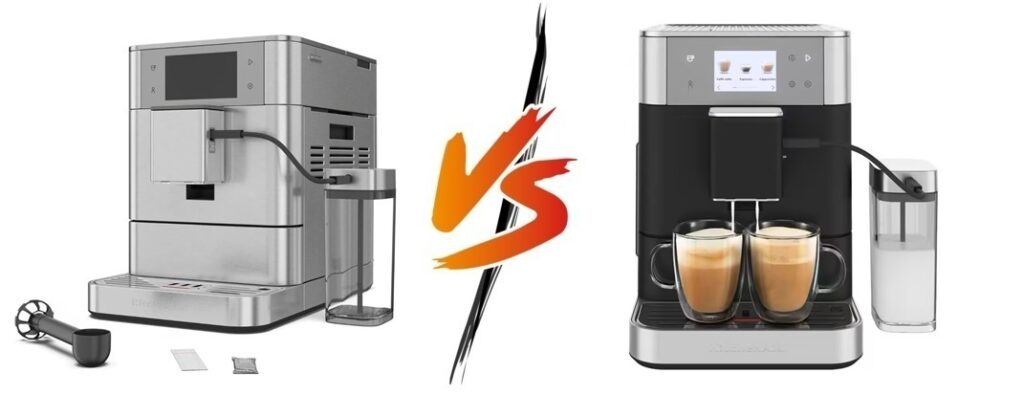
Choosing a fully automatic espresso machine is rarely simple, especially when you’re comparing two models from the same brand that sit close together in the lineup. That’s exactly the case with the KitchenAid KF8 and KitchenAid KF7. On paper, they look very similar. Both are premium bean-to-cup machines designed for people who want café-style drinks at home without the learning curve of a manual espresso setup. They share the same core promise: fresh-ground beans, automatic milk frothing, consistent espresso, and minimal effort.
But small differences matter at this price point. Screen size, drink variety, noise levels, grinder refinement, and everyday usability can all change how satisfied you are over months and years of ownership. The KF8 positions itself as the more advanced, feature-rich model, while the KF7 aims to deliver strong performance without unnecessary extras. In this review, I’ll break down how they compare in real-world use, not just in specifications, so you can decide which one actually fits your kitchen and coffee habits.
KitchenAid KF8 vs KitchenAid KF7 Comparison Chart
If you click the links below, under the product images, you will be redirected to Amazon.com. In case you then decide to buy anything, Amazon.com will pay me a commission. This doesn’t affect the honesty of this review in any way though.
| Feature | KitchenAid KF8 | KitchenAid KF7 |
|---|---|---|
 |  | |
| Check the best price on Amazon | Check the best price on Amazon | |
| Machine Type | Fully automatic bean-to-cup espresso machine | Fully automatic bean-to-cup espresso machine |
| Target Positioning | Premium / flagship model | Upper-mid range model |
| User Interface | Full-color touchscreen | Full-color touchscreen |
| Display Size | 5-inch | Approx. 3.5-inch |
| User Profiles | Up to 6 user profiles | Limited / fewer profiles |
| Coffee Grinder | Integrated conical burr grinder | Integrated conical burr grinder |
| Grinder Material | Stainless steel burrs | Stainless steel burrs |
| Grind Adjustment | Manual internal adjustment | Manual internal adjustment |
| Bean Hopper | Removable | Removable |
| Pre-ground Coffee Bypass | Yes | Yes |
| Brewing System | Automatic brewing with pre-infusion | Automatic brewing with pre-infusion |
| Coffee Strength Levels | Multiple, highly adjustable | Multiple, more limited |
| Temperature Adjustment | Yes | Yes |
| Espresso Customization | High | Moderate |
| Milk System | Fully automatic milk frothing system | Fully automatic milk frothing system |
| Milk Container | Included, detachable | Included, detachable |
| Plant-Based Milk Programs | Yes (dedicated presets) | No dedicated presets |
| Foam Adjustment | Adjustable | Limited adjustment |
| Specialty Drink Presets | ~40+ drinks | ~20+ drinks |
| Supported Drinks | Espresso, cappuccino, latte, flat white, macchiato, plant-milk drinks, more | Espresso, cappuccino, latte, flat white, core classics |
| Brew Unit | Removable | Removable |
| Cleaning Programs | Automatic rinsing, milk cleaning, guided descaling | Automatic rinsing, milk cleaning, descaling |
| Maintenance Guidance | Highly guided, step-by-step | Guided, more basic |
| Water Tank | Removable | Removable |
| Water Filter Support | Yes | Yes |
| Noise Level (Grinder) | Quieter, better dampened | Slightly louder |
| Noise Level (Brewing/Frothing) | Moderate, refined | Moderate |
| Energy Saving Mode | Auto standby & sleep mode | Auto standby & sleep mode |
| Warm-Up Time | Fast | Fast |
| Build Materials | Metal panels with premium finishes | Stainless steel with durable plastics |
| Overall Footprint | Large | Large |
| Best For | Users who want maximum features, customization, and a premium interface | Users who want strong performance and value without extra complexity |
| Typical Price Position | Higher | Lower |
| My individual reviews | KitchenAid KF8 review | KitchenAid KF7 review |
Design & Build Quality
When you’re spending this much on a fully automatic espresso machine, design and build quality matter more than people often admit. These machines aren’t getting tucked away in a cupboard. They live on your counter, get used daily, and become part of your kitchen routine. Both the KitchenAid KF8 and KF7 clearly understand that role, but they approach it with slightly different priorities.
At first glance, the KF8 and KF7 look closely related, and that’s no accident. KitchenAid has kept a consistent visual identity across its automatic espresso range. Both machines have a clean, modern look with strong horizontal lines, squared edges, and a solid, confident stance. They don’t try to look flashy or experimental. Instead, they lean into a premium appliance aesthetic that fits just as well in a modern kitchen as it does in a more traditional one.
That said, when you place them side by side, the KF8 immediately feels like the more upscale machine. The materials feel a touch more refined, and the overall finish is slightly more polished. The KF8 uses a combination of metal panels and high-quality plastics that don’t flex or creak when pressed. The front fascia, in particular, feels solid and well-fitted, with tight seams and no rough edges. It gives the impression that KitchenAid paid close attention to tolerances and long-term durability.
The KF7 is no slouch in this department. Its stainless steel exterior panels feel sturdy and durable, and the machine doesn’t feel cheap or hollow at any point. However, compared directly with the KF8, the KF7’s surfaces feel a bit more utilitarian. That’s not necessarily a negative. In fact, some users may prefer the KF7’s slightly simpler, more industrial feel. It comes across as a machine designed first for function, with aesthetics following closely behind.
Size and footprint are nearly identical between the two models, and this is something worth considering carefully. Both machines are large. They’re tall, deep, and wide enough that you’ll want to measure your counter space before committing. Neither is well suited to cramped kitchens or shallow countertops. Once placed, they tend to stay put. Moving them frequently would be inconvenient due to their weight and bulk.
In terms of weight, both machines feel reassuringly heavy. This isn’t dead weight, though. The heft comes from internal components, reinforced housing, and solid construction. When you press buttons, open panels, or remove the water tank, nothing feels flimsy or loosely attached. Doors open smoothly, parts slide out without resistance, and everything aligns properly when reinserted. This is especially important in a super-automatic machine, where poorly fitted components can quickly lead to rattling, leaks, or wear.
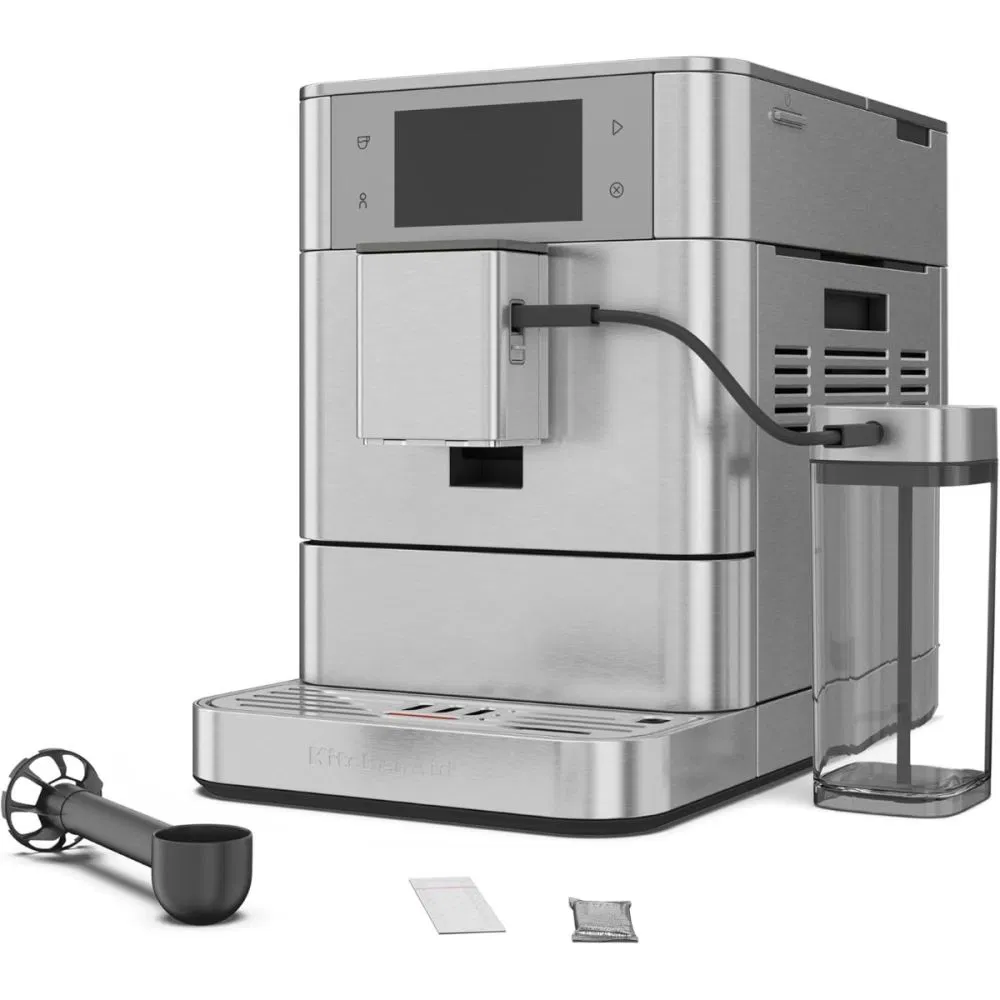
One area where the KF8 clearly pulls ahead is the front display integration. The larger screen doesn’t just improve usability; it also changes how the machine looks. The 5-inch display on the KF8 feels like it was designed as part of the machine from the start. It sits flush with the front panel and blends naturally into the overall design. When the screen is off, it still looks clean and intentional, not like a tablet glued onto the front.
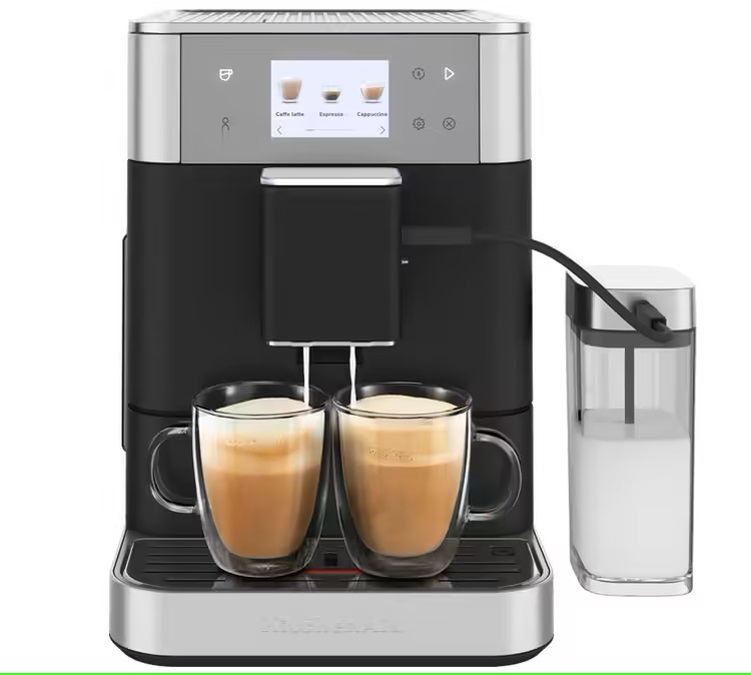
The KF7’s smaller screen is functional but less visually striking. It does its job, but it feels more like a traditional appliance display rather than a centerpiece. This doesn’t make the KF7 look outdated, but it does make the KF8 feel more current and premium by comparison. If you care about how technology integrates visually into your kitchen, this difference is noticeable.
Both machines feature well-designed physical components around the display. The coffee spouts are adjustable and feel solid when raised or lowered. There’s no wobble or sense that they’ll loosen over time. This matters more than it sounds, especially if you regularly switch between espresso cups and taller latte glasses. The milk system connectors also feel secure, with a satisfying click when attached properly.
The water tanks on both models are thoughtfully designed. They’re easy to remove, easy to carry to the sink, and wide enough to clean without awkward hand positioning. The plastic used for the tanks feels thick and durable, not brittle or thin. Lids fit snugly and don’t rattle when the machine is running. The KF8’s tank design feels slightly more refined, but the difference is subtle rather than dramatic.
Bean hoppers are another strong point for both machines. Both the KF8 and KF7 use removable hoppers, which is not something every machine in this category offers. This makes switching beans far easier and also simplifies deep cleaning. The hopper lids seal well and don’t feel loose, which helps preserve bean freshness and reduces grinder noise.
From a tactile standpoint, the KF8 again feels slightly more premium. The edges are smoother, the transitions between materials feel more deliberate, and the machine as a whole feels more cohesive. The KF7 feels sturdy and dependable, but the KF8 feels finished in a way that suggests a higher price bracket.
Durability is always hard to judge without years of use, but based on construction alone, both machines inspire confidence. Hinges feel strong, plastic parts don’t feel brittle, and nothing about either machine suggests planned obsolescence. KitchenAid’s reputation for long-lasting appliances also plays a role here, and both machines seem built to uphold that standard.
Noise and vibration are also indirectly related to build quality, and here both machines benefit from solid internal mounting. Neither machine shakes or rattles during grinding or brewing. The KF8 feels slightly more dampened, especially during grinding, which reinforces the sense that it has more internal insulation and refinement. The KF7 is still well-controlled, just a bit more mechanically present.
In day-to-day use, design details start to matter more than showroom looks. Drip trays slide in and out smoothly, magnets or guides help align parts correctly, and internal components don’t feel fragile when accessed for cleaning. Both machines perform well here, but the KF8 feels marginally more forgiving and polished during routine handling.
Overall, the design and build quality of both the KitchenAid KF8 and KF7 are strong. The KF7 delivers solid, dependable construction that feels built to last and function reliably. The KF8 takes that foundation and elevates it with better material transitions, a more integrated display, and a slightly more refined finish. Neither feels poorly made, but if design and physical presence matter to you, the KF8 clearly positions itself as the more premium option.
User Interface & Ease of Use
User interface is where a fully automatic espresso machine either becomes a joy to live with or a daily frustration. You can have excellent coffee quality and solid build materials, but if the machine feels confusing, slow, or awkward to operate, those strengths start to fade quickly. This is an area where the differences between the KitchenAid KF8 and KF7 become much more noticeable over time, especially in everyday use.
Starting with the KF8, it’s immediately clear that KitchenAid designed this machine around its touchscreen. The large 5-inch color display dominates the front of the machine and acts as the primary control center. Everything you do, from selecting drinks to adjusting strength and running cleaning cycles, happens through this screen. The size alone makes a big difference. Text is easy to read from a distance, icons are clearly labeled, and there’s enough space on each screen that you don’t feel like you’re constantly drilling through menus just to find basic options.
The touchscreen itself is responsive and smooth. Swipes register properly, taps feel accurate, and the system rarely lags. This might sound like a small thing, but on appliances, poorly optimized touchscreens are common. With the KF8, the experience feels closer to using a modern smartphone than an old appliance panel. That smoothness makes the machine feel more premium and more intuitive, even for users who aren’t particularly tech-savvy.
Drink selection on the KF8 is straightforward. You’re presented with a clear menu of drinks, complete with icons and descriptive names. Once you select a drink, you’re taken to a customization screen where you can adjust parameters like strength, volume, temperature, and milk ratio. These options are laid out logically, and the screen gives clear feedback on what each adjustment does. You don’t need to guess what “intensity” means or dig through a manual to understand how changes affect your cup.
One of the KF8’s strongest usability features is its support for multiple user profiles. You can create up to six profiles, each with its own saved preferences. In a household with more than one coffee drinker, this is genuinely useful. Instead of re-adjusting settings every time, you just tap your profile and the machine remembers how you like your drinks. Over time, this turns the machine into something that feels personalized rather than generic.
The KF7 takes a more conservative approach to its interface. Its smaller screen is still a color display and still touch-based, but it offers less space to work with. As a result, menus feel slightly more condensed. You can still access all the core functions, but you’ll often need to tap through more screens to get where you want to go. It’s not difficult, just a bit less fluid.
Responsiveness on the KF7 is good, though not quite as slick as the KF8. Touch inputs register reliably, but transitions between menus can feel a little slower. This doesn’t affect functionality, but it does affect perception. The KF7 feels more like a traditional appliance interface, whereas the KF8 feels like a modern digital device.
That said, the KF7 has an advantage for users who prefer simplicity. The interface is more linear and guided. Instead of offering a wide range of options all at once, it walks you through choices step by step. For first-time users or those who don’t want to think too much about customization, this can actually be a positive. There’s less temptation to tweak endlessly, and it’s harder to get lost in settings.
Both machines do a good job of guiding users through first-time setup. Initial prompts help you install the water filter, fill the water tank, load beans, and run a rinse cycle. On the KF8, these instructions are presented with larger text and clearer visuals, which makes the process feel more relaxed. On the KF7, the guidance is still effective, just more compact.
Daily operation is where ease of use really matters. Making a drink on either machine is simple: place your cup, select a drink, and press start. The KF8’s larger screen makes this process feel more comfortable, especially early in the morning when you’re not fully awake. Buttons are bigger, labels are clearer, and you’re less likely to tap the wrong option.
Milk-based drinks are also well handled on both machines, but again, the KF8’s interface gives it an edge. When you choose a latte or cappuccino, the screen clearly shows each step, including when to insert or remove the milk container. Visual prompts reduce mistakes and make the process feel foolproof. The KF7 provides similar instructions, but with less visual clarity and smaller prompts.
Cleaning and maintenance menus are another important part of the user experience. Fully automatic machines require regular cleaning, and how those routines are presented can make a big difference. On the KF8, maintenance reminders are clearly displayed and easy to access. When it’s time to clean the milk system or descale the machine, the interface walks you through the process step by step, with clear instructions and progress indicators.
The KF7 also offers guided maintenance, but its menus feel more utilitarian. The instructions are clear, but not as visually friendly. You may need to pay closer attention to text prompts rather than relying on icons or diagrams. Again, this isn’t a flaw, but it reinforces the KF7’s more traditional approach.
Another usability detail is how the machines handle feedback and alerts. The KF8 does a good job of explaining why it needs attention. Instead of just showing an error or warning symbol, it often explains what’s required, whether it’s adding water, emptying the drip tray, or cleaning the brew unit. This reduces frustration and keeps things moving smoothly.
The KF7 provides similar alerts, but they’re more basic. You’ll still know what needs to be done, but you may not get as much context. Over time, experienced users won’t mind this, but beginners might appreciate the extra clarity offered by the KF8.
Physical interaction also plays a role in ease of use. Both machines have well-placed access points for the water tank, drip tray, and grounds container. Nothing feels awkward to remove or replace. The KF8’s slightly more refined construction makes these interactions feel smoother, but the KF7 is still very user-friendly.
In terms of learning curve, neither machine is difficult, but the KF8 feels more immediately intuitive. You can hand it to someone unfamiliar with espresso machines and they’ll likely figure it out quickly. The KF7 might take a little longer, but it’s still far from complicated.
Ultimately, both machines succeed in making espresso accessible. The KF7 does so by keeping things straightforward and reliable, while the KF8 adds layers of refinement, customization, and visual clarity. If ease of use means minimal thinking and fewer choices, the KF7 may actually appeal more. If ease of use means comfort, personalization, and a polished digital experience, the KF8 clearly takes the lead.
Coffee Quality & Brewing Performance
Coffee quality is the reason these machines exist. Design, interface, and features matter, but if the espresso in the cup isn’t satisfying, nothing else really saves the experience. With both the KitchenAid KF8 and KF7, the focus is clearly on delivering consistent, approachable espresso rather than chasing the extremes of specialty café performance. Understanding that context is important, because these are fully automatic machines designed for convenience first, with quality close behind.
Starting with the KF8, the overall impression is one of consistency. Shot after shot, it produces espresso with a stable crema, balanced flavor, and very few unpleasant surprises. That reliability is one of the biggest strengths of the machine. You can switch it on in the morning, press a button, and know roughly what you’re going to get every time. For many people, that predictability is more valuable than absolute peak flavor.
In terms of flavor profile, the KF8 tends to favor balance over intensity. Espresso shots generally come out smooth, with moderate acidity and controlled bitterness. Dark roasts develop enough body to feel satisfying without becoming harsh, while medium roasts maintain clarity and sweetness. Light roasts are more challenging, as they are on most super-automatic machines, but the KF8 handles them reasonably well if you adjust grind and strength settings appropriately.
Crema quality is solid, though not exceptional. The crema is thick enough to look appealing and to support milk-based drinks, but it doesn’t have the dense, tiger-striped appearance you might see from a high-end manual setup. That’s expected at this level. What matters is that the crema is stable and doesn’t disappear immediately, which the KF8 manages consistently.
Temperature stability is another key factor in brewing performance. The KF8 generally produces drinks that are hot enough for immediate enjoyment, though not scalding. Straight espresso comes out at a drinkable temperature rather than a piping hot one. For milk-based drinks, the final temperature is usually a little lower than café standards, but still warm enough to be satisfying. Users who prefer extremely hot drinks may find themselves pre-warming cups, which is common with many automatic machines.
Extraction quality on the KF8 benefits from its ability to fine-tune parameters. You can adjust coffee strength, water volume, and temperature to better suit different beans. While you don’t have full control over pressure profiling or shot timing, the available adjustments are enough to noticeably change the character of the drink. This makes the KF8 more adaptable to different tastes and bean types.
The KF7 delivers a similar overall quality level, but with a slightly different feel. Its espresso tends to come across as a bit more straightforward and less customizable. The default shots are well-balanced and smooth, with good body and minimal harshness. For users who don’t want to spend time tweaking settings, the KF7’s out-of-the-box performance is one of its strongest points.
In blind tastings, many people would struggle to tell the difference between a KF7 shot and a KF8 shot using default settings. That says a lot about how close these machines are in core brewing performance. Where the difference starts to appear is in flexibility. The KF7 offers fewer adjustment levels, which means you may hit its limits sooner if you like experimenting with different beans.
Acidity control on the KF7 is generally good, especially with medium to dark roasts. Light roasts can taste a bit muted or flat, which is typical for super-automatics that prioritize speed and consistency over precise extraction. That said, the KF7 avoids the sourness that poorly tuned machines sometimes produce, which is a positive sign of a well-calibrated brewing system.
Shot consistency is excellent on both machines. Once dialed in, they produce remarkably similar results from cup to cup. This is particularly noticeable when making multiple drinks back-to-back. The machines don’t struggle with temperature drop or inconsistent extraction when under moderate use, which speaks to solid internal design and thermal management.
Pre-infusion is handled automatically on both models, helping to reduce channeling and improve extraction. While you can’t manually adjust pre-infusion time, the results are generally good. Shots don’t rush through too quickly, and there’s rarely a watery or under-extracted taste unless the grind or bean quality is poor.
Milk-based drinks naturally benefit from the underlying espresso quality. On both machines, lattes, cappuccinos, and flat whites taste balanced and cohesive. The espresso holds its own against the milk rather than disappearing into it. This is an area where weaker machines often fail, producing espresso that tastes thin once milk is added. Both the KF8 and KF7 avoid that problem.
One subtle difference is how the machines handle longer drinks like Americanos or lungo-style coffees. The KF8 gives you more control over water ratios, which helps prevent over-extraction. The KF7’s approach is more fixed, and while the results are still drinkable, they can sometimes taste slightly diluted if you’re sensitive to that. For casual coffee drinkers, this won’t be a deal-breaker, but more experienced users may notice it.
Another factor worth mentioning is brew speed. Both machines are fairly quick, but neither feels rushed. Espresso extraction takes long enough to suggest proper brewing rather than a shortcut. Milk drinks take a bit longer due to frothing, but the process feels deliberate rather than sluggish.
Coffee freshness plays a major role in final quality, and both machines reward good beans. Using freshly roasted, high-quality beans noticeably improves flavor. At the same time, both machines are forgiving enough to make supermarket beans taste decent, which is an important trait for machines aimed at convenience-focused users.
Neither the KF8 nor the KF7 is trying to replace a manual espresso machine for enthusiasts chasing absolute control and nuance. Instead, they aim to deliver reliable, enjoyable coffee with minimal effort. In that goal, both succeed. The KF8 edges ahead by offering more ways to fine-tune extraction and adapt to different beans, while the KF7 shines by delivering consistently good results with minimal user input.
In practical terms, this means the KF8 appeals more to users who enjoy experimenting and dialing in their drinks, while the KF7 suits those who want dependable, good-tasting coffee without fuss. Importantly, neither machine produces bad espresso when used as intended. The differences are about refinement and flexibility, not fundamental quality.
Ultimately, coffee quality and brewing performance are strong on both models. The KF8 offers more control and slightly greater potential, while the KF7 delivers simplicity and reliability. Whichever you choose, you’re getting a machine capable of producing satisfying espresso day after day, which is exactly what most people want from a fully automatic system.
Grinder Features & Performance
The grinder is one of the most important components in any espresso machine, and in a fully automatic system, it plays an even bigger role. Because you can’t easily swap it out or bypass it entirely, the quality, consistency, and behavior of the built-in grinder directly affect every cup you make. With both the KitchenAid KF8 and KF7, the grinder is clearly designed to support convenience and consistency rather than extreme fine-tuning, but there are still meaningful differences worth examining.
Both machines use integrated conical burr grinders, which is what you want to see at this level. Conical burrs are generally more forgiving than flat burrs in automatic machines, producing consistent grind sizes while generating less heat. Heat management matters because excessive heat can damage coffee flavor before brewing even begins. In everyday use, both grinders perform well in this regard, keeping beans cool and preserving aroma.
Starting with the KF8, the grinder feels refined and well-isolated inside the machine. When it activates, the sound is relatively subdued, especially compared to older bean-to-cup machines. You still hear it, of course, but the pitch is lower and less sharp, making it less jarring in quiet environments. Early morning use is noticeably more pleasant as a result.
Grind consistency on the KF8 is very good for a built-in grinder. The particles are uniform enough to support balanced extraction, and the machine rarely produces excessive fines that could lead to bitterness. This consistency helps explain why the KF8 delivers such reliable espresso shots. You don’t feel like the grinder is working against the brewing system.
Grind adjustment on the KF8 is handled internally, typically through a manual dial located in the bean hopper or accessible when the machine is running. This is standard for machines of this type, and KitchenAid has implemented it sensibly. Adjustments are incremental and clearly labeled, making it hard to get completely lost. The changes you make actually have a noticeable effect on extraction, which isn’t always the case with super-automatic machines.
That said, the adjustment range is still limited compared to standalone grinders. You can’t push the grind extremely fine or extremely coarse. This is intentional, as overly fine grinds can cause clogs or stress the brewing system. For espresso-focused use, the available range is sufficient, but users hoping to experiment heavily with light roasts or non-standard recipes may feel constrained.
The KF7 uses a very similar grinder design, and in many ways, the performance is nearly identical. Grind consistency is solid, and extraction quality benefits from even particle distribution. Shots rarely taste uneven or muddled, which speaks well of the grinder’s calibration.
Where the KF7 differs slightly is in noise and feel. The grinder on the KF7 tends to sound a bit sharper and more mechanical during operation. It’s not excessively loud, but it’s more noticeable than the KF8’s grinder. This doesn’t affect performance, but it does influence the overall user experience, especially in quieter households.
Adjustment on the KF7 follows the same principles as the KF8, with a limited but useful range. However, the feedback when making adjustments feels slightly less pronounced. Changes still matter, but the machine doesn’t always communicate the impact as clearly through the interface. You may need to experiment more to find the sweet spot for a particular bean.
One advantage shared by both machines is the removable bean hopper. This is a feature that often gets overlooked, but it makes a real difference in daily use. Being able to remove the hopper means you can switch beans without having to grind through what’s left, and it also makes deep cleaning much easier. The hoppers seal well, which helps preserve bean freshness and reduces aroma loss.
Both grinders handle oily beans reasonably well, but with some caveats. Dark roasts with heavy surface oils can eventually lead to residue buildup. KitchenAid recommends avoiding extremely oily beans, and that advice should be taken seriously. Over time, oils can cause grinders to clog or become inconsistent. With regular cleaning and sensible bean choices, this isn’t a major issue, but it’s something to be aware of.
Dosing consistency is another important aspect of grinder performance. Both the KF8 and KF7 dose automatically based on the selected drink and strength setting. In practice, this works well. The machines deliver consistent amounts of ground coffee for each shot, which contributes to repeatable results. You don’t get the sense that one shot is weak and the next is overly strong.
The KF8 offers slightly more flexibility in how dosing interacts with drink customization. When you increase strength or adjust volume, the machine adapts grinder behavior more noticeably. This gives experienced users more control over final flavor. The KF7 also adjusts dosing, but the changes feel more subtle and less transparent.
Grinder retention is minimal on both machines, which is important for freshness. While you can’t fully eliminate retention in a built-in grinder, neither machine seems to hold onto large amounts of old grounds. This helps ensure that each shot reflects the beans currently in the hopper rather than stale leftovers from previous brews.
Cleaning and maintenance of the grinder area are straightforward. Both machines prompt you when it’s time for cleaning cycles, and the removable hopper allows access to the top of the grinder. You still can’t disassemble the burrs fully without service intervention, but routine upkeep is manageable. Occasional use of grinder cleaning pellets, where recommended, helps maintain performance.
In long-term use, reliability matters more than absolute grind precision. Built-in grinders are subjected to repeated daily use, and both the KF8 and KF7 appear designed with that in mind. The grinders don’t strain audibly, even when working through denser beans. This suggests good motor sizing and internal support.
One thing neither machine offers is true single-dose capability. Because they’re designed for hopper-based use, they work best when beans are stored in the hopper rather than weighed and added per shot. For most users, this is perfectly acceptable, but purists may see it as a limitation.
Ultimately, the grinder performance on both machines supports their overall goal: consistent, hassle-free espresso. The KF8’s grinder feels a bit more refined, quieter, and better integrated with the machine’s customization options. The KF7’s grinder is reliable and effective, but slightly louder and less nuanced in feedback.
Neither grinder will replace a high-end standalone espresso grinder, but that’s not the point. Within the context of fully automatic machines, both perform well. The KF8 edges ahead in polish and user experience, while the KF7 delivers solid, dependable grinding that gets the job done without fuss.
Milk Frothing & Specialty Drinks
For many people considering a fully automatic espresso machine, milk-based drinks are just as important as straight espresso. Lattes, cappuccinos, flat whites, and specialty drinks are often what justify the jump to a more expensive machine. In this area, both the KitchenAid KF8 and KF7 are designed to make milk drinks easy, consistent, and low-effort, but the experience they deliver differs in subtle yet meaningful ways.
Starting with the KF8, milk frothing feels like a core feature rather than an add-on. The machine uses an automatic milk system with a dedicated container that connects cleanly to the front of the machine. Once attached, the system handles everything from steaming to frothing without requiring manual intervention. This is ideal for users who want café-style drinks at the press of a button rather than learning milk technique.
The foam quality produced by the KF8 is consistently smooth and fine, leaning toward a creamy texture rather than stiff foam. This works particularly well for lattes and flat whites, where integration with espresso matters more than dramatic foam height. Cappuccinos come out balanced, with enough foam to provide structure without overwhelming the drink. The system isn’t designed for latte art, but it produces milk that feels cohesive and well-textured.
One of the KF8’s standout advantages is its handling of plant-based milk. The machine includes dedicated settings optimized for non-dairy options such as oat, soy, and almond milk. This isn’t just a marketing feature. In practice, these presets adjust frothing behavior to account for the different protein and fat structures in plant milks. Oat milk, in particular, froths more reliably and produces a more stable foam on the KF8 than on many competing machines.
Temperature control for milk drinks on the KF8 is well-judged. Drinks come out hot enough to be satisfying but not so hot that they scald the milk or mask flavor. As with most automatic machines, users who prefer extremely hot milk may wish it went a little further, but the trade-off is better texture and taste.
Specialty drink selection is where the KF8 really stretches its legs. The menu includes a wide range of options, from classic espresso-based drinks to longer, milk-forward beverages. Ristretto, lungo, latte macchiato, cappuccino, flat white, and even variations tailored to different milk types are all available. The sheer number of presets makes the machine feel versatile and accommodating.
Customization within those drinks is also strong. You can adjust milk quantity, foam level, coffee strength, and overall drink size. This allows you to fine-tune drinks to your preferences rather than being locked into fixed recipes. Over time, this flexibility becomes more valuable as you learn what you actually enjoy.
The KF7 approaches milk frothing with a similar automatic system but in a more streamlined way. It also uses a milk container that connects to the machine and handles frothing automatically. The process is simple and reliable, making it easy to produce milk drinks without fuss.
Milk foam quality on the KF7 is good, though slightly less refined than the KF8. The foam tends to be a bit thicker and less silky, which works well for traditional cappuccinos but can feel slightly heavy in lattes. This isn’t a flaw so much as a difference in tuning. Many users actually prefer a bit more structure in their foam.
Plant-based milk is supported on the KF7, but without the same level of dedicated presets found on the KF8. You can still froth oat or soy milk successfully, but results may vary depending on the brand and formulation. Some experimentation is usually required to get consistent foam with non-dairy options. For occasional plant milk users, this won’t be a problem. For those who rely on it daily, the KF8’s specialized settings offer a smoother experience.
Drink selection on the KF7 is more focused. It covers the core classics very well, including espresso, cappuccino, latte, and similar staples. The menu is less crowded, which makes it easier to navigate but limits variety. If you enjoy trying different drink styles or switching things up regularly, you may notice this limitation over time.
Customization options exist on the KF7, but they’re more restrained. You can adjust basic parameters like strength and milk amount, but the range isn’t as wide. For many users, this simplicity is actually appealing. It reduces decision fatigue and keeps the process quick and predictable.
One area where both machines perform well is consistency. Once you’ve found settings you like, they reproduce drinks reliably. Milk texture doesn’t vary wildly from cup to cup, and the machines don’t struggle with back-to-back drinks. This is particularly important in households where multiple milk drinks are made in succession.
Cleaning and hygiene are also part of the milk system experience. Both machines prompt you to clean the milk system after use, and both include rinse cycles that flush milk residue from internal lines. The KF8’s interface does a better job of explaining when and why cleaning is needed, which can encourage better habits. The KF7 still provides reminders, but they’re less visually detailed.
The milk containers themselves are well-designed on both models. They’re easy to detach and can be stored in the refrigerator between uses. The plastic feels durable and doesn’t absorb odors easily. Lids seal securely, reducing the risk of leaks when moving the container.
One limitation shared by both machines is the lack of manual steam wand control. You can’t switch to manual steaming to experiment with texture or practice latte art. For some users, this will be a drawback. For most, the convenience of automatic frothing outweighs the loss of manual control.
In real-world use, specialty drinks often become the most-used feature of these machines. The KF8’s broader drink menu and better plant milk handling make it feel more adaptable and future-proof. The KF7, meanwhile, excels at delivering the classics reliably without overwhelming the user.
If milk drinks are a central part of your coffee routine, the KF8 clearly offers more flexibility and refinement. If you mostly stick to a few favorites and value simplicity, the KF7 remains a strong performer. Both machines succeed in making milk-based coffee accessible and consistent, but the KF8 goes further in accommodating different tastes, preferences, and lifestyles.
Maintenance & Cleaning
Maintenance and cleaning are the parts of owning a fully automatic espresso machine that most people think about last and then deal with every day. No matter how good the coffee tastes, a machine that is annoying to clean or unclear about upkeep quickly becomes frustrating. Both the KitchenAid KF8 and KF7 are designed to reduce hands-on maintenance as much as possible, but they approach the task with slightly different levels of guidance, automation, and polish.
At a basic level, both machines require the same types of routine care. This includes emptying the drip tray, emptying the used coffee grounds container, refilling the water tank, cleaning the milk system, and running periodic descaling cycles. None of this can be avoided with a super-automatic machine, but how clearly and smoothly the process is handled makes a big difference in daily ownership.
Starting with the KF8, maintenance feels highly structured and guided. The large touchscreen plays a major role here. When something needs attention, the machine doesn’t just display a vague warning. It tells you exactly what needs to be done and often explains why. For example, instead of simply showing an icon for the drip tray, it will prompt you to remove, empty, and reinsert it, then confirm when the task is complete.
The drip tray and grounds container on the KF8 are easy to access from the front. They slide out smoothly and feel sturdy in the hand. The drip tray is large enough that you’re not emptying it constantly, but not so large that it becomes heavy or awkward when full. The grounds container holds a reasonable number of used pucks and is clearly marked so you can see when it’s nearing capacity.
Cleaning the brew unit is another key maintenance task. Both machines allow you to remove the brew unit for rinsing, which is essential for long-term reliability and hygiene. On the KF8, removing the brew unit is straightforward, and the machine provides clear instructions on how often to do it. Rinsing under warm water is usually enough to keep it clean, and reinserting it feels secure and intuitive.
The milk system is often the most demanding part of cleaning any automatic espresso machine. The KF8 handles this well through a combination of automatic rinsing and clear reminders. After making milk drinks, the machine prompts you to run a milk system rinse. This process is quick and flushes milk residue from internal tubes. For deeper cleaning, the machine guides you through a more thorough routine using cleaning solution.
The milk container itself is easy to disassemble and clean. Parts come apart without excessive force, and there are no awkward crevices that trap milk residue. Dishwasher-safe components are clearly indicated, which simplifies weekly maintenance.
Descaling is another area where the KF8’s interface shines. When it’s time to descale, the machine walks you through the entire process step by step. It tells you when to add descaling solution, when to place containers, and how long the process will take. Progress indicators make it clear that the machine is working, which helps reduce anxiety about doing something wrong.
Water filter management is also well handled. The KF8 tracks filter usage and reminds you when it’s time to replace or rinse the filter. This helps maintain water quality and protect internal components from scale buildup. The filter installation process is simple, and the machine confirms when it’s properly seated.
The KF7 offers a similar set of maintenance features, but with a more straightforward, less detailed presentation. Maintenance reminders appear on the screen, and the machine tells you what needs to be done, but the instructions are more concise. For experienced users, this may be perfectly adequate. For beginners, it can feel slightly less reassuring.
The drip tray and grounds container on the KF7 are also front-accessible and easy to remove. They feel solid and well-designed, though the tray may need emptying a bit more frequently depending on usage. The machine detects when the tray or container is full and prevents brewing until they’re addressed, which helps avoid messes.
Removing and cleaning the brew unit on the KF7 is similar to the KF8. The process is simple, and the unit rinses clean easily. The machine reminds you to clean it periodically, but it doesn’t always provide the same level of explanation about why or how often. This isn’t a major issue, but it reflects the KF7’s more utilitarian approach.
Milk system cleaning on the KF7 relies on automatic rinse cycles and periodic deeper cleaning. The machine prompts you to clean the milk system after use, and the process is effective at preventing buildup. The milk container is also easy to remove and store in the refrigerator, which helps reduce waste and maintain freshness.
One difference some users notice is that the KF7 is slightly less forgiving if cleaning steps are skipped. The KF8 tends to be more proactive with reminders and guidance, while the KF7 expects you to stay on top of routine care. Neither machine is fragile, but consistent maintenance matters.
Descaling on the KF7 is clearly guided, though less visually detailed than on the KF8. The machine provides prompts and timing, and the process is similar in length and complexity. As long as you follow instructions, descaling is straightforward and doesn’t require technical knowledge.
Both machines benefit from thoughtful internal design that minimizes mess. Spent coffee pucks are compact and relatively dry, which reduces residue inside the machine. Internal channels are well-sealed, and there’s little evidence of leakage or excessive moisture buildup during normal use.
Long-term maintenance considerations are also important. Neither machine requires frequent replacement parts beyond filters and cleaning products. Both are designed to handle daily use without constant attention. Regular cleaning and descaling go a long way toward extending lifespan.
One area where the KF8 feels more ownership-friendly is in its communication. It’s harder to ignore maintenance needs because the interface keeps you informed and walks you through tasks. The KF7 gives you the tools, but leaves more responsibility with the user.
In day-to-day life, this means the KF8 feels more supportive, especially for users new to fully automatic machines. The KF7 feels more independent and assumes a bit more familiarity. Neither approach is inherently better, but they suit different personalities.
Overall, both the KitchenAid KF8 and KF7 are well-designed when it comes to maintenance and cleaning. They minimize effort, reduce guesswork, and make routine care manageable. The KF8 stands out for its clarity, guidance, and polished experience, while the KF7 delivers effective maintenance with fewer distractions. As long as you follow basic upkeep, either machine should remain reliable and hygienic over the long term.
Energy Efficiency & Noise Levels
Energy efficiency and noise are two factors that often don’t get much attention during the buying process, but they have a real impact on everyday satisfaction. These machines are used frequently, often early in the morning or late at night, and they stay plugged in all the time. Over months and years, how much power they consume and how much noise they make becomes part of your daily environment. The KitchenAid KF8 and KF7 are both designed with home use in mind, but there are noticeable differences in how refined they feel in this area.
Starting with energy efficiency, both machines are designed to balance performance with reasonable power consumption. Fully automatic espresso machines need energy to heat water quickly, maintain temperature stability, and power grinders and pumps. Neither the KF8 nor the KF7 is a low-wattage device in absolute terms, but both manage energy use sensibly within the category.
The KF8 includes automatic standby and sleep modes that activate after a period of inactivity. When left idle, the machine reduces power draw significantly, keeping only essential functions running. This is especially useful for users who leave the machine on all day rather than switching it off after each use. The transition into standby is smooth and doesn’t feel abrupt. When you return to the machine, wake-up time is short, and you’re not waiting long for it to be ready to brew again.
Heat-up time on the KF8 is relatively quick. From a cold start, it reaches brewing temperature fast enough that it doesn’t feel inconvenient. This efficiency comes from good thermal design and insulation, which helps retain heat between uses. The benefit is twofold: less energy is wasted reheating water, and temperature stability during brewing is improved.
The KF7 offers similar energy-saving features, including auto-off and standby modes. It also powers down intelligently when not in use, reducing unnecessary energy consumption. In everyday use, the difference in power efficiency between the two machines is likely minimal. Both are designed to meet modern energy standards and to operate efficiently in a home setting.
One subtle difference is how transparently energy-saving features are communicated. The KF8’s interface makes it clearer when the machine is in standby or low-power mode. You get visual confirmation that energy-saving functions are active. The KF7 also uses these features, but the feedback is less explicit. This doesn’t affect actual efficiency, but it can affect user confidence.
Water heating efficiency also plays a role in overall energy use. Both machines use internal heating systems that deliver hot water on demand rather than maintaining a constantly boiling reservoir. This approach reduces wasted energy and allows the machines to be more responsive. The KF8’s slightly more advanced thermal management gives it a small edge in maintaining temperature without excessive reheating.
Over long-term ownership, neither machine is likely to cause noticeable increases in electricity bills. Espresso machines are intermittent-use appliances, and while they draw significant power during brewing and steaming, those periods are brief. Standby consumption is where efficiency really matters, and both machines perform well here.
Noise levels are where many users notice differences immediately. Fully automatic machines involve grinders, pumps, and steam systems, all of which generate sound. The goal isn’t silence, which is unrealistic, but controlled, unobtrusive noise.
The KF8 stands out for its relatively quiet operation, particularly during grinding. The grinder produces a lower-pitched, more muffled sound compared to many competing machines. This makes it less jarring, especially in quiet households or apartments with thin walls. Early morning coffee routines feel less disruptive.
Pump noise during extraction on the KF8 is also well controlled. You hear a steady, subdued hum rather than sharp or rattling sounds. The machine feels mechanically composed, with minimal vibration transferred to the countertop. This suggests good internal damping and solid construction.
Milk frothing introduces additional noise due to steam and air injection, but even here the KF8 remains fairly restrained. There’s a noticeable hiss, but it’s not piercing or chaotic. Conversations can continue in the background without needing to raise voices significantly.
The KF7 is also relatively quiet compared to older or cheaper automatic machines, but it’s not quite as refined as the KF8. The grinder on the KF7 has a slightly higher-pitched sound and is more noticeable during operation. It’s not loud in an absolute sense, but it draws more attention.
During brewing, the KF7’s pump noise is consistent and steady, though a bit more audible. The machine doesn’t rattle or shake, which is important, but it feels more mechanically present. For many users, this won’t matter at all. For those sensitive to noise, the difference becomes noticeable over time.
Milk frothing on the KF7 is similar in volume to the KF8, though the sound profile is slightly sharper. Again, this is a minor distinction, but it contributes to the overall impression that the KF8 is more refined.
Countertop vibration is well controlled on both machines. Neither slides around or resonates excessively during operation, provided they’re placed on a stable surface. The weight of the machines helps here, anchoring them firmly in place.
Another aspect of noise is how predictable it is. Both machines operate consistently, without sudden spikes or unexpected sounds. This predictability makes them easier to live with. You quickly learn what sounds to expect and when.
In shared living spaces, noise matters more than people expect. A quieter grinder can be the difference between making coffee early without waking others or waiting until later. In this context, the KF8’s quieter operation is a genuine quality-of-life improvement rather than a marketing detail.
Combining energy efficiency and noise levels, both machines are clearly designed for domestic use rather than commercial environments. They’re efficient enough to leave plugged in and quiet enough to use daily without irritation.
The KF8 feels like the more refined appliance, with better sound dampening and clearer energy-saving feedback. The KF7 remains efficient and reasonably quiet, but with a slightly more utilitarian feel.
Ultimately, neither machine is inefficient or noisy in a problematic way. The differences are about polish and comfort rather than capability. If you value a calm, unobtrusive presence in your kitchen and appreciate knowing when your machine is conserving energy, the KF8 has an edge. If you’re less sensitive to noise and prefer a straightforward, no-nonsense approach, the KF7 performs admirably in this category.
Conclusion
After spending time with both the KitchenAid KF8 and KitchenAid KF7, it becomes clear that these machines are far more alike than they are different. They share the same core strengths: solid build quality, reliable brewing performance, consistent grinders, and fully automatic milk systems that make café-style drinks accessible at home. Neither machine feels compromised, and both are capable of delivering satisfying espresso and milk-based drinks day after day without demanding much effort from the user.
The real distinction comes down to refinement and priorities rather than raw performance. The KF8 is clearly designed for users who enjoy a more polished, modern experience. Its larger touchscreen, expanded drink menu, better handling of plant-based milk, quieter operation, and more detailed maintenance guidance all add up to a machine that feels more luxurious and future-proof. It doesn’t radically change how the coffee tastes compared to the KF7, but it does make the overall experience smoother, more customizable, and more pleasant over time.
The KF7, on the other hand, stands out as the more pragmatic choice. It delivers excellent coffee quality with fewer distractions, a simpler interface, and a slightly more traditional feel. For users who want great results without exploring endless settings or specialty drink options, the KF7 offers outstanding value. It does the important things well and avoids unnecessary complexity.
Choosing between them ultimately depends on how you interact with your coffee machine. If you value convenience, customization, and a premium digital interface, the KF8 justifies its higher price. If you care most about dependable performance, straightforward operation, and value for money, the KF7 remains a very compelling option.